
When Non-Interference Is No Longer Enough: A Qualified Case for Chinese “Interventionism 2.0”
"I believe [China's] traditional doctrine of 'non-interference' urgently needs to be reexamined and adjusted." – Zheng Yongnian
Zheng Yongnian (郑永年), one of China’s best-known public intellectuals, was among the very few voices in our Iran briefing to suggest that the US–Israeli strikes should prompt a more assertive Chinese foreign policy. In this interview with Greater Bay Area Review, he develops that line with greater theoretical precision.
He is not the only scholar calling for a recalibration of China’s foreign policy. Last month, we published Jin Canrong’s (金灿荣) argument that China will struggle to win true friends if it cannot offer support beyond economic engagement. We also observed similar calls in both our January and February digests.
These arguments remain heavily qualified, light on substance and notable precisely because they are unusual, but they do appear to be part of a nascent trend.
In the interview below, Zheng defends China’s non-alignment strategy, crediting it with helping to prevent both a new world war and a new Cold War. But he argues that the related doctrine of non-interference has not kept pace with the scale of China’s overseas interests.
He puts forward one of the more developed cases for recalibration that we have seen, providing both a name—“Interventionism 2.0”—and a set of conditions for more active intervention: namely, when host countries infringe on China’s overseas interests, when third countries threaten them, or when overseas factors profoundly affect China’s domestic interests.
— Jacob Mardell
Key Points
The Strait of Hormuz crisis is no longer a regional conflict. It is reshaping global energy markets, supply chains and geopolitical alignments in ways that no major economy can insulate itself from.
A 1970s-style oil crisis is unlikely, but short-term shocks—especially for economies with limited supplies—will be severe.
Condemning Iran’s “weaponisation” [武器化] of the Strait while ignoring Western weaponisation of semiconductors, supply chains and trade corridors applies a double standard that fails to withstand scrutiny.
Iran’s most viable course is not a total shutdown of Hormuz, but a calibrated strategy of selective, step-by-step closure, tightening pressure on adversaries while avoiding the self-inflicted costs of severing its own export lifeline.
Diplomatically, Iran may seek to play on tensions among the US, Europe and Japan—a modern echo of Li Hongzhang’s late-Qing strategy of using great-power rivalries to preserve room for manoeuvre under pressure.

Face-Off: The U.S. vs China is a podcast about the turbulent relationship between the world’s two superpowers, the two men in charge, and the vital issues that affect us all. The show is hosted by Pulitzer-Prize winning journalist Jane Perlez, the former New York Times Beijing bureau chief. Listen here.
Russia’s consideration of cutting gas supplies to Europe is an act of opportunistic solidarity with Iran, but risks backfiring by pushing Europe toward US energy dependence or direct military involvement against Iran.
Today’s world reflects a Hobbesian state of nature in which the strong prey on the weak [弱肉强食] and historical experience suggests that the emergence of a new order will take decades.
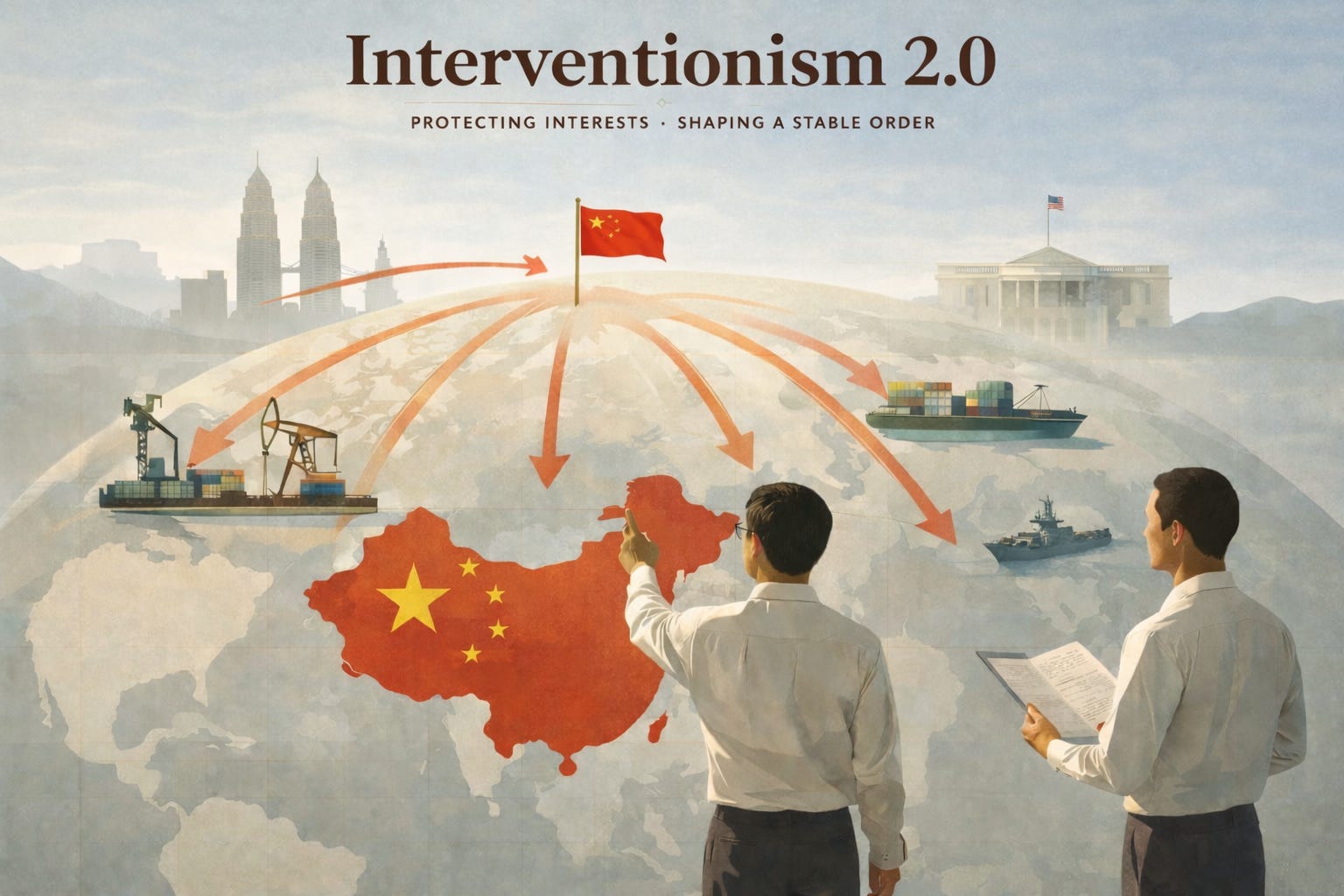
Chinese traditional non-interference should be updated to “Interventionism 2.0” [干预主义2.0版]: active intervention [积极干预] is warranted when host countries infringe on China’s overseas interests, third countries threaten them, or overseas factors profoundly affect China’s domestic interests.
North-South antagonism stems from the West’s practice of “ladder-pulling” [抽梯子] after having reached development itself. China’s Belt and Road offers a countervailing model of open-source [开源式现代化], shared modernisation [共同现代化].
China should maintain strategic resolve [战略定力] and great-power responsibility to avoid being drawn into the logic of war, while actively pursuing its legitimate overseas interests through multilateral institutions.
The Author
Name: Zheng Yongnian (郑永年)
Year of birth: 1962 (age: 63/64)
Position: Founding Dean and X.Q. Deng Presidential Chair Professor, School of Public Policy, The Chinese University of Hong Kong (CUHK), Shenzhen; Founding Director, Institute for International Affairs, Qianhai (IIA), CUHK, Shenzhen
Formerly: Director, East Asian Institute, National University of Singapore (2008–2019); Founding Research Director, China Policy Institute, University of Nottingham (2005–2008); Researcher, East Asian Institute, National University of Singapore (1996–2005)
Research focus: International relations; Chinese politics and society; Nationalism
Education: BA (International Relations), Peking University (1985); MA (Political Theory), Peking University (1988); MA (Political Science), Princeton University (1992); PhD (Political Science), Princeton University (1995)
Experience Abroad: Postdoctoral Fellow, Harvard University (1995–1997); University of Nottingham (2005–2008); National University of Singapore (1997–2019)

DIALOGUE WITH ZHENG YONGNIAN: AS THE LAW OF THE JUNGLE PREVAILS, CHINA URGENTLY NEEDS A “NON-INTERVENTIONISM 2.0”
Zheng Yongnian (郑永年)
Published by Greater Bay Area Review, 9 March 2026
Translated by Cherry Yu
(Illustration by ChatGPT)
The fires of war in the Middle East continue to burn. On one side, Iran has announced that Mojtaba Khamenei has been elected as the country’s new Supreme Leader; on the other, US President Donald Trump stated in an interview with ABC that Iran’s newly appointed leader “must get approval from us”, otherwise he “is not going to last long”. As the conflict spills over, oil prices surge, international trade is disrupted, and global energy and shipping markets convulse violently, this is no longer a “localised Middle Eastern” conflict—it is the eye of a storm that is reshaping the global economic and geopolitical landscape.
As the old order collapses and the law of the jungle [丛林法则] prevails, can China afford to stay on the sidelines [置身事外]? How can it build a “firewall” [防火墙] that both withstands external shocks and avoids missing out on opportunities from globalisation due to over-defensiveness? Following up on a previous conversation (see Dialogue with Zheng Yongnian: When War Begins, Who Really Wins?), Greater Bay Area Review once again speaks with Professor Zheng Yongnian.
I. Severe Short-Term Shocks, but 1970s-Style Oil Crisis Unlikely
Interviewer: Following Iran’s blockade of the Strait of Hormuz, Brent crude oil surged more than 8% in a single day, European natural gas futures spiked 40%, and war-risk shipping insurance premiums skyrocketed. Given how the war is developing, could we be looking at a repeat of the 1970s oil crisis? [Note: Sources give varying figures for the single-day spike in European natural gas futures on 2 March 2026, ranging from approximately 20% in early trading to approximately 50% by end of day.]
Zheng Yongnian: Looking at the global energy structure as a whole, the world is not short of oil—the Middle East, Latin America, and Russia are all producing. Although the United States is a major energy consumer, it has itself become an energy powerhouse, and the Trump administration has been actively developing domestic energy resources. Today’s economic structure is very different from the 1970s, so a similar crisis scenario is not necessarily going to recur; in the long term, the impact may not be transformative [颠覆性的]. That said, short-term impacts will certainly be felt, and they will be very significant. In recent days, not only have energy prices in Asia and Europe risen, but gold prices have also fluctuated sharply. There are several factors that deserve attention.
First, how long these changes last depends on the course of the war. If, as Trump suggested, it ends within one to four weeks, a major crisis is unlikely. At the very least, large economies have enough energy reserves to last several weeks or even longer, and once the war ends, oil supply can recover. However, we must also watch whether the US and Israel will strike Iran’s energy infrastructure. If such facilities are destroyed, the situation will deteriorate sharply. Although Trump’s stated targets are military facilities, Iran claims that civilian infrastructure—including desalination plants—has also been bombed. If this escalates into a prolonged war, Iran’s closure of Hormuz would severely disrupt energy supply chains. In that scenario, Trump might then shift strategy to “convoying” [护航] through the Strait, which would be an entirely different situation.
Second, Iran itself is an energy-based economy. For its own survival and development, the Strait of Hormuz will ultimately have to remain open. Blocking the Strait also prevents Iran from exporting oil, which would severely harm its own economy. In practice, Iran has been selectively blocking the Strait, targeting shipments from countries it considers hostile, while allowing others through. The current situation is that Iran’s leader has been “decapitated” [斩首]—Iran is in the heat of anger and will need some time to recover its rationality. Put yourself in their position: if this were to happen to any other country, would it act rationally?
Third, once war breaks out, normal market functioning is disrupted and speculators multiply, which affects economies around the world. Overall, the crisis is not as severe as some media portray it; however, the short-term shocks are inevitable, especially for economies with limited oil reserves, which will be hit hardest.
II. Weaponisation, Double Standards and Iran’s Strategic Options
Interviewer: The Strait of Hormuz is widely seen as Iran’s ultimate trump card [终极王牌]. How do you view Iran’s “weaponisation” [武器化] of the Strait?
Zheng Yongnian: Of course, we do not wish to see energy corridors “weaponised”. But we should assess this objectively. Have not the United States and other Western powers also “weaponised” supply chains? Have they not “weaponised” trade and commerce? Are US chip restrictions not a form of “weaponisation” against China? And have China’s new rare earth regulations not been criticised by the US and some Western countries as “weaponisation”? By the same logic, why should Iran not be able to “weaponise” the Strait?
We should not apply double standards when criticising others. Ideally, people would hope that the rules of the game do not change with every shift in geopolitics. But in a state of war, when Iran faces such a hostile external environment, it is unreasonable to expect it to keep the passage fully open. If an enemy is coming to attack your home, are you supposed to leave the door wide open?
Therefore, the first priority is to stop the war. Without an end to the war, talk of peace is meaningless. Under the logic of war, what matters is hard power and Iran has ample justification to “weaponise” the Strait. The question is whether it has the capacity to sustain this approach. How will the United States respond? How will European countries and Japan react? All of this is unpredictable.
What will Iran do next? It cannot completely block every corridor, but it may impose gradual, selective closures—and to a considerable extent it is already doing so. This is a true test of Iran’s strategic judgement. The diplomacy Iran now needs brings to mind the late Qing statesman Li Hongzhang. Li did not seek a diplomatic breakthrough by going outward; rather, he leveraged the rivalries among foreign powers within China to balance them against each other, preventing China from becoming fully colonised. Iran may adopt a similar approach in dealing with the West—manoeuvring among the competing interests of the US, European countries and Japan. If outward diplomacy is difficult, then it must wage a “war of attrition” [持久战] on its own soil. [Note: Li Hongzhang (1823-1901) was a late-Qing senior statesman, associated with China’s early self-strengthening reforms and with its crisis diplomacy under mounting foreign pressure. He is often linked to the formula “外须和戎,内须变法”—externally, seek accommodation with foreign powers; internally, pursue reform—which captured a broader late-Qing logic of survival under conditions of weakness].
III. Russia Sees an Opportunity, but Risks Pushing Europe Toward War
Interviewer: After the outbreak of the Iran war, Russian President Vladimir Putin indicated that he may consider halting natural gas supplies to Europe. How do you view the connection between the US–Israel–Iran conflict and the Russia–Ukraine war? What strategic calculations lie behind Russia’s position?
Zheng Yongnian: Russia has obviously spotted its opportunity. It is deeply mired [深陷泥潭] in the Russia–Ukraine war and has had limited capacity to act elsewhere. Now that Iran is in crisis, Russia hopes to use this situation to advance its own interests.
Before the Russia–Ukraine war, Europe relied heavily on cheap Russian energy to sustain its economic prosperity. Since the war began, Europe’s economy has already suffered severe damage. Should Iran’s energy supply now also be disrupted, it will deal another heavy blow to Europe. In this context, Russia’s consideration of cutting off supplies at this moment can be seen as another way of supporting Iran, which is understandable.
Interviewer: If Russia does indeed cut off supplies to Europe, will European countries become more dependent on US gas, or will they make political and military concessions to Russia?
Zheng Yongnian: From the current perspective, several scenarios are possible. One is that Europe turns to dependence on American energy—perhaps what Trump would prefer. Another is that European countries, when pushed into a corner, may act out of desperation [狗急跳墙] by joining the United States in striking Iran, as evidenced by France’s aircraft carrier already moving into the region. So if Putin misplays this move, his intention to help Iran could backfire and instead push Europe and the United States into a joint military action against Iran. We should not underestimate that possibility.
IV. A New World Order Will Be Decades in the Making
Interviewer: You previously said that the old order has already collapsed, while a new one has yet to be established. In just the opening months of this year, we have seen the United States carry out decapitation strikes against Iran and Venezuela. Do you think this kind of “anarchy” is becoming the “new normal” [新常态]?
Zheng Yongnian: The old order is continuing to disintegrate and fragment. Countries are increasingly self-centred, seeking to build regional orders that serve their own interests. The establishment of a new global order remains a distant prospect [遥遥无期]. The world today resembles what the British philosopher Thomas Hobbes described as the “state of nature”—a lawless condition of anarchy marked by a ruthless, predatory logic in which the strong devour the weak [弱肉强食].
Historical experience shows that the establishment of a new order often takes decades. How many years did it take to establish the European order? The postwar order after World War II was only established after decades of catastrophe spanning the First and Second World Wars. Humanity has no memory—or rather, memory simply does not matter. Every order is only established after unbearable disasters and losses. Therefore, we must be mentally prepared for the long haul ahead before any new order is consolidated.
Today, in what is a “de facto G2” [事实上G2] world, the interaction between China and the United States is of vital importance. Although the United States is advancing its own vision of order, China’s role remains crucial. If China had, as the US and some Western countries feared, sided entirely with Russia and formed a bloc against America and Europe, a world war might well have broken out easily. It is precisely because China has adhered to a policy of non-alignment [不结盟政策] that this outcome has so far been avoided. The same applies to the current situation in Iran. We must maintain strategic resolve [战略定力] and shoulder the responsibilities of a major power—both to safeguard our own interests and to preserve world peace. We must not fall easily into the logic of war.
V. Non-Interference to Interventionism 2.0
Interviewer: Behind this military strike lie surging international energy prices, disrupted supply chains, and soaring shipping insurance costs. These external risks are spreading rapidly across the world through channels such as trade, finance, and market expectations. For China, the question is how to protect its overseas interests while preventing external risks from spilling over into the domestic economy. How can it build a “firewall” that is strong enough to withstand external shocks, yet not so defensive that it causes China to miss the opportunities of globalisation?
Zheng Yongnian: China has extensive interests overseas, including in places such as Venezuela and Iran. As Chinese companies internationalise and economic globalisation deepens, our overseas interests will only continue to grow. In the past, we have consistently adhered to the principles of “non-alignment” [不结盟] and “non-interference” [不干预]. I believe the stance of non-alignment is the right one—this independent foreign policy has helped prevent the world from slipping back [重蹈覆辙] into the full-scale confrontation between two rival blocs that defined the Cold War. If China and the United States were each to rally allies into opposing military alliances, the result could well be a new world war.
That said, I believe [our] traditional doctrine of “non-interference” urgently needs to be reexamined and adjusted. What we need now is a new version of “interventionism 2.0”. We must continue to uphold the basic principle of not interfering in other countries’ internal affairs—we must never behave like the United States by pursuing regime change or inciting so-called colour revolutions. But there are at least three major circumstances in which we need to adopt a strategy of “active intervention” [积极干预] or “positive intervention” [正面干预].
The first is when China’s overseas interests are violated by the host country; the second is when those overseas interests are infringed upon by a third country; the third is when overseas factors significantly affect China’s domestic interests. The first scenario is a common one: some countries, for a variety of reasons—such as regime change or a change in political leadership—often fail to honour the agreements they have signed with China, or they descend into domestic instability and even violence. The second scenario is also becoming increasingly common, as seen in Washington’s coercive attempts to reclaim control over the Panama Canal or [to reassert its position on] narcotics treaties. The third scenario is even more common: for instance, if a country supports separatist forces or terrorist activities directed against China from abroad, then of course we must intervene. Likewise, we must also step in to deal with overseas telecom fraud schemes targeting Chinese citizens.
As Chinese companies continue to “go global” [“走出去”], China’s overseas interests are expanding accordingly. We must absolutely not mimic the American hegemonic practice of arresting foreign heads of state, but we should protect our own legitimate rights and interests through proactive means. This is something that calls for serious rethinking.
VI. Open-Source Modernisation and China's Constructive Role
Interviewer: At the diplomatic level, China has long advocated active economic engagement while maintaining a limited military footprint. How do you view this approach?
Zheng Yongnian: At the international level, military force is one means of addressing problems, but its application often creates bigger and more numerous problems. We therefore need to look for the root causes of issues and explore whether more effective solutions can be found.
Why has such sharp antagonism emerged between the Global North and the Global South? At its core, this stems from an imbalance in development models and modernisation paths. Once the United States and other Western countries had developed themselves, they pulled away the ladder by which they had climbed, depriving latecomers—particularly countries in the Global South—of the means to follow the same path. As a result, many countries have found it difficult to escape poverty. Where there is exploitation, resistance is bound to follow.
What China advocates is “open-source modernisation” [开源式现代化]. Having achieved development itself, China seeks to extend the ladder outward, allowing and helping other countries to climb as well—through initiatives such as the Belt and Road, which promote infrastructure development and create opportunities for growth in other countries. This is the idea behind “shared modernisation”, that when all countries are able to develop, the international community will naturally become more harmonious. The same holds true within a society: when common prosperity is achieved, social harmony becomes possible, but when extreme wealth for some coexists with extreme poverty for others, any talk of harmony rings hollow. At the international level, we are fully capable of pursuing a model of development that is more sustainable and more peaceful.
At a time when the law of the jungle prevails, how should China play a constructive role [有所作为]? [Note: 有所作为 carries the sense of not merely standing back, but taking purposeful, meaningful action. It also echoes the long-running foreign policy formulation associated with the Deng Xiaoping era, 韬光养晦,有所作为—often rendered as “hide one’s capabilities and bide one’s time, while also accomplishing something”].
Of course, the kind of “hegemonic” [霸权式], “bandit-style” [强盗式] intervention practised by the United States is fundamentally wrong and something we must avoid. But we need to free ourselves from rigid thinking [解放思想] and avoid mechanically insisting on “absolute non-interference” [绝对不干预]. Whenever states interact, they inevitably affect one another.
The “active intervention” or “Interventionism 2.0” I described above is something China has in fact already been putting into practice in certain respects. For instance, combating telecommunications crime through bilateral cooperation to speed up the intervention process is itself a form of active intervention. In Central Asia, we have helped build the Shanghai Cooperation Organisation as a platform for open and legitimate [光明正大] multilateral cooperation, enabling countries to work together in addressing shared threats such as terrorism and extremism—all of which are viable approaches.
READ MORE


What a difference a couple of weeks makes. Earlier in the month, Chen Dingding’s suggestion that the current conflict might present opportunities was censored after publication, suggesting Beijing might be uncomfortable with such commentary. But here we have a nascent policy proposal. Is Beijing now more comfortable with allowing this?
"Condemning Iran’s “weaponisation” [武器化] of the Strait while ignoring Western weaponisation of semiconductors, supply chains and trade corridors applies a double standard that fails to withstand scrutiny." I think this is a bit of a categorical error. WHat Sinification mentions of things weaponised by the west have little to do with Iran and the weaponisation of the straits of Hormuz. What would have been a more apt comparison would have been a map pit the location of all US military bases in the Persian Gulf and surroundings as well as in proximity to Iran. Plus, point #3 misses to specify that Iran's was a reactive action, after being attacked militaryly twice in less than a year by US/Israel and once economically and via proxy internally at the end of Dec 2025.