



As a paid subscriber, you are receiving this post early. Thank you again for your support, whether financial or otherwise.
What is friendship with China truly worth? This question has been weighing on my mind ever since Trump’s surgical strike against Iran in June 2025, and it became more pressing still following the US military operation to capture Nicolás Maduro.
With the exception of North Korea, Beijing does not make alliances in the traditional sense of the word. Instead, it forms flexible, commitment-light “partnerships”, organised according to a complex, hierarchical taxonomy. This preference is explicitly articulated as a policy of “partnership, not alliance” (结伴不结盟).
That approach made sense as China embarked upon reform and opening up and sought to navigate post-Cold War politics: it preserved an independent foreign policy while creating room to concentrate on development. But as China’s power grows and America’s unipolar moment fades, I’ve wondered how long this model can hold in an era of naked power.
Our briefing on the Venezuela operation was titled “All-Weather Partner, Fair-Weather Response” because even the more strident nationalists were conspicuously quiet about what, in practice, Beijing could do to defend its considerable interests in Latin America. The prevailing mood was one of resignation—an acceptance that felt discordant with the confident, sometimes belligerent tone that often comes through in contemporary Chinese discourse.
At the time, Jin Canrong (金灿荣) stood out from the crowd in calling for retaliation in Asia should Washington interfere with Chinese investments in Latin America. Jin is popular with nationalist audiences and is known for his sometimes unconventional takes, but as a prominent senior scholar at Renmin University, he is worth paying attention to. In a short piece—translated in this edition—he makes the bolder claim that China’s model of economic engagement without security commitments is hitting its limits.
Jin is clearly aware he is on politically shaky ground, going out of his way to praise China’s diplomatic achievements while reaffirming that the “partnership, not alliance” paradigm remains relevant.
Yan Xuetong (阎学通) was arguing in 2011 that China might reconsider its non-alignment strategy, but that line of argument has been conspicuously muted in more recent discourse. As noted in Sinification’s latest digest, January saw a tentative re-emergence of this logic—not in the form of calls for formal alliances, but in arguments for a recalibration of China’s diplomatic posture beyond its long-standing “commitment-light” model.
— Jacob Mardell
Key Points
Trump’s belligerence has left countries deeply uneasy, prompting them both to appease Washington and to seek support elsewhere.
Many countries’ posture towards both the US and China is marked by ambivalence: wary of American power yet reluctant to antagonise it, seeking China’s help yet uneasy about China itself.
Taken as a whole, China’s foreign policy has been a success.
But China will struggle to win genuine friends if it cannot offer support beyond economic engagement.
Alliances are premised on targeting a third party and are therefore not a suitable model for China; instead, Beijing should seek a middle ground between the kingly way (王道) and the hegemonic way (霸道).
The Author

Name: Jin Canrong (金灿荣)
Born: Dec. 1962 (age: 63)
Position: Wu Yuzhang Chair Professor, School of International Studies, Renmin University of China (RUC); Director, Centre for China’s Foreign Strategy Studies, RUC
Other positions: Special research fellow at the Research Office of the Standing Committee of the National People’s Congress; Consulting expert for various ministries and government departments; Director of the China International Public Relations Association (the list goes on)
Previously: Researcher at the Chinese Academy of Social Sciences (1987-2002)
Research focus: American politics; US-China relations; Chinese foreign policy
Education: BA Fudan University (1984); MA University of Chinese Academy of Social Sciences (1987); PhD Peking University (1999)
Experience abroad: Several stints in the United States as a visiting scholar (1990s)

JIN CANRONG: NON-HEGEMONIC STRENGTH INSPIRES NO FEAR—MY MODEST PROPOSAL FOR CHINA’S FOREIGN POLICY
Jin Canrong (金灿荣)
Published on Jin Canrong’s Public Account (金金乐道编辑部), 16 January 2026
Translated by Jan Brughmans
(Illustration by OpenAI’s DALL·E 3)
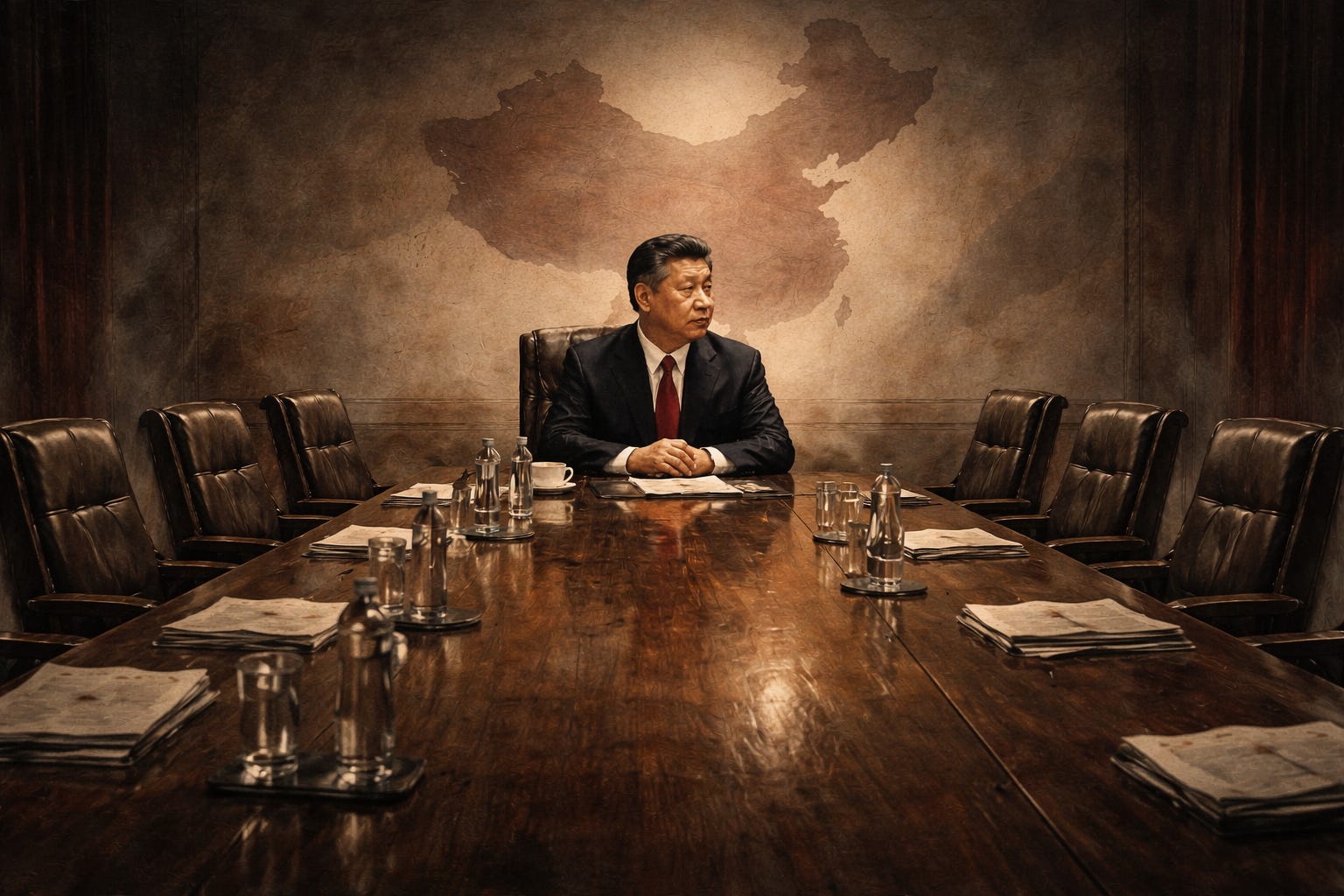
Recently, Trump has been highly active across the Western Hemisphere, striking a brazen, bullying posture of “I’m a thug—who’s there to fear?” [“我是流氓我怕谁”]. This display has left many countries deeply uneasy.
Given the sheer preponderance of US power, many of these countries find themselves pulled in two directions. On the one hand, there is a strong temptation to appease Washington proactively [主动取悦]—to avoid direct confrontation and, above all, to ensure they are not singled out as the next convenient sucker [“冤大头”] hauled out to “make an example of” [“祭旗”]. On the other, it is only natural that they begin to look for safety in numbers, or to seek support from outside. Some Latin American countries have already begun to band together for self-preservation, while others have turned their gaze towards China, viewing it as a power they can lean on [依托]. This, in turn, has produced a series of recent developments: Latin American states joining forces with Spain, the Canadian prime minister embarking on a visit to China, and Argentina’s president, Javier Milei, announcing that he too plans to travel to China this year. One small but telling detail is worth noting. When journalists asked China’s foreign ministry spokesperson to comment on Milei’s proposed visit, the response was that there was, for the time being, no information to share. This makes me believe that the arrangements for Milei’s trip have, in all likelihood, yet to be finalised.
The global order is entering a period of deep turbulence, and many countries appear to be struggling to find their bearings [六神无主]. Their posture towards the world’s two great powers, the United States and China, is marked by ambivalence: they are wary of American power, but reluctant to antagonise it; they seek China’s help yet remain uneasy [心存疑虑] about China itself. Even states with relatively close ties to Beijing display this same inner tension—a paradox that invites the author to a deeper reflection.
Taken as a whole, China’s foreign policy has been a success. Since the advent of the new era, major country diplomacy with Chinese characteristics [中国特色大国外交] has delivered remarkable achievements: it has played a crucial role in extending the window of strategic opportunity [战略机遇期] and in grasping historical initiative [历史主动] for the great rejuvenation of the Chinese nation [中华民族伟大复兴]. For decades, a defining feature of China’s external policy has been its emphasis on economic and trade cooperation—without, however, offering other countries what might be described as “protection” [“保护”]. In my view, this model is strategically sound, but it requires timely subtle tactical adjustments. If we confine ourselves to trade and commercial engagement, and the pursuit of material gain, yet are unable to offer even limited support [一定的支撑] when other countries face existential crises [生存危机], we will struggle to win genuine friends [真正的朋友]. For individuals, survival comes before all else; for nations, the same principle applies. As the saying goes, the greatest tragedy is to be “in heaven while one’s money sits unused in the bank” [“人在天堂,钱在银行”]—to die with wealth unspent, the sense of loss and regret is plain to see. A country that cannot even secure its own survival will hardly have the nerve [底气] to talk business with others. Under such circumstances, can any commercial relationship truly be stable or reassuring? For these reasons, I believe that, from the standpoint of safeguarding China’s national interests, a measured recalibration of China’s foreign policy is both necessary and timely.
This then raises the question: how should such adjustments be made? Should China establish alliance relationships [结盟关系] with other countries? In a certain sense, alliances represent the highest form of cooperation between states. However, I do not believe this approach is suitable for China. Alliances do have their advantages, but they also contain a fundamental flaw: they are, by nature, premised on targeting a third party. To win one ally often means making an enemy elsewhere. If an alliance is poorly chosen, it may even drag a country into irreparable disaster [无法挽回的灾难]. The outbreak of the First World War is a classic example of smaller states pulling major powers into war. For this reason, alliances should not be viewed only through the lens of their benefits; the enormous risks they conceal must also be treated with due caution. On this point, I firmly support the central leadership’s policy of not entering into overt alliances.
At the strategic level, we must continue [仍需] to uphold the valuable legacy left by Chairman Mao and Premier Zhou, adhere to the principle of non-interference in other countries’ internal affairs, and hold high the banner of international morality [国际道义]. The more than five centuries spanning the Spring and Autumn and Warring States periods built up a rich experience for China; even then, there were debates between the kingly way [王道] and the hegemonic way [霸道]. History has already shown that pursuing blatant hegemony is bound to be unsustainable, while rigidly clinging to a purely kingly way may also ultimately end in failure. [Note: In classical Chinese political thought, “kingly way” denotes rule grounded in moral authority and benevolent governance; “hegemonic way” denotes rule grounded in coercive power.]
How should China’s foreign policy proceed from here? In my view, it should continue to be guided by the principle of “a blend of kingly and hegemonic approaches” [“王霸杂之”]. As for the specific tactics this would entail, I would rather not spell them out here.
READ MORE
Jin Canrong on the "Peace Disease" among China's Elite (Part 1)

Jin Canrong is famous in China as a firebrand. As these articles show, Jin enjoys being a “wolf warrior” professor with his strident criticisms of the West and Japan. Considering the political environment in the PRC right now, this is not strange. What is noteworthy, however, is how Jin’s approach has dramatically changed. Up to the mid-2010s, Jin was known as a liberal, who saw world politics in terms of positive-sum international engagement. Fast-forward to 2025, and he has shifted to a social Darwinist view, that imagines the West as China’s evil essential Other, complete with “piratical culture genes”.
Why China's Rise Might Not Be Peaceful — by Prof. Jin Canrong (Part 2)

Jin Canrong: "For China to rise, it must set up its own institutions [制度] and norms [规范] within the international community. However, history shows that the establishment of [new] institutions and norms is almost always accompanied by violent measures [离不开暴力]. Can China truly escape this historical pattern? I have my doubts. The Chinese are human beings too and, no matter how capable, cannot transcend the basic laws of human society. We will, of course, strive to rely on our own diligence and ingenuity to achieve development, but on problems of fundamental national interest [涉及国家根本利益], we must also be prepared to “flex our muscles” [秀肌肉] when necessary."
Liberating Taiwan by Force According to Prof. Jin Canrong

Some of you may sigh at the sight of Jin Canrong’s (金灿荣) name. Once better known for his credentials as an international relations scholar, Jin has morphed into one of China’s top public opinion leaders—a lucrative business involving a massive social media following and daily commentaries that help guide Chinese citizens towards views that align with Beijing’s political needs. But beyond the fame and pecuniary benefits that surely come with this role, Jin may well believe that he is acting in his country’s best interest.