


Key Points
Beijing has hailed the trilateral as a huge success, with the official line describing it as “a landmark event that will go down in history” and a “peace summit”. At the same time, Chinese state media have resolutely rejected the “Yalta 2.0” framing.
This two-track framing carries over into the wider Chinese commentary on the trilateral—though triumphalism comes through more strongly than reassurances that this is not a new Yalta.
Of the 37 authors covered in this analysis, 17 reject the “Yalta 2.0” framing, 18 do not address it, and only two endorse it. Some authors, while explicitly rejecting the Yalta framing, echo the “de facto G2” argument by implicitly or explicitly endorsing the idea of a G3.
The idea of the trilateral sits comfortably with the realist understanding of geopolitics held by many Chinese scholars, which places China, Russia and the USA at the top of the international order.
Authors expand on the official claim that the meeting established a new paradigm of major-power relations, and some tie their rejection of the Yalta analogy to enthusiasm for this new paradigm. The break with the past lies less in any new substance than in the claim of difference itself.
Another prominent theme in the commentary is Beijing’s convening power; there is a sense that the trilateral shows that China has arrived.
Several authors envisage institutionalising the new paradigm, going further than Xi’s call for “regular high-level exchanges”. Only a handful of authors strike a more sober note.
Some also focus on Russia’s gain: the trilateral was “a major diplomatic victory for Russia and President Putin”.
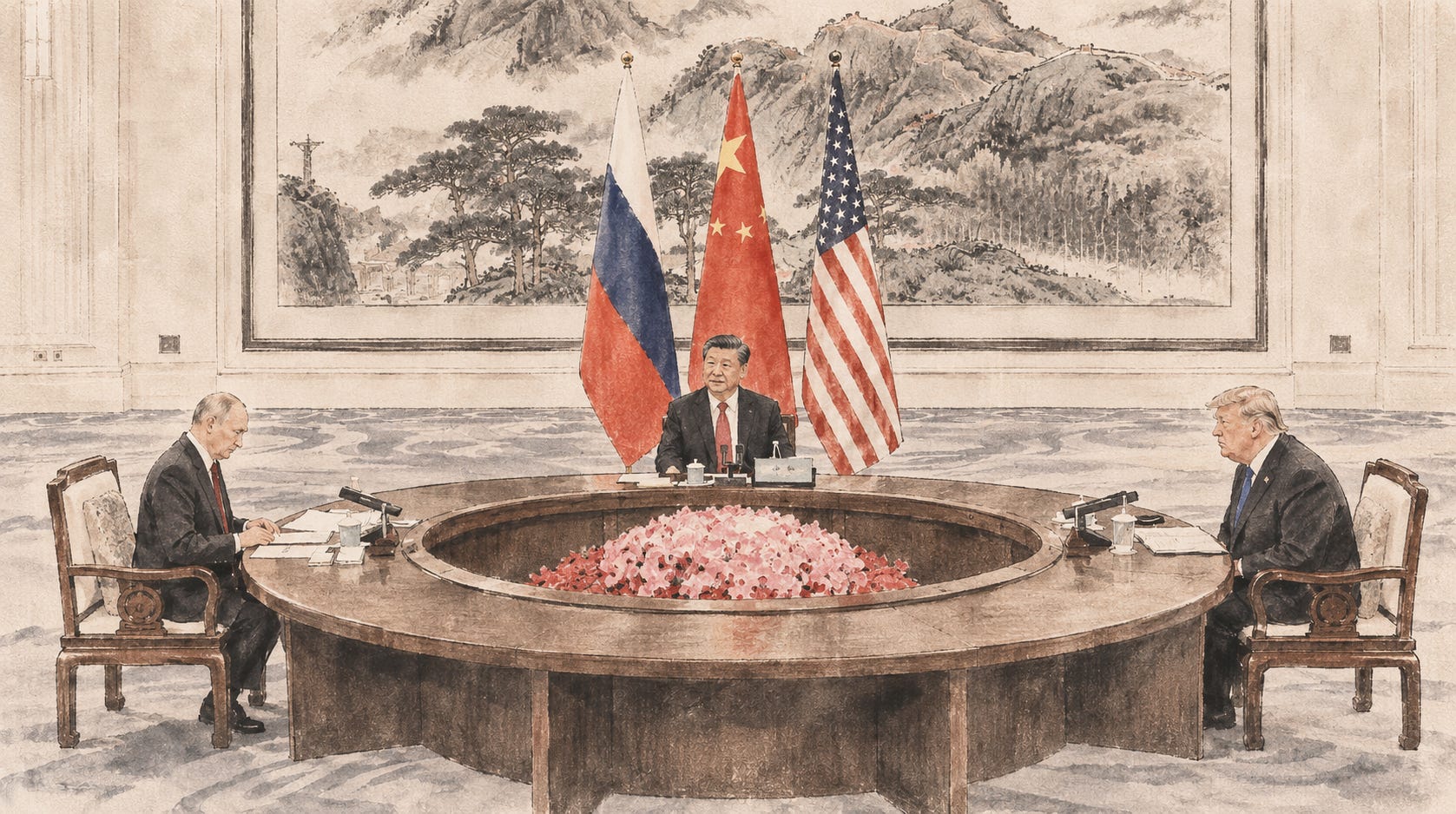
A three-way meeting between the US, China and Russia sits uneasily with Beijing’s stated opposition to spheres of influence.
Beijing has, in the past, brushed off Trump’s description of US–China relations as a “G2”. A “G3”, with its Yalta Conference connotations, arguably looks worse for a self-styled champion of multipolarity, and it brings together the US and Russia—two relationships Beijing may feel it is managing well enough bilaterally.
Still, Beijing agreed—reportedly after some convincing—to host a meeting between Xi, Putin and Trump on the sidelines of the APEC Leaders’ Meeting in Shenzhen. That meeting has now taken place. The three leaders met on 19 November and produced a four-point peace declaration covering: United Nations reform; a plan to increase production of refined petroleum products; agreement that the International Criminal Court and similar bodies must not “abuse their jurisdiction”; and a reaffirmation that a nuclear war cannot be won and must never be fought.
Beijing has embraced the trilateral as a huge success—the official line is that it was “a landmark event that will go down in history” and a “peace summit”, of “pioneering significance” that built “a new paradigm” for major-power interaction in the new era.
At the same time, official media have resolutely rejected the “Yalta 2.0” framing adopted by the Western press, European leaders and—somewhat awkwardly for Xi—both Trump and Putin. The People’s Daily’s Zhong Sheng column, for example, argues that such labels are “viewing a new practice of major-power interaction through the old thinking of power politics and spheres of influence”.
This two-track framing carries over into the wider Chinese commentary on the trilateral—though the triumphalism comes through more strongly than reassurances that this is not a new Yalta.
The debate is reminiscent of commentary on the “G2”, which likewise repeated Beijing’s rejection of “great-power co-governance” (大国共治), while clearly flattered and enthused by the idea of global co-governance. For instance, several prominent authors, including Zheng Yongnian, Jin Canrong and Yan Xuetong, now treat China and the US as a de facto G2 and argue that Beijing should acknowledge it.
I. Limits of the Yalta 2.0 rejection
Of the 37 authors curated for this analysis, 17 reject the “Yalta 2.0” framing and 18 do not address it.
Two authors actually endorse it, though both deserve caveats: Zhang Wenmu is a hard-line nationalist geopolitical strategist; and Deng Fei isn’t a mainland scholar, but a Hong Kong legislator and member of the Chongqing CPPCC. Reposting a 2025 article in which he argues that the world is “reverting to a new Yalta system”, Zhang asks, “if this is not a new Yalta, what is it?” Meanwhile, Deng Fei claims that calling the meeting “a new Yalta is fully deserved”. In his view, discomfort with the term reflects a mindset that has not psychologically caught up with China’s actual level of development, still stuck in “the frustration of more than 150 years of being bullied”.
Authors who push back against the Yalta framing do so on several grounds. Some note that Beijing was left out of, and even a victim of, the original Yalta. Others stress that Yalta was a wartime carve-up, whereas Shenzhen takes place in a multipolar world with a prominent Global South. Some argue that the venue matters. As the former Global Times journalist turned think-tanker Wang Wen puts it, a trilateral embedded in APEC’s multilateral framework is “generally unsuited to secret deals or dividing spheres of influence”. Wu Xinbo (吴心伯), dean of Fudan University’s Institute of International Studies, told CRNTT the outcome speaks for itself: the Peace Declaration had made the “Yalta 2.0” claim collapse of its own accord, because the three discussed problems of world peace and development, not the division of influence.
Some authors, while explicitly rejecting the Yalta framing, echo the “de facto G2” argument by implicitly or explicitly endorsing the idea of a G3. Tian Feilong, while dismissing the Yalta analogy, observes that “there is no G7 here, no G20, not yet a G2, but a G3”. He then contradicts Beijing’s official rejection of great-power co-governance, arguing the day before the meeting that it “created a new tradition of ‘great-power coordination’ and a mechanism of great-power co-governance”.
II. The China–US–Russia Golden Triangle
The idea of the trilateral sits comfortably with the realist understanding of geopolitics held by many Chinese scholars, which places China, Russia and the USA at the top of the international order. Wu Xinbo (武心波), an East Asia and Japan specialist at Shanghai International Studies University, gives this pro-Russian triangular worldview its fullest expression in a May essay reposted during the summit:
The formal establishment of the China–US–Russia Golden Triangle relationship marks the entry of the global order into a wholly new form unprecedented in human history—a multipolar, stable system characterised by controllable competition, effective checks and balances, mainstream cooperation, and dynamic stability. Russia’s entry into the fray does not subvert the G2, but rather perfects it; it does not shatter co-governance, but optimises it; it does not create antagonism, but resolves it.
Wu describes Russia, “bearing the double-headed eagle on its coat of arms” and straddling East and West, as the “key intermediate pivot”. In a similar vein, Zhang Weiwei, the controversial director of Fudan University’s China Institute, argues that “today China and Russia represent the multipolar world and the interests of most countries”.
Elsewhere on the triangular relationship, Wan Qingsong warns that Trump’s domestic constraints increase his incentive to attempt a “reverse Nixon”. Cui Hongjian was asked directly about this risk and answered that in fact, the trilateral format can help allay fears that closer ties between any two countries might come at the third’s expense.
III. Shenzhen International System: A new paradigm
Authors expand on the official claim that the meeting built a new paradigm of major-power relations, and some tie the rejection of Yalta to enthusiasm for that paradigm. Proposing the term “Shenzhen International System”, Wang Wen had done so most explicitly, writing in English weeks before the meeting:
This meeting may come as a historic adjustment of the global structural transformation and the upgrading of major-power relations eighty years after the formation of the Yalta system. It is to be hoped that the interaction between the presidents of the three major powers will not be the “G3 joint management of the world” hyped by Western media, but will emerge as a new “Shenzhen International System”—a model that will operate in parallel with the UN-centered multilateral system and inject certainty into the turbulent world.
This is great-power coordination that complements, rather than bypasses, multilateralism. Li Kaisheng provides a memorable image: great-power coordination, he writes, was traditionally a “dining table” for dividing spheres of interest, but driven by China, it can become a “kitchen” for “cooking up more public goods”.
According to Wang Wen, the three powers “have begun jointly exploring a new order that transcends the outdated thinking of the Yalta system”. The general pattern will be familiar to students of Chinese foreign-policy discourse. Novelty is established by contrast: the old order is zero-sum, bloc-based and coercive, and the new transcendent one differs simply by virtue of China’s participation and its framing in principles of mutual respect, coexistence and win-win cooperation. The break with the past lies less in any new substance than in the claim of difference itself.
Wu Xinbo (武心波) is the one author who makes the distinction dependent on measurable outcomes. He concedes that without an open agenda, outcomes being fed back into multilateral bodies, and no imposition on third parties, the Yalta worry is “not entirely groundless”.
IV. Beijing’s convening power and arrival as agenda setter
Another prominent focus of commentary is on Beijing’s convening power. As Tian Feilong argues:
[…] such is China’s prestige that no country other than China could successfully convene a ‘Big Three’ meeting. That prestige rests on the strength of Chinese-style modernisation and the peaceful influence of Chinese culture […] China’s role in great-power coordination has thus essentially matured, and its institutional standing in the global governance system has been further consolidated […]
As with Trump’s G2 remarks, there is a sense that the trilateral shows China has arrived. This chimes with the wider APEC coverage, a trope of which was China’s journey from APEC participant to agenda-setter. Qu Hongbin makes a similar point for the trilateral: China was once “an adapter to rules and an outsider to the order” and the meeting marks its “formal entry into the core circle of global decision-making”.
V. Institutionalising the trilateral
Several authors envisage institutionalising the new paradigm, going further than Xi’s call for “regular high-level exchanges”.
Wu Xinbo (吴心伯) told CRNTT that:
[…] if the China–Russia–US paradigm of trilateral strategic communication and cooperation can be institutionalised, and used to promote benign major-power relations, then in the long run it will move international politics in a more constructive, positive and forward-looking direction.
For Wang Wen, who before the meeting set as a benchmark whether a regular communication mechanism takes shape, not just a one-off meeting, institutionalisation is a test of the meeting’s worth. At least one author—Yang Cheng—is cautious, warning that institutionalisation is by no means easy and without it the political dividend of a single meeting is very likely to fade over time.
VI. Sober voices and Russia’s gain
Only a handful of authors strike a more sober note. Zhou Wenxing warns that the symbolic breakthrough must not be equated with substantive strategic reconciliation, while Mei Yang claims that the triangle “can move the world but cannot run it” and that it should be judged by “how many real problems it actually solves”.
Yang Cheng is the most explicit, arguing that the lack of trust and structural contradictions between China and the US, and between Russia and the US, are rooted in national interests as well as historical and cultural differences, and will persist for the long term. Nor, he stresses, is the China–Russia relationship free of differences.
Somewhat straining against the mainstream focus on China’s convening prowess, Yang—a Russia scholar who worked at the Chinese Embassy in Russia—also focuses on Russia’s gain: of the three parties, he says, Russia has the most pressing needs and stands to benefit most directly. Others make the same point: in the words of Liu Jun, the trilateral was “a major diplomatic victory for Russia and President Putin”.
VII. Conclusion
Chinese commentary converges on two claims: the trilateral was a success, and it was not a new Yalta. As in the older G2 debate, the two claims pull against each other without directly contradicting one another. The first celebrates China’s centrality and a new governance format shaped by Beijing. The second rests on China’s principled support for multilateralism and its opposition to great-power co-governance (大国共治).
It falls to Chinese commentators to square the circle Beijing has drawn, and they do so with varying success. Wu Xinbo (武心波) argues that minilateralism and multilateralism can be reconciled, provided the two processes feed into each other—and he sets conditions for legitimacy. Others reconcile the two claims more performatively, by reciting foreign-policy formulas: it cannot be Yalta because China upholds the UN Charter and the Five Principles of Peaceful Coexistence. In doing so, these authors arguably betray greater enthusiasm for the first claim: that China has arrived at the centre of world politics.
READ MORE
China’s G2 Dilemma

Ahead of our fuller assessment of Chinese reactions to this week’s summit, we turn to a related debate already underway: Chinese engagement with Trump’s revival of the G2 concept. The analysis below draws on a review of around fifty articles (full bibliography
Beyond the G2, Unruly Middle Powers | Digest: October 2026

With US–China relations entering what Da Wei calls an “L-shaped stabilisation”, Chinese commentators in October turned their strategic anxiety towards the disruptive potential of US allies and middle powers. Da Wei is not exactly sanguine — as the L metaphor suggests, he doesn’t see relations as improving, but merely stabilising, and he predicts more “trouble and noise” to come, especially after the midterms. Jin Canrong picks up the G2 framing and contrasts it with the broader international picture, arguing that while Trump has reached the bargaining stage of grief over China’s rise, Europe and Japan remain in denial and anger.
Zhao Long on Central Asia as the Heartland of a New Eurasian Order

Zhao Long is a senior research fellow and director of the Institute for International Strategic and Security Studies at the Shanghai Institutes for International Studies. Across his recent writing on great-power relations and global governance, he has repeatedly returned to the question of what China’s growing international weight should require in terms of global responsibility and the provision of “public goods”.