


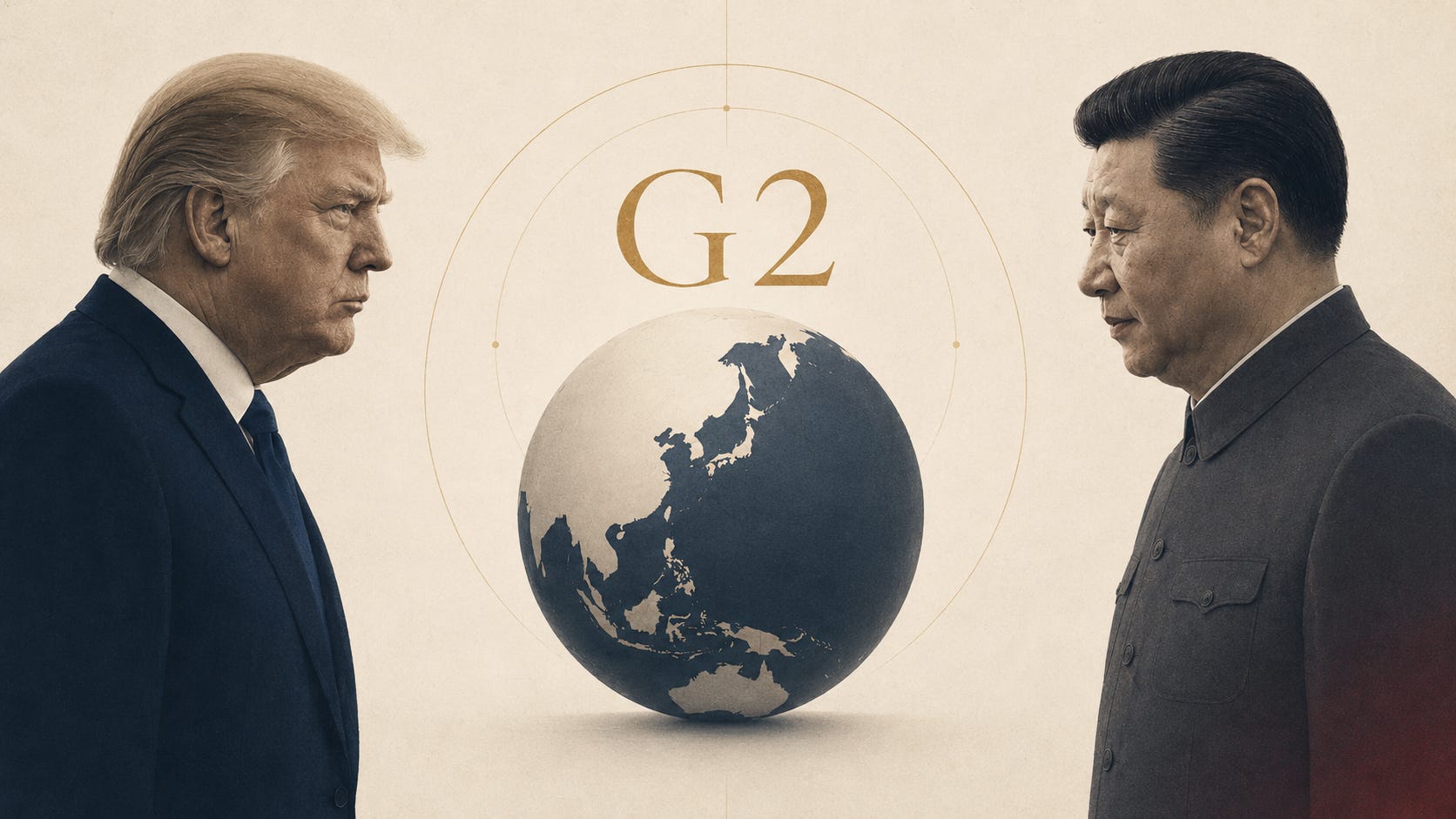
Ahead of our fuller assessment of Chinese reactions to this week’s summit, we turn to a related debate already underway: Chinese engagement with Trump’s revival of the G2 concept. The analysis below draws on a review of around fifty articles (full bibliography here) touching on the idea, from which we have selected six representative articles. Many thanks to Cherry Yu for her help with the review. — Jacob
When Trump framed his October 2025 meeting with Xi Jinping as a meeting of the “G2”, he did more than revive an old phrase. He reactivated a debate that has existed in Chinese policy circles for nearly two decades: how should China respond when Washington recognises it as a peer, but does so through a framework Beijing sees as hegemonic, exclusionary and politically costly?
Beijing has now rejected the G2 framing twice: first in 2009, when the concept was floated under Obama, and again following Trump’s revival of the term. After the Busan summit on 31 October, an MFA spokesperson brushed off the framing by restating China’s commitment to independent foreign policy, multipolarity and the Global South. Wang Yi made the rejection more explicit in March 2026, when he said China does not “subscribe to the logic of great-power co-governance”.
That remains the official line. In the first of the pieces presented below, former official Zhou Li (周力) gives it its sharpest articulation, warning Chinese analysts against taking the concept seriously. For Zhou, G2 is not a neutral description of US-China weight in the international system. It is a world-order frame: one that legitimises great-power monopoly, threatens China’s Global South positioning, and contradicts Beijing’s claim to support an equal, orderly multipolar world.
And yet Chinese scholars have not simply heeded the warning. They repeat the official language on multipolarity and South-South relations, but continue to probe the concept’s possible uses. This is the central tension in the debate: China rejects G2 as a label, but parts of the policy world are implicitly grappling with the structural reality behind it.
One reason is status. American recognition matters less to the more confident China of 2026 than it once did, but Trump’s “G2” language still carries symbolic value. Alongside Washington’s treatment of China as a “near peer”, it signals that the US is no longer able to look down on China in quite the same way.
The dominant workaround is therefore not to embrace G2 outright, but to recode it. Scholars such as Xia Liping (夏立平) reframe it as “coordination” rather than “co-governance”. Xia goes furthest in operationalising this idea, proposing a “China-US Plus” format that would keep US-China coordination embedded in wider regional and multilateral settings. In his hands, G2 becomes less a duopoly than a mechanism China can use: to constrain Washington, reinforce Beijing’s One China principle and check Japan’s strategic ambitions.
Yan Xuetong (阎学通) and Zheng Yongnian (郑永年) approach the question differently, treating G2 less as a policy proposal than as a description of de facto bipolarity. For them, Trump’s language matters because it reflects an emerging structure in which only China and the US qualify as true superpowers. Zheng takes the most explicit step from structural diagnosis to strategic accommodation, arguing that China’s sovereignty claims over Taiwan and the South China Sea need not be incompatible with continued US geopolitical space in the Western Pacific, and going so far as to suggest that, once these sovereignty issues are resolved, China could “welcome” a continued US presence in the region.
Wu Xinbo (武心波) illustrates the same ambivalence from another angle. He begins by laying out the material foundations that might make US-China co-governance plausible — economic complementarity, security weight, technological interdependence and global demand for joint problem-solving — before ultimately dismantling the case. His conclusion is not that coordination is unnecessary, but that formalised co-leadership would be politically and structurally impossible.
Reading across these pieces, Trump’s G2 language appears to be understood less as a settled framework than as a signal of opportunity. For some Chinese analysts, it points once again to a more transactional US president who may be open to bargaining across issues. Taiwan recurs in this context, not always explicitly as a bargaining chip, but as the central sovereignty question around which any imagined grand bargain would turn.
That said, the deeper story is not simply Chinese enthusiasm for a Trumpian G2. It is the unresolved tension between China’s ideological commitment to multipolarity and its practical recognition that US-China coordination is likely to remain the central axis of global politics. Beijing wants the benefits of peer recognition, practical coordination and strategic stability without the costs of an explicit two-power directorate: alienating the Global South, appearing to abandon multipolarity or accepting responsibility for a US-shaped order.
Finally, several authors are aware that the Trump window may be temporary. Jia Qingguo (贾庆国), the sixth author discussed below, focuses on the domestic US politics that make the moment possible. Trump’s China policy is unusually transactional and value-light, and for now his grip on the Republican Party limits open pushback. But the opportunity remains vulnerable to hawks inside the administration, Congress, bureaucratic momentum and allies seeking to pull Washington back towards confrontation.
— Jacob Mardell
Executive Summary
Despite Beijing’s formal rejection of the G2 concept floated by Trump, Chinese scholars continue to engage with it, treating it as a signal of Trump’s openness to a quid-pro-quo relationship—with Taiwan recurring as a potential bargaining chip.
The official line, crystallised by Zhou Li’s December 2025 article, casts G2 as hegemonic in character and incompatible with Beijing’s commitment to multipolarity—not least because it would risk alienating China’s partners in the Global South.
Chinese scholars’ dominant workaround is to reframe G2 as “coordination” rather than “governance”. Xia Liping gives this approach institutional form through his proposal for a “China-US Plus”, while also spotting a chance to bind Washington more tightly to Beijing’s One China principle.
Yan Xuetong and Zheng Yongnian treat G2 as a description of de facto bipolarity, with Zheng floating sovereignty-versus-geopolitics trade-offs including a “welcomed” US Western Pacific presence post-reunification with Taiwan.
Several authors also present Trump’s presidency as a temporary window of opportunity. Jia Qingguo looks to the domestic US politics behind that window, arguing that Trump’s value-free China policy remains unpopular but largely unchallenged within the Republican Party.
Selected Articles
1. Zhou Li
Takeaway: This piece crystallises the Party line rejecting the G2 and warns domestic scholars against entertaining the concept.
Name: Zhou Li (周力)
Position: Former Vice Minister of the International Department of the Central Committee of the Communist Party of China
Source: Xi Jinping Thought on Diplomacy website (24 Dec. 2025)
Trump’s G2 framing reflects hegemonic thinking and should be rejected. China already formally rejected the concept when it was floated under Obama in November 2009.
Chinese scholars who now describe the future international order as a US-China ‘bipolar structure’ (两极格局), with everyone else reduced to a ‘vast middle ground’ (广大的中间地带), abandon the principle of sovereign equality and risk separating China from Russia and the Global South. This also betrays Xi’s vision of an equal and orderly multipolar world.
Chinese leaders since Mao have consistently rejected superpower status. Multipolarity means multiple centres of power, not a two-power arrangement in which the US and China act as co-governors.
Zhou: “After Trump took office for a second term in 2025, certain scholars within China have likewise proposed that the principal axis of international relations going forward will be a US-China ‘bipolar structure,’ with everything else constituting ‘vast middle ground’; some have plainly endorsed ‘G2’ and called for China's foreign policy to be reshaped accordingly.”
2. Xia Liping
Takeaway: China should embrace “G2”, rebranded as “coordination” (中美协调) rather than “co-governance” (中美共治), and weaponise it to constrain the US, lock in the One China principle, and check Japan’s militarist revival.
Name: Xia Liping (夏立平)
Position: Founding Dean, School of Political Science and International Relations, Tongji University
Source: CRNTT (16 Mar. 2026)
G2 should be understood as ‘China-US coordination’ (中美协调), not ‘China-US co-governance’ (中美共治). Trump’s revival of the term shows that Washington has been forced to ‘look across’ (平视) at China rather than ‘look down’ (俯视). China’s rare-earths and soybean leverage helped blunt Trump’s trade war and pushed Washington into the ‘bargaining’ (讨价还价) stage of accepting China’s rise.
China should operationalise this through ‘China-US Plus’ (中美+) groupings — China-US+ASEAN, China-US+EU, China-US+AU and China-US+Arab League — keeping G2 compatible with multipolarity rather than turning it into a superpower duopoly.
US compliance with the One China principle should become a ‘political foundation’ (政治基础) of this arrangement, while the format should also be used to push back against Western criticism on human rights, Taiwan, Hong Kong, Tibet and Xinjiang. G2 should also be used to constrain the US-Japan alliance, highlight Japan’s nuclear ambitions as a threat to the US itself and, if necessary, pursue IAEA inspection of Japanese nuclear facilities through a ‘China-US+EU’ mechanism.
Xia: “China needs to use Trump’s revival of ‘G2’ to build a major-power coordination and cooperation mechanism centred on ‘China-US Plus’ (中美+). The current trend of world multipolarity continues to advance.”
3. Yan Xuetong
Takeaway: Trump may not have had a clear idea of what “G2” means, but the term reflects a bipolar order that was in fact already established in 2019.
Name: Yan Xuetong (阎学通)
Position: Honorary Dean, Institute of International Relations, Tsinghua University
Source: 中国网 (21 Jan. 2026)
Brexit and the US-China trade war marked the turn towards deglobalisation (逆全球化), a process that is now complete.
The gap between China and the US and the rest of the world will continue to widen, while the gap between the two superpowers narrows. Quantitative projections show that no other major power can become a superpower within the next decade: their starting points are too low and their growth rates too slow. India is the only partial exception.
Trump’s “G2” language therefore signals structural recognition rather than a project of co-leadership. What it points to is a “bipolar structure” (两极格局), not joint US-China leadership.
Yan: “China and the US are already considered superpowers by the world; Trump has proposed ‘G2’, and Hegseth has said this is a new era of superpower confrontation. So the international community increasingly regards China and the US as superpowers, and other countries as not.”
4. Zheng Yongnian
Takeaway: We shouldn’t over interpret Trump’s remarks — the fact is that we are already living in a “G2” bipolar world.
Name: Zheng Yongnian (郑永年)
Position: X.Q. Deng Presidential Chair Professor and Dean, School of Public Policy, The Chinese University of Hong Kong (Shenzhen); Director, Institute for International Affairs, Qianhai
Source: GBA Review (1 May 2026; based on remarks at the Boao Forum, 27 Mar. 2026)
A “de facto G2” (事实上的G2) already exists. On every measurable indicator — economic size, technology and military power — only China and the US qualify as superpowers. Kissinger’s formula of “two superpowers, several major powers” (两超多强) has collapsed into “two superpowers”, as the “several major powers” decline. Multipolarity (多极化) remains an ideal and a goal, not a present reality. After reciprocal tariffs, the world has returned to “power politics” (实力政治), with relations increasingly grounded in strength rather than ideology or alliance blocs.
East Asia is reading this shift through three anxious lenses: first, that the US is retreating to the Western Hemisphere, making self-reliance necessary; second, that individual states can become America’s regional anchor and use that position for leverage; and third, that China and the US are converging in a way that erases their strategic room for manoeuvre. Japan embodies all three: militarising in response to US retrenchment, trying to become “the Israel of East Asia” (东亚的以色列), and working to obstruct China-US rapprochement. Other East Asian states are “Japanising” to varying degrees.
For China, Taiwan and the South China Sea are sovereignty issues on which there is no room for compromise; for the US, they are questions of geopolitical space. The mistaken US assumption is that China resolving these issues would mean expelling the US from the Western Pacific. Instead, after reunification, China could “welcome” a continued US presence in the region — even signing long-term contracts allowing US warships to dock at sovereign Chinese ports. South China Sea reefs could also be developed as international public goods.
Zheng: “At the international-politics and diplomacy level, precisely because Taiwan and the South China Sea are sovereignty issues, China has no compromise room. But China's sovereignty issues don't necessarily damage US geopolitical space. Once China resolves the sovereignty issue, everything else can be defused through pragmatic cooperation.”
5. Wu Xinbo
Takeaway: “China-US dual leadership” (中美双领导体制) has real material foundations and global demand, but the structural obstacles are insurmountable—coordination, not co-leadership, is the way forward.

Name: Wu Xinbo (武心波)
Position: Professor, Shanghai International Studies University (SISU).
Source: 海外看世界 (20 Dec. 2025; written 12 Dec. 2025)
There are material foundations for a “China-US dual-leadership system” (中美双领导体制): economic complementarity, with the US occupying the innovation and pricing end and China the manufacturing and market end; security complementarity, with US alliances and Chinese non-aligned peacekeeping; and technological complementarity, with the US leading in basic research and China stronger in application. There is also global demand for joint leadership, from emissions reduction and pandemic response to the mismatch between IMF voting rights and current economic weight.
However, four structural obstacles are decisive. First, there is cognitive incompatibility: the US “G2 vision” amounts to hegemonic co-management (霸权共管) aimed at constraining China, which is fundamentally opposed to China’s position of “cooperation but not co-governance, equality but not domination” (合作而不共治、平等而不主导). Second, strategic trust has collapsed under US polarisation and China’s drive for “autonomous controllability”. Third, the Global South — 88% of the world’s population — rejects great-power co-management as an illegitimate monopoly. Fourth, the EU, India and Brazil refuse subordination to either pole.
The solution is to reject both “hegemonic co-management” and “zero-sum confrontation”, and instead build a model of “coordination rather than dominance, complementarity rather than opposition” (协调而非主导、互补而非对立), with the Global South as the indispensable third leg.
Wu: “The 'G2 vision' advocated by some forces in the US is, in essence, an attempt to use bilateral co-management to maintain hegemonic position and to limit China's technological breakthroughs and industrial upgrading.”
6. Jia Qingguo
Takeaway: Trump 2.0 has unexpectedly opened a rare window for stabilising China-US relations, but the relationship rests on Trump’s personal grip on the Republican Party and remains exposed to multiple complicating factors.
Name: Jia Qingguo (贾庆国)
Position: Standing Committee Member, CPPCC; Professor, School of International Studies, Peking University; Director, Institute for China-Foreign Cultural Exchanges, Peking University
Source: 全球经济治理观察, reposted via WeChat (4 Feb. 2026)
Trump 2.0’s China policy has four defining features: tariff-centred leverage; interests over values (重利轻义); deliberate avoidance of Taiwan, Xinjiang, Tibet and Hong Kong; and public emphasis on cooperation, including references to “G2”.
This breaks with Washington’s hardline China consensus, but has faced little open Republican pushback because Trump retains strong support among Republican voters.
The window for stabilising relations remains fragile. Four factors could still derail it: hawks inside the administration; Congress; bureaucratic momentum below the political level; and allies seeking to pull Washington back towards confrontation in order to relieve pressure on themselves.
China should build a high-level unofficial (非官方) communication mechanism alongside official channels, so that potential provocations can be clarified before they escalate. Trust should also be rebuilt through concrete cooperation on Russia-Ukraine, non-proliferation, strategic-stability dialogue and AI norms.
Jia: “Although there are now signs of stabilisation in US-China relations, and new opportunities for the future development of the relationship, there remain major variables and risks.”
READ MORE
Briefing: Trump's National Security Strategy

Chinese establishment commentators read Trump’s National Security Strategy as strategic narrowing: America is shedding global policing burdens, shifting costs to allies and prioritising the Western Hemisphere. Yet most do not celebrate US retreat; they suspect tactical retrenchment, designed to rebuild strength for longer competition with China. Softer language on Beijing is treated as cosmetic, with containment continuing through technology controls, Indo-Pacific deterrence and allies. Scholars debate whether this is strategic self-rescue or accelerating decline, and expect NATO to reshape rather than collapse. Overall, the mood is wary: opportunity exists, but turbulence and sharper China–US rivalry may follow soon for Beijing ahead.
Hopium. The USA is not China’s peer. That’s over.