


The full-scale trade war that Huang Yiping warns of in the speech below has not yet come to pass, but the reprieve may be temporary.
The EU has said that talks must yield “tangible results” before the next ministerial-level meeting in October, but many of the Chinese analysts we’re reading see the underlying conflict as structural and persistent.
Since Huang delivered this speech, Beijing has also formalised its answer to “China Shock 2.0” with a Ministry of Commerce position paper that explicitly rejects the claim that insufficient domestic demand is contributing to excess capacity, instead rebranding China’s industrial rise as “China Opportunity 2.0”.
Huang is very much an establishment voice and he doesn’t stray far from the mainstream framing, but he takes European anxiety far more seriously than most and makes an important concession along the way.
He begins with the defence (China is making progress in rebalancing its economy towards consumption) and continues with a long diagnosis of Europe’s myriad problems, but he also concedes that China can no longer simply overlook the external pressures created by its large trade surplus. China, he argues, must move beyond “simply invoking the broad macroeconomic benefits of free trade” to take fuller account of the effects its surplus has on partner countries.
That this concession feels refreshing says something about the tenor of the wider debate, which is largely focused on shifting the blame for Europe’s economic malaise away from China.
This should offer some encouragement to EU policymakers, who for years have felt that their concerns have fallen on deaf ears. However, those same policymakers may be less heartened by Huang’s reading of European fragmentation and his later recommendation that China “bypass highly politicised EU-wide negotiating frameworks”.
— Jacob Mardell
Key Points
The “China Shock 2.0” narrative refers to the widening of China’s external imbalances, particularly as Chinese competition at scale has begun to emerge in frontier and high-end manufacturing sectors.
Although China has made progress in pursuing rebalancing, its economic scale means it still faces considerable external pressure—the pressure its surplus exerts on other countries’ industrial structures cannot be overlooked.
Europe is particularly anxious because the sectors now under pressure are pillar industries that sustain employment and its high-income, high-welfare model.
Meanwhile, the US fears being overtaken in specific technologies but retains strong endogenous growth momentum and sees AI-driven automation, rather than Chinese competition, as the greater employment threat.
While China and the US lead on AI, and Northeast Asia supplies much of its hardware base, Europe struggles to translate its strong research assets into industrial scale.
Europe is not monolithic—France and southern Europe lean towards protection, while Germany and northern Europe are more restrained—and there is no shared model for turning “economic resilience” into policy.
China and Europe may be the last hope for preserving an open, multilateral international economic system—a bilateral trade war would deliver a major shock to global trade and supply chains.
China’s approach should therefore shift from emphasising “competitiveness” to pursuing “win-win” outcomes, taking full account of trading partners’ capacity to absorb the impact of China’s trade surplus and their likely policy responses.
China should stay firmly committed to expanding domestic demand and stabilising property without returning to speculation, while more effectively communicating its rebalancing policies abroad.
Five areas of practical cooperation would allow both sides to draw on their respective comparative advantages: green transition, high-end manufacturing, industrial AI, high-end services and third-party markets.
The Author
Name: Huang Yiping (黄益平)
Year of birth: 1964 (age: 62)
Positions: Dean, National School of Development, Peking University; Dean, Institute of South-South Cooperation and Development, Peking University; Director, Institute of Digital Finance, Peking University; Peking University Boya Distinguished Professor
Other: Member, Monetary Policy Committee of the People’s Bank of China
Research focus: Macroeconomic and financial policy; international financial system; rural economic development
Education: Bachelor’s degree in Agriculture [Agricultural Economics], Zhejiang Agricultural University (1984); MA (Economics), Renmin University of China (1987); PhD (Economics), Australian National University (1994)
Experience abroad: Senior Lecturer, Australian National University (1994–2000); General Mills International Visiting Professor of Economics and Finance, Columbia Business School (1997–1998)

CHINA–EUROPE RELATIONS ARE MARKED BY BOTH ICE AND FIRE, AND COOPERATION IS THE ONLY WAY FORWARD
By Huang Yiping (黄益平)
Published by China Finance 40 Forum on 12 June 2026
Adapted from a keynote speech at the 488th CF40 seminar on 31 May 2026
Translated by Cherry Yu
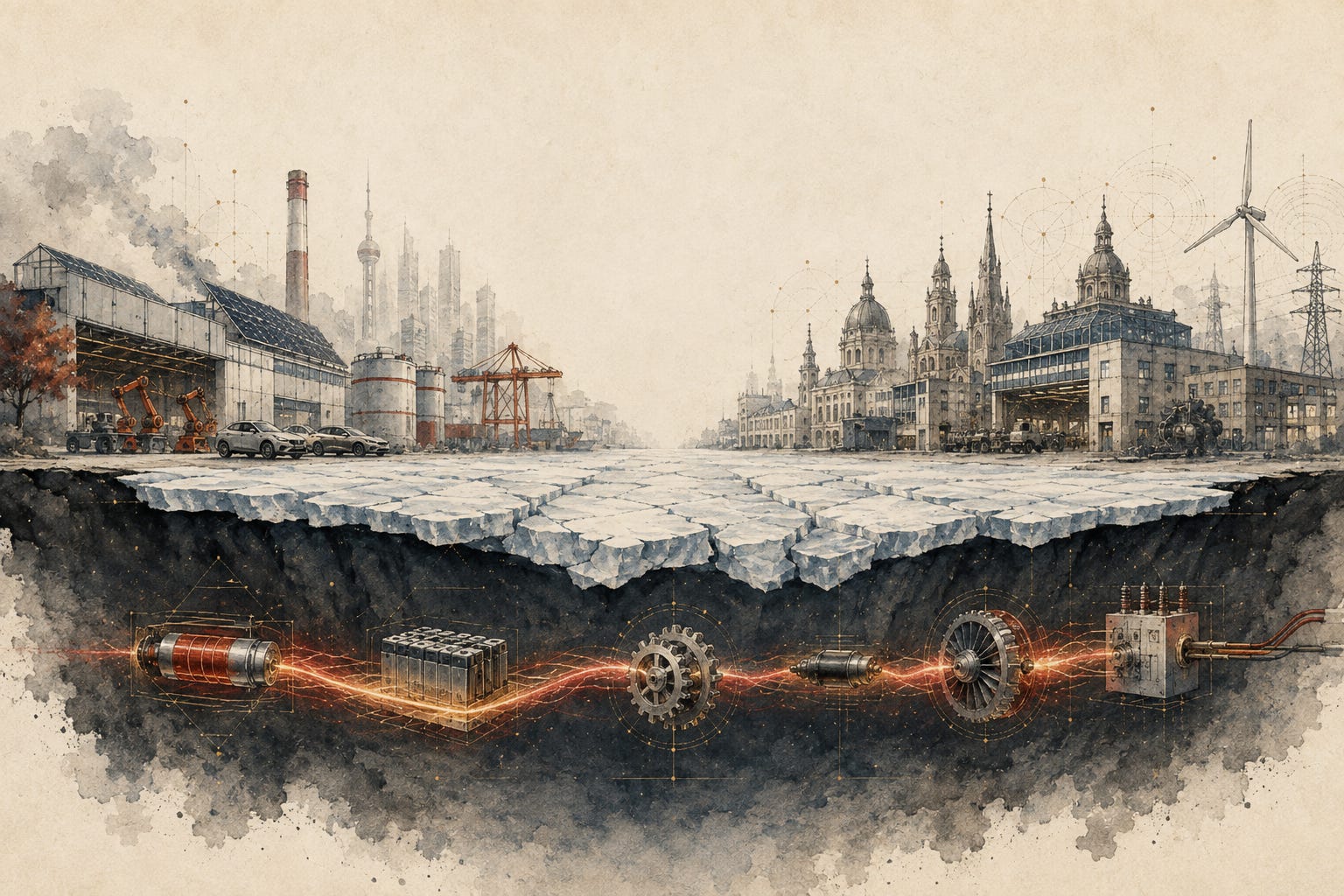
(Illustration by ChatGPT)
I. Europe’s Anxieties Behind the “China Shock 2.0” Narrative
My remarks today are based mainly on impressions and judgments formed through recent exchanges in Europe, though not all of them relate directly to Europe itself. I should say at the outset that I do not endorse labels such as the so-called “China Shock 1.0” or “China Shock 2.0”. However, for the sake of discussion, I will use these terms provisionally. In an era of globalisation, shocks of this kind have always existed, whether in the rise of German and Japanese manufacturing or the dominance of US and UK finance. The real issue is how different countries respond and adjust.
At present, “China Shock 2.0” has become one of the most heavily hyped topics internationally. During our visit, it surfaced in virtually every setting, from bilateral meetings and think-tank discussions to roundtables with political and business figures, all centred on the structural challenges it is seen to pose.
The so-called “China Shock 1.0” refers to the wave of exports that followed China’s accession to the WTO, as large volumes of traditional manufactured goods—from low-end light industrial products and textiles to toys—entered international markets and had a discernible impact. Objectively, however, the structural impact of that earlier shock on many developed economies was not as large as is often assumed. Many labour-intensive industries were already moving offshore, and even if China had not absorbed that capacity, it would likely have shifted to other low-cost economies. As some American economists have argued, the decline in manufacturing employment across developed countries was not simply the result of China’s rise, but reflected the combined effects of technological progress, automation and changes in the global division of labour. In short, this was a dynamic process of change.
By contrast, the so-called “China Shock 2.0” mainly refers to the widening of China’s external imbalances over the past few years, particularly as competition at scale has begun to emerge in frontier and high-end manufacturing sectors such as electric vehicles, lithium batteries, photovoltaics, high-end machinery, industrial robots and semiconductors. The main difference from the past is that these are sectors developed countries had spent decades cultivating, and where they believed they held secure competitive advantages. Yet China has performed remarkably well upon entering these fields, supported by its complete industrial chain, large-scale production capacity and continually improving manufacturing processes. This is not to say that Chinese products have reached the very highest level in every subcategory. But judging from field research and industry data, many high-end Chinese products are already close to European standards, reaching around 90%, or even more than 95%, of that level. At the same time, the advantages of China’s domestic industrial chain can keep overall production costs 30% to 50% lower [than comparable European production costs].
[Note: A February 2026 report by France’s High Commission for Strategy and Planning estimates average China–Europe production-cost gaps of 30% to 40% at comparable quality, reaching 50% or more in some sectors. Huang’s specific 90% and 95% quality estimates could not be verified against a public source or clearly defined metric.]
In fact, over the past two to three decades, the Chinese economy has been moving gradually towards rebalancing and has made considerable progress. Recently, with France preparing to host the 2026 G7 summit, the French presidency commissioned the Centre for Economic Policy Research to produce a special report entitled “The New Global Imbalances”, for which I was invited to write the section on China’s economy. In reviewing the data systematically, I found that over the past two-plus decades, China has been moving towards greater balance over the medium to long term, whether measured by investment as a share of GDP, household final consumption as a share of GDP, or the current account balance as a share of GDP. In other words, rebalancing has indeed been taking place. [Note: This is a selective presentation of Huang’s own report, where the quoted consumption figures include both household and government consumption, yet remain below the 2000 level. Huang also identifies a persistent policy bias towards investment, although household consumption has improved modestly since its 2010 trough.] We have also noted that since 2018, China’s current account surplus has risen somewhat as a share of GDP, reaching 3.7% at one point in 2025, a rebound from previous years but still below the 4% warning threshold. What deserves closer attention is what has driven this marginal change.
[Note: The 4% figure was discussed as a potential surplus limit during the G20 rebalancing talks in 2010, but the G20 ultimately adopted non-binding indicative guidelines rather than a formal cap or warning threshold.]
Even so, at this stage China still faces considerable external criticism and economic and trade challenges over its external imbalances. The first reason is that China’s economy has become very large. Although China’s current account surplus as a share of GDP has fallen sharply from its historical peak of 10% to 3.7% in 2025, some experts have pointed out that the picture looks different when set against changes in the global GDP structure. Measured against the GDP of the rest of the world, the relative size of China’s surplus has in fact increased. This shows that once China has become a major economy, the existing scale of its surplus can still exert an impact on other countries’ industrial structures that cannot be overlooked, even as China continues to pursue rebalancing.
Second, there is the debate around “China Shock 2.0”. Europe’s sense of alarm is greater this time because these sectors were originally pillar industries that allowed developed countries to maintain their high-income, high-welfare systems. They worry that once Chinese products enter global markets in large volumes, they may well displace existing domestic industries. If that happens, and these pillar industries are replaced or placed under sustained pressure, will these countries be able to cultivate new industries to fill the economic gap and maintain their existing welfare spending? In advanced economies that have been more successful in developing high-tech industries and diversifying their economies, such concerns are relatively limited. But in much of Europe, where industrial structures remain closely tied to traditional high-end manufacturing, the pressures of industrial transition have become especially apparent. Put simply, for many developed countries, this round feels entirely different from the earlier era of low-end industrial relocation.
II. Changes in the Global Technology Landscape: The Rise of Northeast Asia and Europe’s Awkward Position
Let me give one example to illustrate some recent changes in the global distribution of emerging technologies and industries. The changes are especially clear in AI. China and the United States now form the first tier, performing relatively well in algorithm development, computing-infrastructure deployment and the commercialisation of applications. The UK is generally seen as belonging to the second tier, and also as doing reasonably well. During our exchanges there, our overall impression was that the UK’s upward momentum was quite clear, and that its attitude and position were somewhat more moderate than those of continental EU economies. Because the UK’s traditional manufacturing base is less substantial than that of Germany, France and other Western European countries, it is less directly exposed to substitution by Chinese high-end manufacturing and has more scope to expand into future industries.
In recent exchanges with industry and think tanks across different countries, we also noticed an interesting phenomenon that we had not paid much attention to before, which is that beyond China itself, Northeast Asia’s rise in AI hardware deserves close attention. Japan’s advanced materials and precision components, South Korea’s memory chips, and the advanced-node semiconductor fabrication and packaging-and-testing industries in Taiwan together provide a stable and well-developed hardware foundation for the global AI industrial chain, mainly in support of Western technology companies. Whether measured by investment and financing data in global capital markets or by capacity trends in emerging industries, Northeast Asia now appears to be entering a second wave of manufacturing resurgence.
Within this stratified global landscape of technological innovation, Europe appears to be in a somewhat awkward position. European interlocutors noted that, although their universities and research institutes hold a substantial stock of patents in frontier technologies and a strong cohort of innovative start-ups, these strengths have not yet translated into visible progress in commercialisation and large-scale industrial deployment. Europe has moved relatively quickly in building regulatory frameworks, from the digital economy and the implementation of GDPR data protection rules to stablecoin regulation and AI legislation. Yet the commercialisation and industrial application of frontier innovations do not seem to have kept pace with this institutional development. The reasons are highly complex, but the point of this example is that as emerging industries evolve rapidly, countries experience global industrial change differently depending on their resource endowments, policy arrangements and levels of development.
III. Europe’s Internal Challenges
Within Europe, although the 27 EU member states have differing priorities and clear internal divisions, there is now one core concern shared across Europe: if its existing competitive industries are displaced by foreign products, and emerging industries cannot develop sufficient scale in time to fill the resulting economic gap, Europe’s medium- to long-term economic development will face serious challenges. To put it more starkly, Europe sees this not simply as a matter of concern over market competition but as a systemic challenge concerning the survival of its high-welfare system.
This also explains why there are clear differences between China–US and China–Europe relations on many economic, trade and technology issues. US anxiety initially stemmed from distributional tensions caused by the loss of blue-collar jobs among young people in small towns across the Midwest. Later, as China’s new energy, 5G, high-end equipment and other industries rose, this anxiety extended into questions of competition over the commanding heights of global technology and competition over the power to set international economic and trade rules. Overall, however, the United States still has strong upward momentum in industrial innovation. Its competitive advantages remain highly pronounced in frontier fields such as artificial intelligence, quantum computing, biotechnology and aerospace, as well as in technological innovation, industrial innovation, high-end manufacturing and financial services. The United States is concerned that China may one day overtake it in certain areas, yet its own economy as a whole still has strong endogenous growth momentum.
Recently, I met with industry contacts visiting from the United States, and when the conversation turned to Europe, they said its current concern is whether China’s industrial expansion will eventually lead to the loss of European pillar industries, jobs and household income. Americans had previously worried about these issues of manufacturing offshoring as well, and I remember Janet Yellen raising related issues when she visited our institute. According to this contact, however, Americans are now less worried about the employment problems Chinese industries might create for the United States, as the biggest variable affecting industrial employment at this stage is displacement by AI-driven automation. I do not know whether this judgment is backed by solid data, but his broader impression was that US sensitivity to China-related issues has shifted at this stage, marking a fundamental difference from Europe’s current situation.
Europe’s problem lies in the fact that its long-running high-welfare social model has relied heavily on the excess returns generated by the technological premiums and brand barriers of high-end manufacturing sectors such as automobiles, precision machinery and chemicals, yet these pillar industries are now coming under considerable pressure from highly cost-effective Chinese products. Europe also faces multiple development bottlenecks arising from its own internal weaknesses. During our field research in Germany, we heard a particularly interesting view that Germany’s vast stock of high-quality patents and specialised, innovative start-ups has not been matched by sufficiently developed domestic capital markets or a strong venture-capital ecosystem, leaving it without a smooth funding and incubation pathway and making it difficult to turn laboratory technologies into emerging industries at scale.
I said that China does indeed face some similar difficulties in industrial commercialisation. We had originally seen Germany as an important model for our own industrial transformation and upgrading, but as both countries move into a new stage of industrial upgrading, it now seems that China and Germany are facing a similar constraint, with a lack of direct financing holding back the commercial application of technological innovation. I wonder whether this might suggest that, at this new stage of development, traditional bank-led financial systems around the world are struggling to meet the needs of innovative industries, thereby posing even greater challenges for financial system reform across countries.
I came across a set of figures in the UK showing that a large share of Europe’s capital-markets business had once been concentrated in London. Since Brexit, only 4% of that business now remains there, while the rest has been diverted to continental European cities such as Paris and Amsterdam. Yet in the short term, these cities are unlikely to fully match the market depth and supporting legal infrastructure that once sustained London’s market position. Europe’s capital markets remain underdeveloped overall and have yet to play a major role in scaling up emerging industries.
[Note: ECB data indicates that London retained a major role in most euro-denominated financial-market segments after Brexit, although EU equity trading shifted sharply to continental venues.]
Meanwhile, Europeans attach great importance to regulation and standard setting in relation to innovation, and to some extent this may have dampened start-up activity by creating stringent compliance thresholds. In my view, all industrial regulatory rules ultimately need to strike a dynamic balance between innovation and risk control, and between industrial vitality and compliance management. The GDPR is a case in point: Europe has built a highly comprehensive system for protecting personal privacy, but years after its implementation, Europe has not seen the emergence of major home-grown global technology companies or large-scale big-data industrial clusters of its own.
The same can be seen in AI regulation, where Europe introduced tiered and classified AI regulatory rules at an early stage, an approach that has been studied and drawn on repeatedly in China’s policy research community. Regulation is differentiated according to risk level, with lighter oversight for areas without systemic importance and strict regulation reserved for those with systemic importance. The outcome is plain to see, with Europe producing very few home-grown, benchmark-setting AI companies.
[Note: The EU AI Act classifies AI systems by four levels of risk; “systemic risk” is a separate classification applied to certain general-purpose AI models.]
During our talks in Brussels, we also discussed stablecoins, and they noted proudly that their Markets in Crypto-Assets Regulation had been implemented far earlier than the various bills in the United States. I then asked why Europe’s own crypto industry and blockchain-related sectors had not achieved any obvious development at scale, given that the regulatory rules had been put in place so early. Admittedly, their legislative approach may place greater weight on risk control and on safeguarding the bottom line of financial security, which is an understandable policy choice. Yet judging from actual industrial outcomes, Europe’s own emerging technology industries have shown only limited signs of progress.
Across Europe, policy thinking is now widely shifting from its previous emphasis on economic stability towards a stronger focus on economic resilience. But there is still no common, workable plan for how to quantify and deliver that resilience, or which industries it should rest on.
At the same time, it is important to recognise that Europe is far from monolithic. Divisions of interest between northern and southern Europe, and between France and Germany, are also quite pronounced. France and the southern European economies are more directly exposed to imports of Chinese high-end manufactured goods and are therefore more inclined at the policy level to introduce various forms of protective trade legislation. By contrast, Germany and many northern European countries have a large investment presence in China, while the interests of their multinationals are deeply tied to the Chinese market, making their overall position more pragmatic and restrained. The fragmentation of priorities among the EU’s 27 member states and the normalisation of policy bargaining have also sharply reduced the effectiveness with which unified industrial policies can be put into practice. Against this backdrop, the EU has successively introduced new rules, including the Cybersecurity Act Revision and the Industrial Accelerator Act. Many of these measures are presented as security safeguards or industrial-support policies, but in reality they raise barriers to foreign investment and further securitise and politicise economic and trade issues.
[Note: Both measures were European Commission proposals at the time of the speech and, as of August 2026, remained pending under the EU’s ordinary legislative procedure.]
IV. Firmly Advancing Domestic Economic Rebalancing
Although the EU continues to step up protectionist policies and raise trade barriers, China and Europe still have many deep-seated interests in common.
I think the most important question is what we should do if Europe’s economy faces industrial shocks and downward pressure on growth in the years ahead. At a meeting in Europe, I told the head of a leading think tank that as unilateralism, protectionism and great-power rivalry intensify globally, China and Europe may be the last hope for preserving a multilateral and open international economic system. The long-term survival of this system is therefore crucial, because a serious, large-scale trade war or economic confrontation between China and Europe would deliver a major shock to the global multilateral trading system and to global industrial and supply chains. The direction of US economic and trade policy is already clear to everyone.
The question, then, is how the current frictions and tensions in the bilateral relationship can be resolved. In my view, China’s approach to external economic and trade relations should shift from simply emphasising the “competitiveness” of its own industries to pursuing “win-win” [共赢] outcomes in bilateral economic and trade relations.
Now that China is a major economy—the world’s second largest, with manufacturing output accounting for more than 30% of the global total—any new round of export expansion or shift in its import structure will have a substantive impact on supply-demand balances in international markets, as well as on industries and employment in partner countries. If real livelihood concerns are not properly addressed, simply invoking the broad macroeconomic benefits of free trade is unlikely to win support from public opinion or policymakers in partner countries. China therefore needs to take full account of the capacity of partner-country industries to absorb the impact and of their likely policy responses when shaping its external economic and trade strategy, and to update its top-level strategic thinking accordingly [与时俱进].
More specifically, I think there are two practical directions. Internally, China needs to stay firmly committed to domestic economic rebalancing. In fact, we should already recognise—or be coming to recognise—that if we cannot steadily reverse the pattern of external imbalances, our own insufficient domestic demand and overreliance on external demand as a driver of growth will create risks to the sustainability of growth over the medium to long term. Rebalancing the economy by expanding domestic demand is therefore not only an external necessity for easing international pressure but also an internal requirement for China’s own high-quality development. Going forward, China will need to communicate its policies more clearly and effectively in multilateral settings and bilateral economic and trade talks, both to achieve win-win outcomes in bilateral trade and economic relations and to strengthen the foundations of its own outward-facing economy. Rebalancing will remain a crucial macroeconomic policy priority for a long time to come.
In the current macro environment, stabilising the domestic property market is therefore an economy-wide strategic priority and a key lever for expanding domestic demand and advancing macroeconomic rebalancing. The real-estate value chain connects dozens of real-economy sectors, including building materials, home renovation, home appliances and property services.The sector underpins large-ticket household consumption and local government finances, serves as the main form of asset allocation for Chinese households, and is closely linked to the financial system through bank credit, non-standard financing and other channels. Anchored in the basic principle that “houses are for living, not for speculation” [房住不炒], policy should focus in the short term on stabilising expectations, reducing inventories and protecting essential housing demand, while working over the medium to long term towards a new model of real estate development that supports both renting and home ownership [租购并举] through a coordinated set of targeted measures.
V. China–Europe Relations Are Marked by Both Ice and Fire, and Cooperation Is the Only Way Forward
As for the specific areas of China–Europe economic cooperation, I have identified five practical areas that could be discussed and advanced jointly with European countries, allowing both sides to draw on their respective comparative advantages, deepen the division of labour and achieve mutually beneficial cooperation.
The first area is green transition, where cooperation is already largest in scale and has the clearest prospect of producing concrete results. China brings large-scale capacity across the full industrial chain in photovoltaics, wind power, energy storage and new energy vehicles, together with clear advantages in cost and industrial deployment. Meanwhile, Europe has accumulated deep expertise in green hydrogen, carbon capture, carbon-footprint accounting standards, new grid technologies and green project certification. Given the strong complementarity between their industrial chains, cooperation on green transition will be essential for Europe’s efforts to implement the European Green Deal and meet its carbon-neutrality goals.
The second area is collaboration and division of labour in high-end manufacturing. The two sides could explore a differentiated model of specialisation, with Europe focusing on high-value-added upstream segments such as core components, specialised materials, industrial software and chassis design, while China builds on its strengths in large-scale smart manufacturing, end-product assembly and deployment, and its vast domestic consumer market. Cooperation in the automotive industrial chain could serve as a model for binding upstream and downstream interests together [利益绑定] between upstream and downstream segments.
The third area is careful, sustained engagement in industrial AI and smart manufacturing. Europe has first-mover advantages in data compliance, privacy legislation and the development of global AI governance rules, while China has a vast range of industrial application scenarios, a large computing-power base and practical experience in implementing smart manufacturing. The two sides could avoid sensitive areas such as general-purpose foundation models and facial recognition and instead focus their cooperation on more practical projects such as smart factory upgrades and industrial digitalisation.
The fourth area is two-way opening in high-end services, a field that is relatively less politically sensitive and serves as a major source of Europe’s services trade surplus with China. In 2024, the EU’s services trade surplus with China exceeded US$50 billion, with intellectual property licensing fees alone surpassing US$10 billion.
[Note: Eurostat records EU services exports to China of €67.3 billion and imports of €45.5 billion in 2024, implying a surplus of €21.8 billion, not more than US$50 billion. The claim that intellectual-property licensing fees exceeded US$10 billion could not be independently verified.]
Sectors such as finance, insurance, commercial legal services, healthcare and high-end education are areas of clear European strength, while also matching China’s pressing needs as its domestic industries move up the value chain. Greater two-way opening in these areas would steadily expand the two sides’ shared interests.
The fifth area is joint development of third-party markets. China should initially bypass highly politicised EU-wide negotiating frameworks and instead partner with individual sovereign states with greater capacity for action, such as Germany and France. In Global South markets such as Africa and Central Asia, the two sides could jointly deliver projects in new energy, infrastructure and manufacturing parks, drawing on their respective strengths to open up additional markets.
To conclude briefly, current China–Europe relations are marked by both ice and fire. The “ice is thickening” as tariff barriers rise and protective legislation continues to expand, yet beneath the surface there remains a “warm current”: multinational companies continue to expand their on-the-ground investment in China, the green transition creates a compelling practical need for cooperation and both sides share an interest in preserving the multilateral system. Structural problems undoubtedly exist, but so does a solid foundation of deeply intertwined bilateral interests. The real question is not whether China and Europe should cooperate, but in which areas and under what rules. Even so, translating these broad principles into practice remains difficult, making this an issue that deserves sustained and close attention over the long term.
READ MORE
Huang Qifan on China’s Trade Surplus Problem

Relatively few retired officials maintain an active public presence in policy debates, and those who do typically come from specialist financial and economic institutions such as the PBoC or central policy-research committees. Huang Qifan is an exception to this, having risen to ministerial-level rank as Mayor of Chongqing, before stepping down in 2016 and being appointed as vice chairman of the Financial and Economic Affairs Committee of the 12th NPC.
Zhang Jian on China, the EU and Russia "De-Risking" from the US

That this argument comes from a vice-president of CICIR, the Ministry of State Security’s main research institute, is significant. Zhang turns “de-risking” back on the United States, arguing that China, Russia and Europe are simultaneously seeking to reduce exposure to US power. He folds Europe’s strategic autonomy into China’s own geopolitical opportunity—euro internationalisation, the digital euro and European discomfort with US unilateralism are presented as forces that can help constrain dollar hegemony, weaken bloc politics and open new space for China–Europe cooperation on global governance.
Industrial obsolescence in advanced economies is a component of imbalanced structural transformation to automation and the substantial remedy is internal to each country and its continental amalgamation - mostly precision state capacity and responsibility ethics, that support tasks of rebalance, reengineering offering, efficient construction, and elevating the conceptual and ethical capacity of mass labor to operate automation. or in the case of maritime east Asia the coordination of China-Japan-Korea juridical-commercial leadership.
However global trade is an important component and the tailoring of trade policy by China and other major exchangers to the transformation needs of individual regions and countries can be win-win for the rate of development and smoothness of reallocating labor to evolving comparative advantage. This can be called enlightened sovereign state capacity, china shock can help players to get there.
This may help middle countries to choose sooner the nascent juridical-commercial order advocated by China over the mercantile bloc America is trying to cajole.