


Trump’s announcement on Sunday of a blockade against Iran included a warning over Tehran’s tolls in the Strait of Hormuz: “no one who pays an illegal toll will have safe passage on the high seas.”
Although it is not yet clear what the blockade will mean in practice, the implicit threat against Chinese shipping is unmistakable. Yet again, questions around Beijing’s red lines—and how it would respond if they were crossed—come to the fore.
Chinese commentary on the blockade has so far been sparse and even popular nationalist commentators like Chairman Rabbit have tended to stress China’s resilience and the fact that the blockade appears to narrowly target Iranian ports, rather than wider commercial shipping through the Strait.
In contrast, today’s piece by Ye Yan offers clear recommendations for how China should handle the Strait, alongside an unusually disapproving view of his country’s drift towards accommodating Iranian tolls.
The piece seems to have been written shortly before Trump announced the blockade. Its title—As the US and Iran Make the Rare Move of “Joining Forces” to Block the Strait of Hormuz, What Should China Do?—now feels especially prescient. Originally the author meant something more specific: the convergence of a US strategy to drain East Asia’s industrial strength with Iran’s own recent unlawful moves against the law of the sea.
The willingness to call out Iran is notable, as is the reading of the war as part of a US strategy directed at China. Hawks in Washington tend to take this view and Chinese commentators are also usually quick to read China-focused strategic intent into everything the United States does, but such narratives have been less prominent in Chinese analyses of the Iran war. Instead, the conflict is more commonly read as a strategic blunder, driven by US domestic politics and Trumpian swagger.
The author’s core conceit is that celebration in China over paying the Iranian toll in RMB constitutes a “fatal strategic misreading”. What matters is not the currency of payment, but China’s acceptance of the precedent of maritime extortion.
Ye Yan is not a major voice in Chinese geopolitical commentary, but he has an interesting profile. A legal academic with experience in China’s state energy sector and in sanctions compliance, he is an establishment-adjacent, policy-facing figure, even if not a particularly senior one.
His recommendations are broadly in line with Beijing’s current posture of “strategic restraint”: he urges China to hold the line, drawing on strategic reserves rather than paying Iran and undermining maritime norms. His more distinctive proposal is that Beijing should try to assemble a buyers’ club of major Asian importers—a move that fits Beijing’s self-image as a responsible, multilateral actor, but may demand more Sino-Japanese co-ordination than the relationship can realistically bear.
— Jacob Mardell
Key Points
Treating RMB settlement of Hormuz transit fees as a breakthrough is a “fatal strategic misreading”: it confuses tactical convenience with strategic gain and overlooks the broader erosion of China’s legal and geopolitical position.
The Strait has not returned to free navigation, but has instead entered a state of “controlled passage” [受控通行]: high uncertainty, tight regulation, low traffic, and political screening beneath the surface appearance of a ceasefire.
The crisis is not a local aberration but part of a wider U.S. strategy: recasting the Middle East as a “West Asian corridor” within an Indo-Pacific frame and sustaining controlled friction that wears down East Asian manufacturing powers.
The current “controlled-passage equilibrium” suits Washington: it keeps pressure on China, Japan and other energy-dependent Asian economies at a low cost to the United States.
China’s real challenge is not maximising short-term energy access, but minimising long-term losses from setting a precedent that erodes maritime norms, increases exposure to secondary sanctions and links Hormuz and Malacca risk.

Face-Off: The U.S. vs China is a podcast about the turbulent relationship between the world’s two superpowers, the two men in charge, and the vital issues that affect us all. The show is hosted by Pulitzer-Prize winning journalist Jane Perlez, the former New York Times Beijing bureau chief. Listen here.
Energy security and legal principle are foundational interests; sanctions risk and precedent transmission are destructive costs. Any strategy that amplifies the latter risks triggering a cliff-like collapse in China’s net benefit.
The spillover effects of this crisis fall overwhelmingly on East Asia. Japan appears especially exposed, while China faces steep freight, insurance and financing costs that could erode manufacturing competitiveness.
Plugging China’s Cross-Border Interbank Payment System (CIPS) into an unlawful tolling regime would not create institutional rights for Chinese shipping. It would merely turn payment convenience into sanctions exposure and diplomatic extortion.
The legal red line is transit passage. Accepting tolls and political screening in Hormuz could legitimise similar coercion in Malacca or Sunda, creating a future “dual chokepoint dilemma” [双喉管困境] across the sea lanes on which China depends.
The recommended response is legal resistance backed by strategic reserves, full use of overland pipelines, and a staged “Asian Consumer Order Alliance” to reject unlawful tolls and reshape the regional order.
The Author

Name: Ye Yan (叶研)
Position: Adjunct Professor, School of International Law, Southwest University of Political Science and Law
Other: Expert at China National Petroleum International Exploration and Development Co.; observer expert to UNCITRAL Working Group III via the China Council for the Promotion of International Trade
Research focus: Economic sanctions and counter-sanctions; sovereign immunity; international investment; international dispute resolution
Education: PhD (Law), Peking University Law School (2018)
WHAT SHOULD CHINA DO AS THE US AND IRAN MAKE THE RARE MOVE OF “JOINING FORCES” TO BLOCKADE THE STRAIT OF HORMUZ?
Ye Yan (叶研)
Published by Beijing Cultural Review (BCR), 13 April 2026
Thank you to BCR for granting Sinification permission to share this article
Lightly edited machine translation
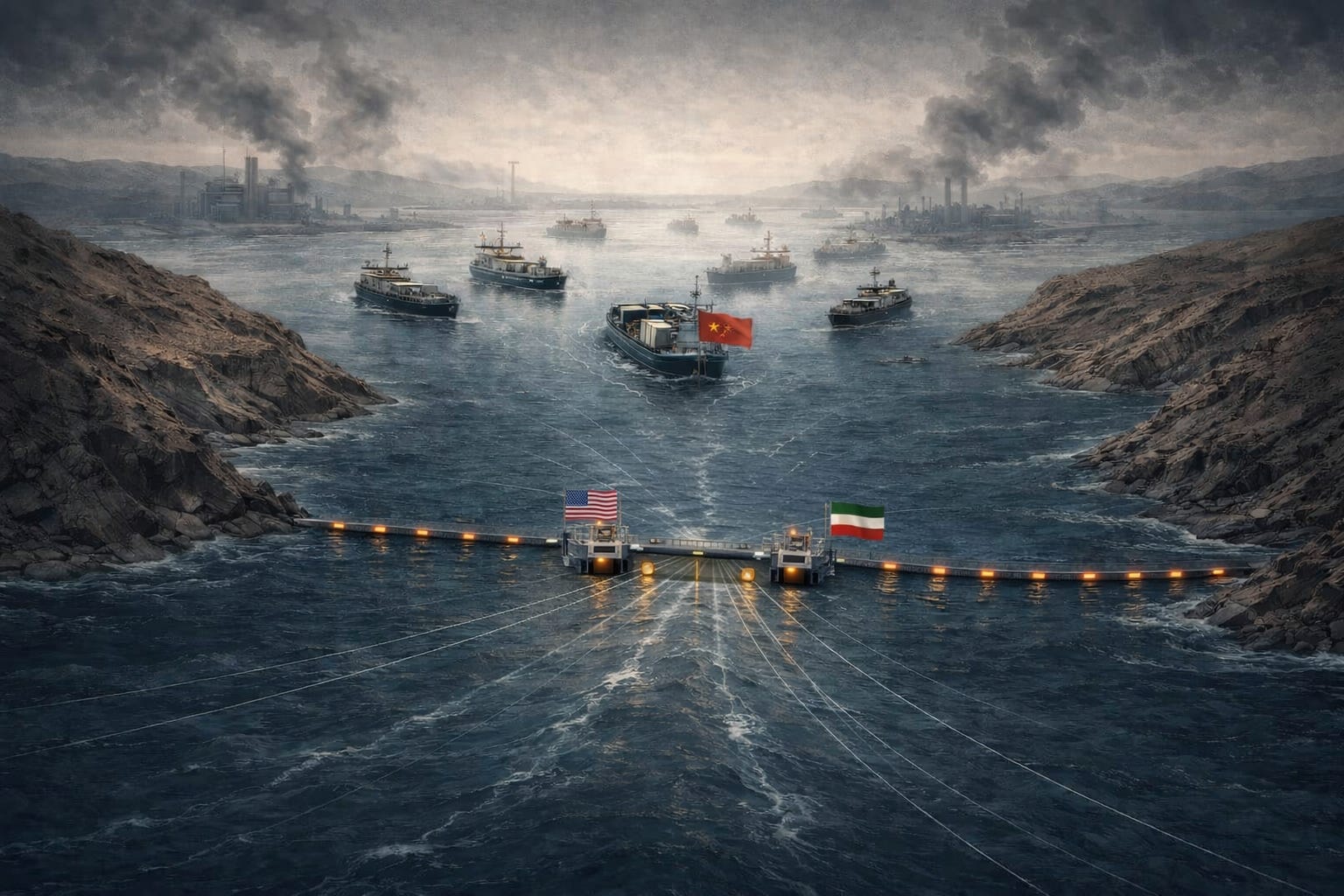
(Illustration by ChatGPT)
I. A Misread “Victory” and the Undercurrents of Global Maritime Order
The course of history often conceals its sharpest ruptures beneath a seemingly placid surface. As of mid-April 2026, global geopolitics and the order of the law of the sea stand at an intensely deceptive crossroads. On the surface, the United States and Iran have reached a fragile ceasefire in the Gulf, and the smoke hanging over global energy markets appears, for the time being, to be clearing.
According to the relevant ceasefire initiatives and negotiating process, the Strait of Hormuz—this vital artery carrying nearly 20 per cent of global oil consumption and 20 per cent of liquefied natural gas (LNG) trade—has seen a limited resumption of transit. Yet once one strips away the political façade of “ceasefire”, the Strait of Hormuz reveals a chillingly complex contest beneath: far from having returned to a normal state of free navigation, the Strait remains in a controlled operating pattern marked by extreme uncertainty, tight regulation and low traffic volumes.
Within this pattern, Iran is not only insisting on maintaining continued control over the Strait of Hormuz; it has also proposed an unprecedented charging scheme, seeking to levy transit fees of roughly US$1 per barrel of oil, or as much as US$2 million per vessel. This move is expected to bring Iran annual revenues ranging from several billion to tens of billions of US dollars, helping to fill the reconstruction funding gap left by sanctions and the devastation of war.
Catalysed by this geopolitical surface appearance, commentary in China has been awash with excessively optimistic sentiment about RMB settlement. Recently, in ceasefire negotiations, the Iranian side proposed the idea of charging fees to vessels transiting the Strait, and some reports indicated that RMB or cryptocurrency could be considered as alternative means of payment. Combined with the historic milestone reached since March 2026 by the Cross-Border Interbank Payment System (CIPS)—with single-day transaction volume exceeding RMB 1.22 trillion and average daily processed transaction value reaching RMB 920.45 billion—many voices have treated this negotiating proposal, together with the limited transit convenience secured for Chinese vessels through case-by-case co-ordination, as a major breakthrough in RMB internationalisation. Some views have even interpreted it as China having, without bloodshed [兵不血刃], gained strategic leverage in the Middle East’s geopolitical landscape, seeing it not only as a powerful blow against dollar hegemony, but also as a sign of the rise of China’s global financial infrastructure.
It must be stressed that this is a fatal misreading that confuses tactical convenience with strategic gain. From the broader perspective of international legal principle and great-power rivalry, China’s optimal strategy in the Hormuz crisis is not to maximise the limited gains from RMB settlement, but to minimise the long-term, systemic order losses produced by the entrenchment of a bad precedent, exposure to secondary sanctions and the coupling of dual-Strait risks [双海峡风险耦合].
The real victory does not lie in using China’s own currency to pay “protection money” on a shipping lane that has been illegally turned into a checkpoint and subjected to political screening. It lies in holding the line on “free passage” through the world’s sea lanes. This apparent attempt by a regional power to test the rules in fact reflects deeper turbulence in the global maritime order and a concealed shift in US geopolitical strategy. At a moment when international law is shifting irreversibly from “competition over legitimacy within the system” [制度内合法性竞争] to a condition in which “facts change the rules” [事实改变规则], China must see through the lure of localised financial gain and demonstrate the unshakeable steadiness of a major power, using a systematic strategic counterattack to break this carefully designed strategic trap.
II. The Mathematical Logic of “Controlled-Passage Equilibrium”
To see through the underlying logic of the current crisis, one must build a game theory framework incorporating multiple variables. In this crisis, the United States is trying to wear down its Asian rivals at the lowest possible cost, Iran is trying to turn the Strait into a cash machine, and China, for its part, must find the optimal solution between energy security and international rules. To that end, we construct a “composite utility model” [综合效用模型] for China’s strategic choices.
1. Core Variable Design and the Composite Utility Function
In strategic competition, China’s national interests can be quantified as several core variables. Setting aside the complex subscripts of pure theory, we extract five macro-variables that bear decisively on decision-making:
[Note: The article is slightly encumbered by its game-theory framing. This has been included for fidelity, but is not necessary in order to understand the author’s arguments.]
E: Energy supply security. This refers to the availability of crude oil and natural gas within China, and the degree of price stability.
R: Rule integrity. This refers to the extent to which principles of international law such as the right of transit passage under the United Nations Convention on the Law of the Sea (UNCLOS) are upheld.
A: Substitutive buffer capacity. This refers to China’s ability to use overland pipelines (such as the China–Russia and China–Central Asia pipelines) and strategic reserves to make up for disruptions in maritime transport.
S: Secondary sanctions risk. This refers to the compliance risk exposure of Chinese financial institutions (such as CIPS nodes) to attack under US long-arm jurisdiction for participating in illegal settlement.
P: Precedent transmission risk. This refers to the long-term strategic cost whereby, once Hormuz toll-charging is legitimised, other chokepoints such as Malacca may follow suit, creating a “dual chokepoint dilemma” [双喉管困境].
These five variables together constitute China’s composite utility function (U):
U = αE(A) + βR - γS - λP
In this function:
α and β are extremely high positive weights, representing the fact that energy survival and juridical rules are the foundations of China’s interests. It is worth noting that energy security E is an increasing function of substitutive capacity A. When maritime transport is disrupted, if A is sufficiently large, it can greatly cushion the decline in E.
γ and λ are extremely large negative penalty weights. Sanctions risk S and precedent cost P are “destructive costs” [毁灭性成本]. If, in pursuit of short-term gains, S and P surge sharply, overall national utility U will suffer a cliff-like collapse.
2. The Dynamic Game Decision Tree and Three Equilibrium Forms
Based on the model outlined above, the decision path and possible equilibrium outcomes of this multi-stage game involving the United States, Iran and China can be projected through the following dynamic game tree structure:
Node One (initial move): Iran’s strategic choice
Option 1: Fully reopen the Strait (abandon toll-charging).
Option 2: Implement “controlled passage” [受控通行] (setting up checkpoints and charging fees—the current choice).
Option 3: Impose a full military blockade of the Strait.
Node Two (response and reaction): the United States’ strategic choice
In response to Iran’s Option 2, the United States adopts a posture of “acquiescent attrition” [默许消耗]: condemning it on the surface, while in reality refraining from decisive military intervention, with the aim of wearing down East Asian manufacturing states through a prolonged state of high friction.
Node Three (final response): China’s strategic choice
Strategy H (deep cooperation): Accept the charges and use the CIPS system to provide Iran with an RMB settlement scheme.
Strategy P (limited cooperation): Conduct private, case-by-case coordination without publicly recognising the legality of the charges, while tacitly allowing some firms to pay.
Strategy L (legal resistance): Refuse payment categorically, contest the issue through legal and juridical instruments, and at the same time activate China’s own alternative supply networks.
Scenario Projections and Sensitivity Analysis Table:
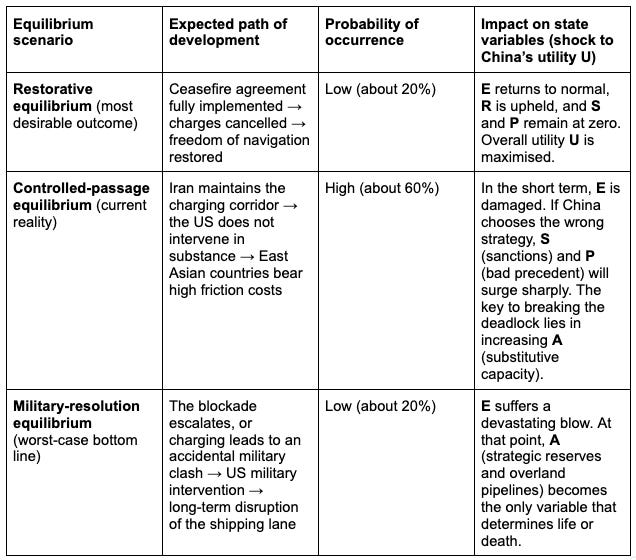
The results of the projections show clearly that the current situation has been firmly locked into the second form of “controlled-passage equilibrium” [受控通行均衡]. In this high-friction quagmire, if China were rashly to choose “deep cooperation” [深度配合] (Strategy H) in pursuit of short-term energy gains (raising E), the result would inevitably be the triggering of massive S and P penalty terms, causing the country’s overall utility U to collapse completely.
III. Structural Vulnerability and the Asymmetric Distribution of Costs: Who Is Really Paying for the Crisis?
To understand why “controlled-passage equilibrium” [受控通行均衡] can be tolerated and sustained by certain major powers, one must unpack the asymmetrical distribution of crisis costs across the world’s principal economies. The cruel law of geopolitics is this: whoever feels the sharpest pain from supply-chain disruption will be the one placed at a disadvantage when the rules are being remade.
According to data from the US Energy Information Administration (EIA) and other authoritative bodies, between 2024 and 2026 an average of roughly 20 million barrels of crude oil per day passed through the Strait of Hormuz, accounting for one-fifth of global seaborne oil trade; over the same period, around 20 per cent of global LNG trade also had to pass through it. More important than the total volume, however, is the direction of flow: more than 80 per cent of LNG and the overwhelming majority of crude oil were shipped to Asian markets, of which China, India, Japan and South Korea together accounted for a very large share.
[Note: The U.S. Energy Information Administration says oil flow through the Strait of Hormuz averaged 20 million barrels per day in 2024, equivalent to about 20% of global petroleum liquids consumption; it characterises the Strait as carrying more than one-quarter of total global seaborne oil trade.]
To present this asymmetry in the underlying physical structure more intuitively, the table below offers a quantitative comparative assessment of the core energy exposure and structural buffer capacity of China, the United States and Japan in this crisis:
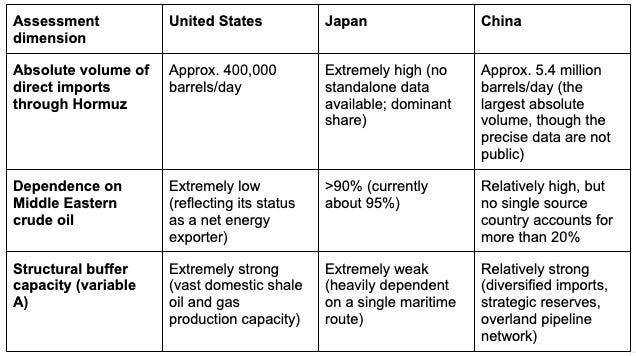
From the data matrix above, one can see clearly that the spillover costs of the crisis are borne almost entirely by East Asia’s industrial powers, while the extra-regional powers that either set the crisis in motion or are content to see it unfold have emerged almost entirely unscathed.
Japan’s position within this structure is close to hopeless. Its dependence on Middle Eastern crude oil is as high as 87 to 95 per cent, and this extreme concentration of imports leaves it with virtually no real room to manoeuvre once the Strait comes under controlled passage. If transit costs through the Strait were to surge or physical disruption were to occur, the Japanese government would be forced to confront extraordinarily heavy economic burdens and the risk of industrial paralysis.
As the largest importer in absolute terms, China, by contrast, has gained a degree of buffer resilience thanks to its sustained efforts in recent years to build out its energy-security network (thereby raising variable A). Yet its vast absolute scale means that the economic friction costs China faces are equally staggering. After the crisis broke out, crude freight rates from the Middle East to Asia (the TD3C index) soared to a six-year high, while single-vessel charter costs shot up into the tens of millions of US dollars. At the same time, multiple marine insurers withdrew war-risk cover for Gulf waters, driving up both insurance premia and financing frictions. These costs will seep through like capillaries, directly eroding the global competitiveness of Chinese manufacturing.
In sharp contrast, the United States has displayed a striking kind of “offshore” immunity. At present, the United States imports only around 400,000 barrels of oil per day directly through Hormuz; its energy exposure is exceptionally low by the standards of the major powers, and it can readily absorb the shock through its vast domestic shale oil and gas production capacity. More ironically, disruption in the Strait has tightened energy supplies in Asia and Europe, driven LNG prices up by more than 80 per cent, and pushed Middle East–Asia crude freight rates (the TD3C index) to a six-year high—yet refineries on the US Gulf Coast have benefited instead, reaping windfall arbitrage profits. This relative insulation has given Washington considerable strategic latitude.
More dramatic, however, is that the Gulf oil-producing states cannot simply pass these transit charges on to global consumers, because they must compete with producers such as the United States that do not face such costs. This means the Gulf states themselves will also come under severe pressure on profit margins. Some economists estimate that they may ultimately bear 80 to 95 per cent of the total charges.
IV. The Grand Strategy of the “West Asia” Corridor and the Narrative Trap of American Offshore Balancing
The deadlock in the Strait of Hormuz is not an isolated by-product of a regional conflict, but a direct projection of the transformation of America’s global grand strategy. To fully understand the strategic trap China now faces in this game, it must be examined within the framework of the “West Asia” grand strategy that the United States has in recent years been vigorously promoting.
1. A Profound Shift from “Nation-Building” to “Order-Building”
In his book West Asia: A New American Grand Strategy in the Middle East, the well-known American strategic scholar and Middle East Institute senior fellow Mohammed Soliman systematically sets out this profound shift. The core logic of this theory is that the US Middle East strategy of the late twentieth and early twenty-first centuries, based on direct military intervention and “nation-building”, has already failed completely. Faced with China’s rise, the United States must reconstruct the traditionally fragmented “Middle East” as “West Asia”—a vast intermediate zone and supercontinent linking Europe with the Indo-Pacific.
Within this top-level cognitive framework of “Asia-first”, the Middle East is no longer a geopolitical endpoint requiring the direct commitment of core US military resources for direct control. Instead, it becomes a “load-bearing corridor” [承重走廊] wholly subordinated to Indo-Pacific strategy and used to contain strategic rivals. The United States’ new strategic paradigm thus shifts to “offshore balancing” [离岸平衡]: abandoning large-scale direct military occupation, and instead building alliance networks across three dimensions—geostrategy, hard power and geotechnology—so as to pass the costs and risks of maintaining regional balance on to its allies. This allows Washington to concentrate the core projection of its military and economic resources on the Indo-Pacific in order to confront China comprehensively. One explicit aim of this alliance is to curb the expansion of China’s influence in the Middle East in fields such as 5G networks and artificial intelligence.
2. Weaponising Crisis and Casting a “Tailor-Made Noose”
Under the macro-level guidance of the “West Asia” strategy, the high-friction state of the Strait of Hormuz has become the perfect testing ground for the United States to practise “offshore balancing” [离岸平衡]. So long as no uncontrolled conflict breaks out that drags the United States back into a ground war, this “controlled equilibrium” [受控均衡] can, at extremely low cost to America, impose sustained economic attrition on Asian manufacturing states that are highly dependent on energy transported through this waterway.
More deceptive still was the ambiguous attitude of senior US officials towards Iran’s charging scheme. In April 2026, President Trump publicly sent highly contradictory signals. On the one hand, he warned Iran to stop charging fees; on the other, he suggested that the United States might seek to establish a “joint venture” with Iran to operate the charging system together, even describing it as “a good thing”. This astonishing rhetoric—an attempt to recast an illegal military blockade as a supposedly lawful “commercial joint venture”—lays bare a deeper ambition: to privatise and weaponise the global commons, and thereby impose a “geopolitical tax” [地缘政治税] on the world’s manufacturing powers.
In this contest, if China were to take satisfaction in being able to use RMB to pay this “protection money”, repackaged as a negotiating condition, and mistake that for a breakthrough against dollar hegemony, it would be little different from securing for itself a tailor-made noose in the very war of attrition its rivals would be glad to see. The United States could simply stand by as China and Iran reach some kind of RMB-based charging arrangement, then wait until Chinese financial institutions are deeply entangled before using long-arm jurisdiction to deliver a precise and potentially devastating blow.
V. The Tactical Temptation and Strategic Risk Exposure Behind CIPS’s Business Breakthrough
Any discussion of China’s policy choices in the Hormuz crisis cannot avoid the recent explosive growth of the Cross-Border Interbank Payment System (CIPS), which has attracted widespread international attention. Some domestic voices advocate adopting the previously outlined “Strategy H (deep cooperation)” and linking the CIPS system to the charging mechanism. In terms of our utility function, this means actively detonating the sanctions-risk variable (S).
1. CIPS’s Counter-Trend Growth and the Strengthening of the RMB’s Role
CIPS has recently achieved what can fairly be called a milestone breakthrough. In March 2026, against a broader geopolitical and macroeconomic backdrop that included the weakening of traditional safe-haven dynamics, CIPS’s average daily processed transaction value reached RMB 920.45 billion, the highest level in nearly a year; single-day processed transaction value also broke through the RMB 1.22 trillion mark for the first time in history. As of the end of March 2026, the CIPS system had, through more than 5,100 incorporated banking institutions, extended its coverage to 191 countries and regions around the world. The share of cross-border trade conducted in RMB has already been marked by a strong upward trend.
2. The convenience of a means of payment is by no means an institutional right.
However, it is an extremely dangerous conceptual confusion to crudely graft a tool grounded in lawful trade onto an unlawful charging mechanism for passage through the Strait. Under conditions of controlled passage, the essence of transit through the Strait is a bundle of “permission, inspection and political screening”. The charging proposal put forward by Iran is, in essence, a bargaining chip in a political game. An RMB-denominated arrangement would be nothing more than an expedient. It would not give Chinese vessels any reliable or institutionalised right of priority passage. So long as the littoral state in fact monopolises the right of access, it can at any moment turn the “convenience” of local-currency settlement into an instrument of diplomatic extortion—using it to apply external pressure and drive up the price on the spot [坐地起价].
3. The “Sword of Damocles” of Secondary Sanctions and the Narrative Trap
Once the RMB settlement system is institutionally bound to a highly controversial charging regime, the resulting compliance exposure risk (variable S) rises in a non-linear surge. The US Treasury Department’s Office of Foreign Assets Control (OFAC) has long treated Iran-related sanctions as a core focus of its enforcement network. Bank of Kunlun [昆仑银行] was previously dealt a heavy blow for assisting with the transfer of Iran-related funds.
Within the highly politicised anti-China strategic narrative advanced in the US Congress and the USCC, China has already been cast as a force helping sanctioned states evade sanctions. Once China’s financial channels are substantively used to support Hormuz’s controlled charging mechanism, the US side will be able with ease to complete the full legal-narrative chain: namely, that China is not merely conducting ordinary energy trade, but is providing “state-level financial infrastructure” to support conduct that tramples on freedom of navigation. This would hand Washington an excellent pretext for deploying secondary sanctions. What China would gain is merely a tactical right of passage, while the price it would pay would be a collapse of the security of global financial compliance.
VI. The Collapse of the Bottom Line of International Legal Principle and the Systemic Transmission of the “Dual Chokepoint Dilemma”
Returning to our utility model: even more lethal than sanctions risk (S) is the cost of precedent (P). The Hormuz crisis is a systemic challenge to the contemporary international law-of-the-sea order, and the loss of the legal bottom line will trigger disastrous knock-on effects.
1. The Juridical Red Line of Transit Passage Is Not for Bargaining Away
From the standpoint of international legal doctrine, the imposition of a regime of “charging and controlled passage” on an international Strait used for navigation entails a fundamental juridical conflict. According to the core doctrine of “transit passage” in Articles 37 to 44 of the United Nations Convention on the Law of the Sea (UNCLOS), all ships and aircraft enjoy the right of unimpeded transit passage through such straits, and littoral states may not require prior authorisation. In addition, Article 26 of UNCLOS makes clear that, unless specific services are rendered to a ship, no charge may be levied solely on account of its passage through the territorial sea.
Even if some seek to dress this up as a “self-defence” argument under Article 51 of the United Nations Charter, the San Remo Manual on International Law Applicable to Armed Conflicts at Sea, which reflects customary international law, makes clear that a lawful maritime blockade must never be established solely for economic purposes or in order to punish neutral merchant vessels of third states. The International Maritime Organization (IMO) has already explicitly warned that charging vessels for transiting a strait would set an extremely dangerous precedent and fundamentally shake the foundations of global maritime governance.
[Note: The San Remo Manual does not appear to state this in exactly these terms. It does, however, provide that a blockade must not bar access to the ports and coasts of neutral states, must be applied impartially, and is prohibited if its sole purpose is starving the civilian population or denying it objects essential for survival. The IMO spokesperson did warn that charging vessels would set a dangerous precedent, but no quote about “fundamentally shak[ing] the foundations of global maritime governance” has been found.]
2. The Coupling of “Dual Chokepoint” [双喉管] Risks and the Reverse Demonstration Effect of Rules
If China were in effect to acquiesce in this charging model, then in our game theory model the risk of precedent transmission (P) would immediately reach its maximum value. This points directly to the most lethal hidden danger in China’s geopolitical strategy—the “Dual Chokepoint Dilemma”.
Asia’s vital energy arteries do not end at the Persian Gulf. The overwhelming majority of supertankers sailing eastwards, after exiting the Strait of Hormuz, must pass through the Strait of Malacca before reaching East Asia. Data show that in the first half of 2025, the Strait of Malacca carried roughly 23.2 million barrels of oil per day, with China accounting for as much as 48 per cent of crude flows. By virtue of the geopolitical advantage conferred by the Andaman and Nicobar Islands, India would, in an extreme conflict scenario, possess the ability to monitor and exert pressure on this core shipping lane.
The precedent effect in game theory is this: if you tacitly accept someone else doing this today, tomorrow others can do the same to you. If, for the sake of short-term payment convenience, China were to acquiesce in the legality of littoral states setting up toll stations in Hormuz, then once the coastal states of the Strait of Malacca or the Sunda Strait establish similar “charging plus permit” regimes in the future, citing marine pollution or geopolitical security as justification, China would completely lose any solid juridical basis for mounting a defence. Such short-sighted behaviour—in which local gains conceal broader losses—would mean that every tonne of China’s future energy imports could be exposed to endless political extortion.
VII. Responding to “Controlled Equilibrium”: Great-Power Strategic Agency in Reconstructing Order
Faced with America’s strategy of attritional “offshore balancing” [“离岸平衡”] and the geopolitical extortion of regional powers seeking to rewrite the rules, China must not fall into a passive cycle of adaptation in which “whoever feels the pain is forced to compromise” [“谁痛谁妥协”].
According to our decision-making model, China must abandon Strategy H (deep cooperation), which would detonate sanctions risk (S) and precedent cost (P). Instead, it should resolutely implement Strategy L (legal resistance), supplemented by systematic economic and institutional countermeasures, so as to maximise composite utility U.
1.. The Legal Bottom Line: Upholding the Principle of Transit Passage (Maximising Variable R)
In its public diplomacy and juridical characterisation of the issue, China must hold the line: it must never recognise the legality of any unilateral, coercive charging regime imposed on an international strait used for navigation. This is not only a matter of defending China’s own interests, but also of protecting the model’s legal-rules variable (R).
China’s diplomatic and legal departments should actively use multilateral mechanisms such as the United Nations General Assembly and the IMO to push for an authoritative legal interpretation on the question of charging for passage through the Strait. More than that, China should explore the possibility of bringing within the ambit of international responsibility any conduct whereby a state uses waters under its jurisdiction to impose a de facto blockade and thereby causes major economic harm to third countries. At the same time, at the level of domestic financial regulation, it should implement prudent risk ring-fencing, clearly delineate the strict boundary between lawful CIPS settlement and unlawful settlement of Strait transit charges, and resolutely block the spread of secondary sanctions risk (S) into China’s domestic financial infrastructure.
2. Supply-Chain Defence: Trading Space for Time [以空间换时间] (Maximising the Substitutive Buffer Variable A)
In our utility function, U = αE(A) + βR - γS - λP, if China chooses to hold the line, then in the short term seaborne energy volumes will inevitably be disrupted. At that point, the only parameter capable of cushioning the decline in energy security (E) is China’s substitutive buffer capacity (A).
During the period of crisis deadlock, China should decisively and orderly activate its emergency national petroleum reserve plan, releasing supplies in a targeted way into the domestic market in order to smooth price volatility. Even more crucially, it must accelerate the mobilisation and full-load operation of its existing cross-border, non-maritime energy pipeline networks, comprehensively increasing the transmission capacity of the “north-to-south gas transmission” [北气南输] network, the China–Russia crude oil pipeline, the China–Central Asia pipelines, and the China–Myanmar oil and gas pipelines. This strong marginal substitution effect (raising A), combined with the accelerated substitution provided by new energy sources, would be sufficient to extend greatly China’s macro-level tolerance for disruption to seaborne transport. Through this supply-chain defence strategy of “trading space for time” [以空间换时间], China can turn time itself into a strategic ally and frustrate any attempt to extort vast sums of money through coercion in the Strait.
3. Institutional Reconstruction: Building an “Asian Consumer Order Alliance” [亚洲消费者秩序联盟] Through Three-Tier Advancement
While breaking the old controlled state of affairs, China must not passively accept the geopolitical coercion embodied in the US-led, unilaterally assembled “escort coalition” [护航联盟]. The real point of leverage for breaking the deadlock lies in reconstructing the matrix of shared interests among East Asia’s importing states.
Faced with the dual disruption risk posed by these two great “dual chokepoint” [双喉管] arteries, China, Japan, South Korea and India confront a highly convergent systemic crisis. China should adopt a three-stage strategy to reshape the regional energy-security architecture. The first step is to establish an Asian consumer policy coordination platform and forge a united front in rejecting unlawful charging schemes. The second is to promote the creation of a multinational Asian maritime emergency corridor and escort coordination mechanism, while exploring a jointly backed insurance support network to ease shipping frictions. The third is to institutionalise the “Asian Consumer Order Alliance” [亚洲消费者秩序联盟]. Once a bloc representing more than half of global energy purchasing power acts in concert on questions of maritime rules, the institutional weight it generates will fundamentally alter the existing equilibrium of the game. It could even turn passivity into initiative and thereby break America’s offshore-balancing manipulation based on its “West Asia” strategy.
VIII. Conclusion: The Strategic Steadiness of a Major Power and the Choice Facing a New World Order
At the highest level of great-power competition, the contest is not over the gains and losses of one city or one place, but over leadership in rule-making and in the operation of systems. In the treacherous and ever-shifting waters of the Strait of Hormuz, the United States is trying to use its grand “West Asia” strategy as a lever to quietly strangle Asia’s manufacturing foundations, while the regional power in question seeks to use the blockage of this vital artery as a bargaining chip in exchange for short-term geopolitical survival and vast reconstruction funding.
At such a sweeping historical juncture, to misread the natural growth of RMB cross-border payment business during a particular period as a pass that can be used to exchange for institutional rights on an unlawful shipping lane is no different from swallowing tactical bait wrapped in geopolitical poison. This would not only expose China’s financial system to the crossfire of secondary sanctions, but would also bring about, by China’s own hand, the destruction of the juridical bottom line that safeguards the unimpeded flow of countless maritime lifelines.
For a resurgent great power like China, whose economic lifeblood is deeply embedded in the global system, the true national core interest must always lie in preserving an international navigation corridor through which “anyone can pass, without obstruction and without political screening”. When international competition unfolds in the concealed form of “offshore attrition” [离岸消耗], China must demonstrate the unshakeable steadiness of a major power. It must hold the red line of international rule of law, rely on strategic depth [战略纵深]—that is, substitutive buffer capacity—to withstand the pain of transition, and join forces with all Asian actors that depend on freedom of navigation. This is not only the right path out of the “dual chokepoint dilemma” [双喉管困境]; it is also the only road by which China can establish its own strategic agency and lead the reconstruction of the global system of public governance in this period of upheaval and change.
READ MORE
Countering Western Sanctions: Building a CES Network by Ye Yan

Ye Yan argues that growing US-led sanctions and export controls threaten China’s development, while longer-term responses such as renminbi internationalisation and technological upgrading cannot provide sufficient near-term protection. Because China still lags behind the US in overall power, Beijing should avoid reflexive tit-for-tat retaliation that could damage its own interests. Instead, he proposes a cross-border business alliance of sanctioned firms and sanctions-tolerant companies to preserve supply chains, reduce isolation, expand opportunities for Chinese firms, and strengthen China’s leverage. Although slow to build and potentially polarising, such a network could blunt Washington’s coercive tools and help avert full US–China economic decoupling.
I think this piece is valuable because it gets one big strategic point right: for a country like China, the real issue is not whether it can technically settle payments in RMB, but whether it can preserve non-discriminatory, predictable, low-friction passage through critical maritime chokepoints. In that sense, the article is absolutely right to warn against confusing payment convenience with strategic gain. A payment channel is not the same thing as a legal right, and financial settlement is not the same thing as durable access.
I also strongly agree with the article’s concern about precedent. If a major chokepoint like Hormuz becomes normalized as a place where political screening, ad hoc charges, and conditional passage are tolerated, the long-term damage goes far beyond one episode of higher shipping costs. It would mean that the rules governing global trade arteries become more contingent, more coercive, and more vulnerable to strategic manipulation. For China, as a manufacturing superpower deeply dependent on stable maritime flows, that is clearly a long-term problem.
That said, I think the article becomes less convincing when it moves from identifying a real strategic danger to describing it almost as an already consolidated long-term equilibrium. The risk is real, but the structure is not yet fully formed. What we are seeing still looks more like a highly unstable crisis, a coercive test, and a fluid bargaining environment than a mature and durable new order. In other words, the article is strongest on the principle, but somewhat too certain on the degree of strategic consolidation already achieved.
I would add one more boundary condition. China’s real-world response is unlikely to be binary. It is unlikely to simply “accept” such a system, but it is also unlikely to rely on pure legal resistance alone if immediate energy security and shipping stability are at stake. More likely, China would operate in a gray zone: not legally endorsing the practice, not politically legitimizing it, but potentially using temporary commercial workarounds while accelerating diversification, buffers, and alternative supply routes. That may be less morally clean, but it is often how large states actually behave under high-pressure external shocks.
So my overall view is this: the article is right to insist that China must think in terms of long-term rules, not short-term transactional convenience. That is its strongest contribution. But it goes a bit too far when it treats a still-volatile crisis as if it has already crystallized into a stable strategic architecture. The warning is important. The degree of closure is overstated.
The most interesting aspect (to me), is Ye’s assertion that the US’s blockade is an element of some “West Asia” strategy to economically strangle East Asian countries (and specifically China). Yes, the disruption of Gulf oil supply creates challenges to Beijing, but is significantly more devastating to US allies Japan, South Korea, and Philippines. Moreover, to suggest that the US action is a deliberate element of ANY well-considered US regional grand strategy is to grant the Trump administration a level of strategic forethought that no reasonable observer would grant. Yes, the US action against Iran-originated shipments does in fact harm China more than any other nation. But Washington presumably would not have implemented its blockade if Tehran had not first threatened the shipments coming from other Gulf nations. The US move was a REaction rather than part of a grand strategy. (As an aside, if the current administration has ANY grand strategy, I’d love to see it.) Second, it’s interesting that he points to the precedence (if allowed to stand) that might be used in the Strait of Malacca but fails to mention that it might also provide a similar precedent for the Strait of Taiwan.