



Intellisia is not a state-linked think tank, but nor is it a fringe outlet. Founded in 2015 by Jinan University professor Chen Dingding, it presents itself as one of China’s early “new-type” independent think tanks and enjoys a measure of standing within that world.
What makes this short, memo-like analysis especially striking, however, is not just its argument but its fate: it was swiftly censored after publication. Chinese commentary has often framed US policy mistakes as strategic opportunities for China, but the live war in Iran seems to be more politically delicate terrain. Presumably, any suggestion that a prolonged Middle East war could amount to a strategic opportunity for China sits awkwardly with Beijing’s preferred self-portrait as a neutral mediator and responsible great power.
In past newsletters, we have noted cautious arguments for a more proactive and assertive foreign policy, but the prevailing strategic instinct in the volatile early months of Trump 2.0 has been that “China should keep doing China well” while chaos unfolds elsewhere.
The Intellisia piece pushes that logic a step further, arguing that chaos is not simply something for China to endure, but something from which it can profit.
The article argues, predictably enough, that “a protracted Middle East conflict would systematically drain the military, diplomatic and financial resources of the United States”. But it also advances a more developed case that protracted war in Iran will reroute capital, energy routes, and supply chains in Beijing’s favour.
Its closing prescription is “trading with the sword in hand”: a somewhat harder-edged version of “China doing China well”, even if the “sword” here is not military force but Beijing’s command of new energy and manufacturing.
— Jacob Mardell
Key Points
A protracted Middle East war would be a “period of strategic opportunity” for China—one that drains US resources while pushing global capital, industry and trade routes towards China as the “next best option”.
Turmoil at sea leaves US allies—dependent on seaborne energy—vulnerable, expanding demand for alternative land routes and accelerating China’s “revival of continental power”.
Capital will initially flee to the US dollar, but as war drags on, it will seek new safe havens. Hong Kong has already emerged as a preferred destination for Middle Eastern money.
The war will accelerate the shift towards a global industrial chain resting on US demand, China as the hub, and the rest of the world in supporting roles, handing China pricing power and rule-setting authority.
This is a stress test for the petrodollar and US military credibility. The US is signalling that interests take precedence over allied security, while trade settlements are using the renminbi to hedge risk.
The Institute
Name: Intellisia Institute (海国图智研究院)
Founded: 2015
Founder and President: Chen Dingding (陈定定), Professor of International Relations, Jinan University; Associate Dean, Institute for Belt and Road Initiative and Guangdong–Hong Kong–Macao Greater Bay Area Studies, Jinan University
Research focus: International affairs, especially US–China relations, Chinese foreign policy, risk forecasting, and AI / new technology in international relations
Other: Named after Wei Yuan’s Haiguo Tuzhi (海国图志), a landmark 19th-century work widely regarded as one of China's first serious studies of the Western world and an early call to learn from Western military power. Recent profiles describe the institute as having around 20 full-time researchers.

IF THE MIDDLE EAST WAR LASTS TEN YEARS, IT WILL CREATE CHINA’S GREATEST PERIOD OF STRATEGIC OPPORTUNITY
Intellisia Institute (海国图智研究院)
Published by Intellisia, 17 March 2026
Lightly edited machine translation
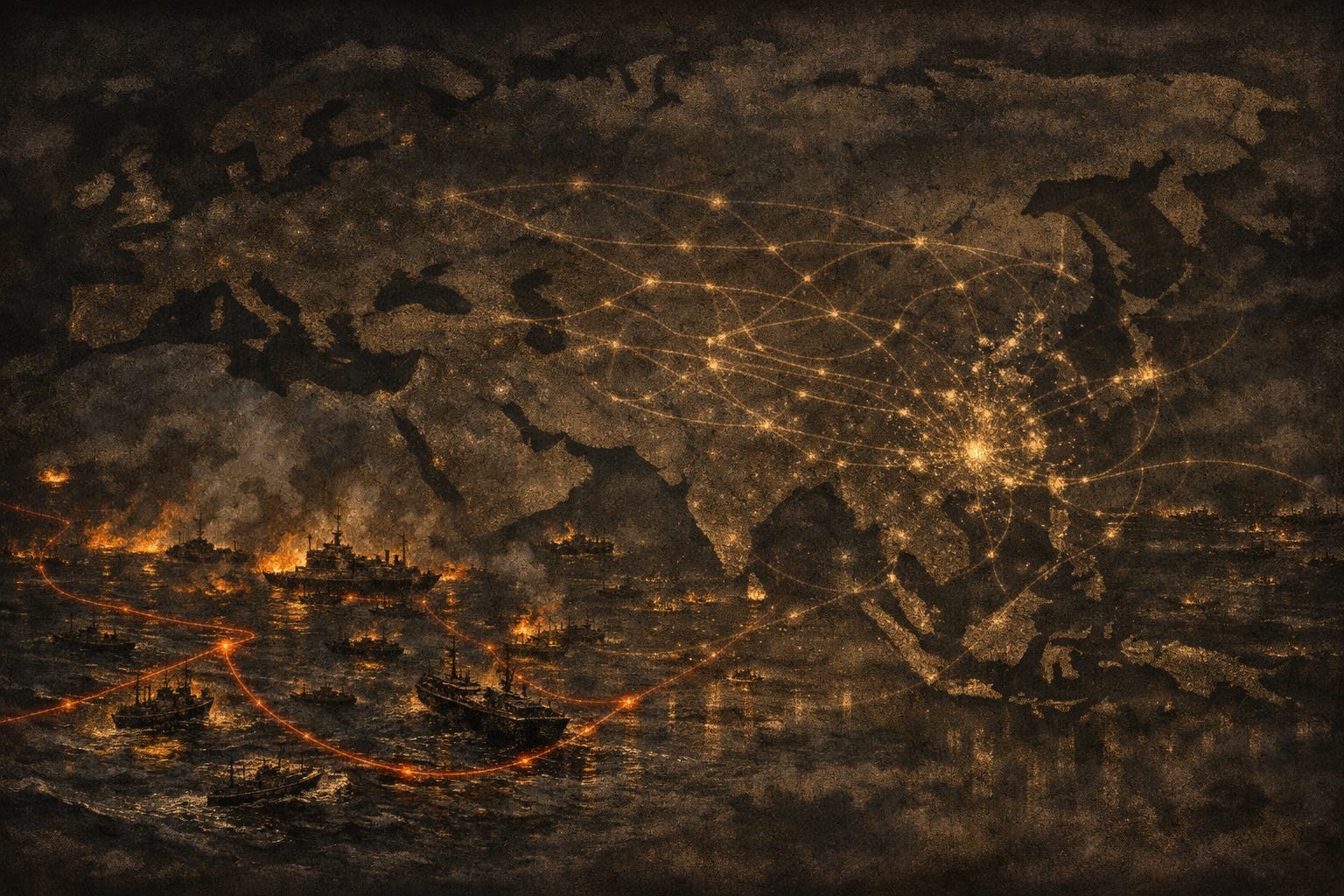
(Illustration by ChatGPT)
I. Trading with the sword in hand—not vying for hegemony, but for the right moment
As global attention fixes on the smoke of war above the Persian Gulf, a quiet yet profound reconfiguration of global power has already begun. Mainstream narratives portray a protracted Middle East war as nothing but risk and crisis. Yet viewed through the lens of long-term history and geoeconomics, it may instead provide China with a crucial lever with which to prise open the “changes unseen in a century” [百年变局], offering a strategic time window of maximum pressure and long duration.
Our assessment is that the core dynamic is as follows: a protracted Middle East conflict would systematically drain the military, diplomatic and financial resources of the United States as China’s primary strategic competitor, while forcing global capital, industry and trade routes—amid pervasive fear—to seek the “next best option”. China, by virtue of its uniquely vast scale, the completeness of its industrial chain and the rapid transformation of its energy mix, is emerging as the option offering the greatest certainty.
This is not schadenfreude, but a cold structural reality. What follows is our four-dimensional analysis, supplemented by the latest data and case studies since the beginning of 2026.
II. Energy security: the return of the continental era [陆权时代] and the allies’ predicament
China’s “Malacca dilemma” still echoes in policy discourse, yet the script is being rewritten. Conflict in the Middle East is driving up the risk premium on maritime shipping and accelerating a route revolution [路径革命] in global energy trade. Two main trajectories are set to become increasingly pronounced:
Opening the north–south land bridge: the multimodal corridor linking the Middle East (the Persian Gulf), Pakistan (Gwadar) and China will shift from conceptual blueprint to an economically urgent lifeline.
Integration of the continental hinterland: the vast pipeline network connecting Russia, Central Asia and China will see its strategic value—and the demand for its expansion—rise sharply.
Key data and case studies:
The vulnerability of Japan and South Korea laid bare: in March 2026, shipping volumes through the Strait of Hormuz fell sharply, leaving more than 40 Japanese oil tankers stranded. [Note: Media report that 40 Japan-linked vessels “including oil tankers” are stranded.]
In response, the Japanese government urgently released 80 million barrels from its strategic petroleum reserves—the largest drawdown since the reserve system was established in 1978. South Korea, meanwhile, was compelled to implement its first “oil price cap mechanism” in nearly three decades. With dependence on Middle Eastern oil reaching 95.1% and over 80% respectively, the two economies were among the first to be hit. [Note: While the figure for Japan is broadly supported, Reuters reports that Korea gets about 70% of its oil from the Middle East, rather than over 80%.]
The Nomura Research Institute forecasts that if oil prices rise to US$140 per barrel, Japan’s economic growth rate could be reduced by 0.65 percentage points, bringing it close to stagnation. [Note: The Japanese analysis goes further, warning that US$140 per barrel would raise the possibility of recession.]
America’s inflation dilemma: according to an analysis by China International Capital Corporation (CICC), if conflict in the Middle East pushes the oil-price baseline higher, US year-on-year CPI inflation in 2026 could rise from 3.1% under the baseline scenario to 3.9%. This would intensify “stagflation” risks and place the Federal Reserve’s monetary policy in a dilemma. [Note: The CICC report treats both 3.1% and 3.9% as post-conflict scenarios at different oil-price levels, rather than a baseline and an upside case.]
Conclusion: while the flames of war burn at sea, they also pour tar on China’s “revival of continental power” [陆权复兴], placing US allies—heavily dependent on seaborne energy—in a precarious position. Energy security is thus shifting from the passive defence of “securing sea lanes” [保航线] to the proactive strategy of “building corridors and controlling hubs” [建走廊、控枢纽]. [Note: The Chinese is ‘浇上了焦油’—literally “poured tar on”. The image inverts the more familiar idiom “pour oil on the fire”: tar burns slowly, clings, and is hard to extinguish, so the metaphor is one of entrenchment.]
III. Capital flows: from the “safe-haven dollar” [避险美元] to the “store-of-value renminbi” [价值人民币], with Hong Kong emerging as a new port in a storm [避风港]
In the early stages of a crisis, capital will inevitably flee to the US dollar. But this is only the first act. A protracted war will bring on the second and third acts, and capital flows in the first quarter of 2026 already offer early signs:
Act I (panic): capital flows back to the United States in search of currency safe havens.
Act II (pain): soaring energy and logistics costs steadily erode profit margins in the real economies of Europe and the United States.
Act III (choice and return): capital searches globally for a “port in a storm” [避风港] that combines production stability, cost competitiveness and market depth.
Hong Kong is emerging as a preferred destination for Middle Eastern capital.
Key data and case studies:
Middle Eastern capital stages a forceful return to Hong Kong: since March 2026, enquiries from Middle Eastern clients about investing in Hong Kong equities and establishing family offices in the city have surged by more than 50% month-on-month. Hong Kong media report that nearly 30% of these enquiries come from large Middle Eastern families that had previously relocated to Singapore or Dubai and now plan to reallocate 15–20% of their assets back to Hong Kong. A report by Citigroup likewise notes that geopolitical instability is driving capital rotation towards “neutral” Asian financial centres such as Hong Kong. [Note: The 50%, 30%, and 15–20% figures all originate from unnamed financial industry sources cited in PRC media coverage in March 2026.]
The redefinition of “safe assets”: Hong Kong’s Financial Secretary, Paul Chan Mo-po, has publicly stated that geopolitical tensions are driving capital inflows into Hong Kong as a safe haven, adding that Middle Eastern funds may choose the city in search of a greater sense of security. Behind this lies growing distrust generated by the “weaponisation” of the US dollar, as well as the distinctive advantages Hong Kong enjoys under “one country, two systems”, including the rule of law and the free movement of capital.
Implication: the current withdrawal of certain capital is, in fact, a prelude to a larger and more strategic wave of return in the future. Positioning in Chinese assets is essentially a move to secure a place at the core nodes of the global division of labour in the post-crisis era.
IV. Supply chain reconfiguration: from globalisation to bloc fragmentation, with China as an irreplaceable hub
War is the most powerful catalyst for the relocation of supply chains. Two major trends are set to accelerate:
The targeted relocation of “energy-intensive industries”: Europe’s high energy-consumption sectors—such as chemicals and non-ferrous metal smelting—face a dual blow from elevated domestic energy costs and supply chain disruptions. As a result, the pace at which capacity shifts towards lower-energy-cost locations such as China and Central Asia will accelerate dramatically.
The “China market” as the ultimate counterweight to “friend-shoring”: the US-led push for “de-risking” is forcing its allies to seek alternative production capacity in Southeast and South Asia. Yet these alternative production bases remain heavily dependent on China for upstream equipment, key raw materials and even financial services.
Concrete scenarios and data:
European chemicals industry: conflict in the Middle East has led to the suspension of nearly 20% of global liquefied natural gas (LNG) export capacity following attacks on facilities in Qatar, triggering a 70% single-day surge in European natural gas prices. This will compel major firms such as BASF and Lanxess to further assess shifting production capacity towards locations with more stable energy supplies, including China. [Note: Media reporting indicates a roughly 70% increase in European natural gas prices over several days, rather than a single-day surge.]
Japanese and South Korean automotive industries: amid conflict-related concerns, Japan’s stock market saw the Nikkei 225 Index plunge by 3.61% in a single day on 4 March—the steepest decline in a year. The risk of supply chain disruption will draw the sector closer to China’s more complete electric-vehicle supply chain.
Insight: the future global industrial chain will rest on a deeper structure: US demand, China as the hub, and the rest of the world in supporting roles [美国需求、中国枢纽、全球配套]. To control the hub is to control pricing power and rule-setting authority.
V. Monetary power: the quiet acceleration of “de-dollarisation” and the fading of military hegemony
Conflict in the Middle East is an extreme stress test for the petrodollar system, as well as a public test of the credibility of the US military security umbrella.
On the monetary front: China’s strategy is clear and pragmatic—it does not challenge dollar hegemony directly, but quietly cultivates alternative options. When Middle Eastern countries increasingly use renminbi in trade and channel investments through Hong Kong’s financial markets, this signals a loosening of the system’s foundations.
On the military front: the United States’ global military deployment is falling into the predicament of “robbing Peter to pay Paul” [拆东墙补西墙]. In March 2026, the US “THAAD” missile defence system stationed in South Korea was urgently redeployed to the Middle East to fill air-defence gaps following Iranian strikes. [Note: THAAD redeployment was reported by the Washington Post on 9 March 2026, citing two unnamed US officials, and corroborated by Korean media. The Pentagon has not confirmed specific asset movements.]
This move clearly signalled to allies such as South Korea that US core interests take precedence over allied security. At the same time, Gulf states including Saudi Arabia and the United Arab Emirates have publicly refused to allow their territory or airspace to be used for attacks on Iran. [Note: Public refusals by Gulf states to allow their airspace or territory to be used for attacks on Iran predated the U.S.-Israeli strikes of 28 February 2026.]
With 27 US bases in the Middle East coming under attack and core command hubs damaged, its military presence has been exposed as a security liability [安全负资产]. [Note: The figure of 27 US military bases comes from Islamic Revolutionary Guard Corps (IRGC) claims rather than US confirmation.]
The principal battlefield for renminbi internationalisation lies not in the trading floors of New York or London, but beside the oil wells and ports of Dhaka, Dubai and Riyadh—in the many thousands of trade settlements that choose the renminbi to hedge risk. This is a bottom-up, pragmatism-driven revolution. The loosening of US military hegemony is meanwhile reducing external resistance to this process.
Conclusion
In an age of great contention [大争之世], the opportunities that shape national fortunes are often concealed beneath turbulent waves. Prolonged conflict in the Middle East constitutes a quagmire that drains US strength, a nightmare on Europe’s doorstep and a direct economic shock to [US] allies such as Japan and South Korea.
But for China, provided it maintains sufficient strategic clarity and resolve, this may well constitute a systemic and structural period of strategic opportunity. It is already creating strong external pressure that forces change [倒逼压力] and a valuable strategic time window [时间窗口] for addressing core strategic priorities such as securing energy transport routes, advancing industrial upgrading and promoting renminbi internationalisation.
At this moment, “trading with the sword in hand” [持剑经商] means holding the “sword” of new energy and manufacturing while doing the “trading” of continental integration and supply-chain hub-building. It means not fretting over the gains and losses in any one place, nor being swayed by the temptations of short-term deals, but ensuring that when the balance of history ultimately tips, we are already standing on the side of greatest weight.
READ MORE
Iran as the "Bridgehead" for Securing China’s Western Frontier | by Zhang Wenmu

With Iran’s future in question, we found this 2013 article by Zhang Wenmu, an old-school strategist from Beihang University, worth revisiting. One conclusion from our briefing on Chinese reactions to the recent US-Israeli strikes is that many analysts appear relatively unworried about the Iranian regime’s immediate prospects. Zhang offers a contrasting perspective—albeit one from over a decade ago—casting Iran as a strategic barrier to NATO’s eastward expansion and the westernmost link in the Zagros–Hindu Kush–Himalaya chain that has historically shielded China from outside powers’ eastward advance. That barrier has not yet collapsed, but it appears more vulnerable now than it has in years. Read in that light, this piece lands rather differently today.
China's Middle East Policy by Peking University Prof. Wu Bingbing

• China pursues ‘balanced diplomacy’ [平衡外交] in the Middle East, which entails not picking sides and not making any enemies.
• To help strengthen its ties with the region, Beijing’s strategy has been one of 'positive balancing' [积极的平衡]. That is, closer cooperation with one actor (e.g. Iran) will pressure others to follow suit (e.g. Arab Gulf countries).
• China’s two main priorities in the region are: (i) resolving the Israeli-Palestinian conflict; and (ii) establishing a Gulf security dialogue platform.
• If Chinese initiatives such as the BRI, GDI and GSI are highly compatible with the region’s need for development and security, ‘Chinese-style modernisation’ is the ideational glue that can help bring countries in the Middle East and China closer together.
Active Neutrality in the Middle East – Chinese Commentary on the US-Iran war

Chinese expert commentary largely recommends pursuing a position of neutrality and mediation in the Iran-US war, with only two senior academics making subtle arguments for a more assertive posture: Zheng Yongnian writes that Beijing should “demonstrate the strength and policies befitting a great power”; Zheng Ge claims that the sustainability of China’s “active neutrality” depends on the war’s direction, noting that meaningful mediation “requires China to transcend its traditional ‘non-interference’ principle”.
Very interesting article. But I’m curious about why it would be censored? The setup mentions that the think tank isn’t “on the fringe.” And since it isn’t state supported, its views don’t purport to represent official thinking. Finally, any fair reading would conclude there’s not much radical here. So why the official reactions to these ideas at this particular time?
Hundreds of thousands (and perhaps millions) will die in a 10 year war (many of them in African countries). Unlike Japan, China's closest relationships are in the 3rd world. When China was dirt poor, it helped to build the Tanzam railway. Could it be that it doesn't see "geopolitics" as a chessboard where you MUST keep grabbing power? It's also motivated by old fashioned notions of socialist solidarity?