


Brazil is a nation close to my heart and, as many readers may know, it is in the midst of a decisive and highly divisive election contest between incumbent Lula da Silva and his challenger on the populist right, Flávio Bolsonaro, son of the former president, who is serving a 27-year sentence for plotting a coup. In this newsletter, we interrogate the consequences for China, which has significant interests—economic and geopolitical—in Brazil. Maurício Santoro, who has literally written the book on China-Brazil relations, has very kindly provided an introduction to the following piece by Xu Tianqi.
Maurício is a fellow at the Brazilian Navy’s Centre for Political and Strategic Studies. He holds a PhD in political science from IUPERJ and twice headed the Department of International Relations at the State University of Rio de Janeiro (UERJ). We are grateful for his contribution. — Jacob Mardell
The Brazilian elections are mostly about domestic issues, but international affairs are also being discussed—especially Brazil’s relationship with the United States and with China. If the right-wing opposition wins, as polls suggest it will, we can expect changes on both fronts, since one of Flávio Bolsonaro’s proposals is closer cooperation with Donald Trump’s administration.
Xu Tianqi rightly observes that Brazil will not leave BRICS if the opposition wins. Among this year’s candidates, only one minor figure, Romeu Zema, pledged to leave. Flávio Bolsonaro has mentioned in passing that he might consider leaving the bloc, but Brazil’s exit is unlikely, and not what is at stake. This is just one facet of a wider debate on Brazil, China and the BRICS.
China is, by far, Brazil’s biggest trade partner, the destination of 30% of Brazilian exports, and a major investor in the country—especially in the electricity sector. Brazilians are buying increasing numbers of Chinese products, such as cars, smartphones and computers, and there is a growing appreciation for companies such as BYD, Didi, Geely and Huawei—which are now even appearing in Brazil’s prime-time telenovelas.
The United States is Brazil’s second largest trading partner, though exchanges are decreasing due to Trump’s protectionism. Around 10% of Brazilian exports go to the American market. However, US influence stretches far beyond that because of decades of strong political, military and cultural ties. Conservatives usually advocate a stronger partnership with Washington.
In the last 50 years, the Brazilian foreign policy establishment has held a consensus on non-alignment with major powers and the search for a multipolar world. Countries such as China, India and Russia have been important partners in these efforts, and the creation of the BRICS was a milestone in that cooperation.
However, the Bolsonaro family has a different approach. During Jair Bolsonaro’s administration (2019-2022), he tried to establish a strong relationship with Trump and had something of a roller-coaster relationship with China, including several very low points during the coronavirus pandemic, before ending his mandate on a more moderate and pragmatic note. His son Flávio proposes to repeat the partnership with the United States, especially on public security, but does not share his father’s record of hostile comments or behaviour against the Chinese.
Still, the question remains: can Flávio Bolsonaro reconcile a pragmatic approach to China and a strong relationship with the US, in a period in which Trump is putting so much pressure on Latin America to reduce Chinese influence? Other right-wing presidents in Argentina, Chile and Peru have been able to tread this line, but there is more at stake in Brazil, a country with much broader geopolitical ambitions.
— Maurício Santoro
Key Points
No political camp with significant influence in Brazil can easily abandon BRICS, nor would they lightly weaken Brazil’s economic and trade ties with China.
If Flávio Bolsonaro and the right-wing forces he represents win the 2026 election, Brazil’s foreign policy is likely to resemble that of his father’s administration from 2019 to 2022.
Only Romeu Zema, former governor of Minas Gerais, has called for Brazil to leave BRICS, but this proposal amounts to little more than a political stunt and Zema’s state itself has deep economic links with China.
None of the three groups shaping the Brazilian right favours a rupture with China. Flávio Bolsonaro’s team stresses pragmatism, agricultural producers depend on Chinese demand and São Paulo’s business interests seek Chinese investment.
Both China and the United States are important partners that Brazil can ill afford to lose. There is even a degree of structural complementarity between Chinese and US trade and investment ties with Brazil.
Brazilian voters face significant financial pressures in their everyday lives and are primarily concerned not with foreign policy, but with candidates’ positions on domestic issues affecting their livelihoods.
If Flávio Bolsonaro does win, the right-wing forces he represents are more likely to call for the so-called “depoliticisation” and “de-ideologisation” of BRICS, but would not withdraw from the grouping.
The Scholar
Name: Xu Tianqi (徐天启)
Positions: Deputy Director, Area Studies Department, Chongyang Institute for Financial Studies, Renmin University of China (RDCY); Associate Research Fellow
Research Focus: Latin American affairs; US policy towards the Western Hemisphere; Marxist political economy; monetary economics and finance
Education: Master’s degree in Finance, Drexel University, United States

BRAZIL LEAVING BRICS? MERELY POLITICAL THEATRE BY A HANDFUL OF POLITICIANS
By Xu Tianqi (徐天启)
Published on Guancha (观察者网) on 1 October 2026
Human-edited machine translation
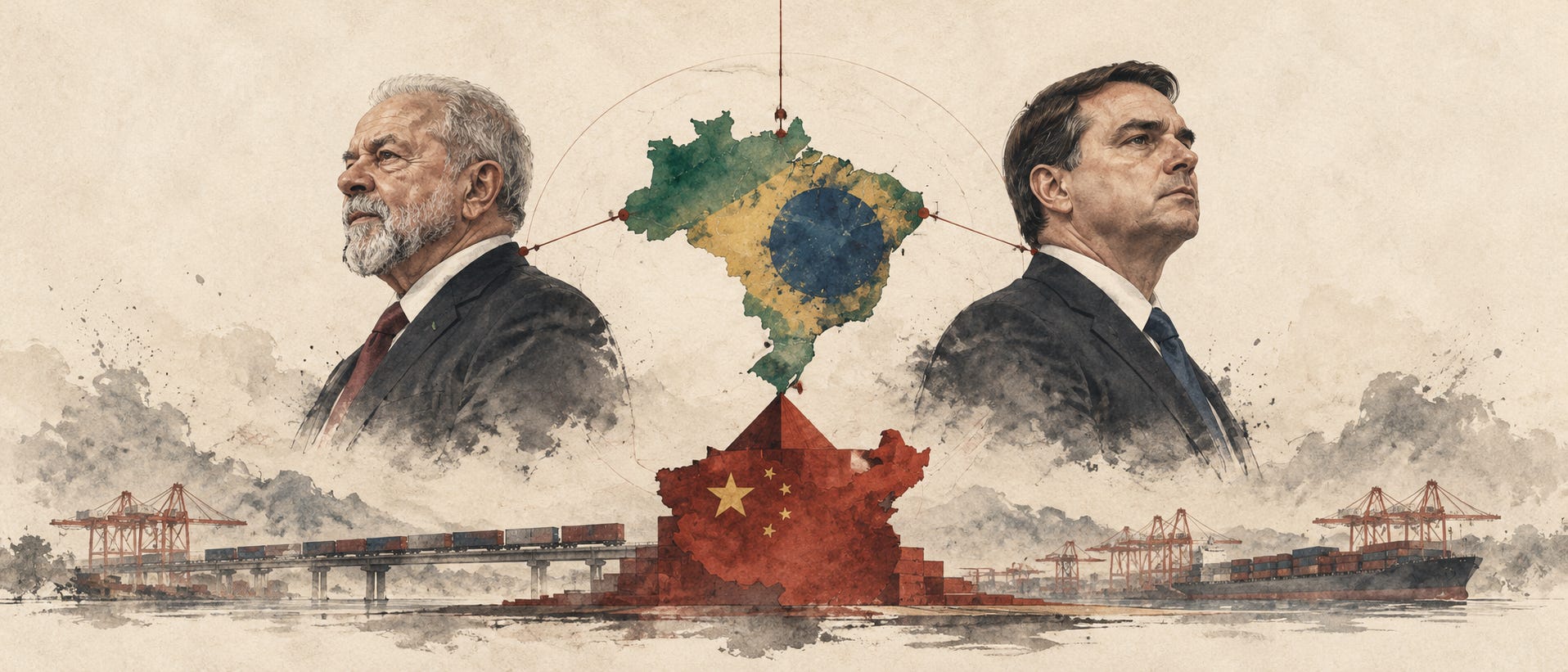
(Illustration by ChatGPT)
As Brazil’s 2026 general election draws closer, the BRICS mechanism has once again become a subject of campaign debate among some Brazilian politicians. A handful of right-wing politicians have floated the idea of “leaving BRICS” or reassessing the grouping, prompting questions about the future direction of Brazil’s foreign policy.
Viewed dispassionately from a Chinese perspective, one central point in this debate must be kept in mind: Brazil’s election is approaching, and under the system of “ballot-box politics” prevalent across the Americas, candidates are seeking to distinguish themselves and win votes. This has given rise both to extreme rhetoric from right-wing politicians about withdrawing from international groupings [退群] and severing economic and trade ties with China, and to criticism from the Brazilian left that the right is tying Brazil to the United States, making it dependent on Washington and selling out the national interest.
At a deeper level, however, no political camp with significant influence in Brazil can easily abandon BRICS, which is an important multilateral strategic platform for the country. Nor would they take the decision to weaken Brazil’s economic and trade ties with China lightly. If Flávio Bolsonaro (the younger Bolsonaro) and the right-wing forces he represents win the 2026 election, Brazil’s foreign policy is likely to resemble that of his father’s administration from 2019 to 2022. A Bolsonaro government might push BRICS to focus more on practical economic and trade cooperation, but would not withdraw from the grouping, thereby safeguarding Brazil’s strategic standing and broader economic and trade interests.
I. Leaving BRICS: Political Theatre on Brazil’s Right
Of the 13 candidates in Brazil’s 2026 election, only Romeu Zema, leader of the right-wing Novo party and governor of Minas Gerais, has called for Brazil to leave BRICS. He claims that BRICS has become an “anti-American and anti-Western club” and has pledged that, if elected, he would push for Brazil to withdraw from the grouping and pivot towards the OECD.
[Note: The author makes two small factual errors here: 1) There were 12 presidential candidates, rather than 13 after the Superior Electoral Court rejected Pablo Marçal’s candidacy on 11 September 2026; 2) Zema is no longer governor, having resigned on 22 March 2026 to pursue national political office.]
In practice, however, this proposal amounts to little more than an attention-grabbing political stunt. Opinion polls show that Zema’s nationwide support has long hovered at a meagre 1.3%, meaning that he cannot be considered representative of mainstream opinion.
In fact, Minas Gerais, the state Zema governs, is one of the Brazilian states with the closest economic ties to China and other BRICS countries. China has long been the state’s largest trading partner and export market, accounting for nearly 40% of its total exports. Annual iron ore exports to China alone are worth tens of billions of US dollars.
[Note: According to Minas Gerais government figures, the state’s iron ore exports to China were worth approximately US$9.7 billion in 2024 and US$9.8 billion in 2025.]
Since becoming governor in 2019, Zema has personally spearheaded efforts to attract Chinese investment. In July 2023, he attended a ceremony marking the first shipment of lithium ore from Minas Gerais to China, hailing it as “a historic moment for Minas Gerais and for all of Brazil”. That November, he led a 15-day delegation to China, promoting the state’s “Lithium Valley” project and engaging with Chinese companies including Ganfeng Lithium and Huawei. The initiative has since attracted several Chinese companies, including BYD, which have acquired exploration rights in Lithium Valley and become deeply involved in lithium extraction and processing. Another major infrastructure project in the state that Zema takes pride in is the Belo Horizonte metro project, which CRRC began constructing in 2024.
[Note: BYD acquired lithium exploration rights in Minas Gerais in 2023, but its subsidiary was still in the research phase as of February 2025, so “deeply involved” overstates the evidence. Likewise, CRRC was contracted to supply 24 trains for the Belo Horizonte metro in 2024, while construction of Line 2 is the responsibility of Metrô BH, a Grupo Comporte subsidiary.]
Zema is therefore fully aware of the importance of China and the BRICS countries to his state and to Brazil as a whole. When questioned by members of the public about whether leaving BRICS might provoke Chinese “retaliation”, he repeatedly assured voters that he would “absolutely not abandon China” and that “China is a major buyer that deserves the red-carpet treatment”. These contradictory statements reveal that his remarks are more akin to political theatre designed to serve a particular purpose.
II. How Brazil’s Right Views Relations with China
Although Minas Gerais carries considerable weight in Brazilian politics—there is even a saying that “whoever wins Minas wins the presidential election”—assessing the likely policy direction of a right-wing government requires closer attention to three groups:
First, Flávio Bolsonaro and members of his core campaign team;
Second, large agricultural producers in Brazil’s Centre-West and South, particularly in states such as Mato Grosso, Goiás and Paraná. They form a powerful agricultural caucus in Congress, whose leading figures include Tereza Cristina, a former minister of agriculture and livestock and leader of the congressional agricultural caucus;
Third, industrial and financial interests in Brazil’s Southeast, including factory owners, exporters and financial conglomerates in São Paulo state. A leading representative of this group is São Paulo governor Tarcísio de Freitas.
Judging by the public statements and interests of these three groups, their policy towards China has never been to leave BRICS or tie Brazil exclusively to the United States.
On 22 September 2026, when questioned about foreign policy, Flávio Bolsonaro explicitly stated: “My approach to foreign relations will always be grounded in economic pragmatism… Brazil does not need to take sides.” He did not endorse the fringe radicals’ calls for Brazil to leave BRICS.
[Note: In a June 2026 interview, Flávio Bolsonaro said he would reassess Brazil’s BRICS membership, but he has been relatively quiet on the topic—Brazilian analysts, including the author of this newsletter’s introduction, predict that under Flávio Bolsonaro, Brazil would stay in BRICS, but downgrade its engagement.]
As a leading figure among the power brokers of the Brazilian right wing, São Paulo governor Tarcísio de Freitas places considerable importance on attracting Chinese investment. His team has actively engaged with Chinese companies, including China Communications Construction Company (CCCC) and CRRC, to secure investment for the state’s intercity railway and power grid modernisation projects. When questioned by the United States and Europe, he emphasised that São Paulo welcomes efficient investment, and capital carries no geopolitical label.
Tereza Cristina, a leading figure in the right-wing agricultural caucus, has repeatedly emphasised the importance of safeguarding agricultural exports to China. China buys more than 70% of Brazil’s soybean exports. The agricultural sector knows full well that there is no other buyer of agricultural products quite like China. [Note: The original Chinese says “seller” [卖家], apparently in error.] US farmers compete directly with Brazilian soybean and beef producers on international markets, and Brazil cannot afford to surrender its largest and most reliable overseas market.
III. Comparing the US and Chinese Economic Interests in Brazil
In fact, given Brazil’s current economic and trade structure, both China and the United States are important partners that the country can ill afford to lose. There is even a degree of structural complementarity between Chinese and US trade and investment ties with Brazil.
In terms of bilateral trade, exports to China are of major economic importance to Brazil. According to data from Brazil’s Ministry of Development, Industry, Trade and Services, China has been Brazil’s largest trading partner for 17 consecutive years. In 2025, bilateral trade reached a record US$171 billion, with Brazilian exports to China totalling US$100 billion and Brazil recording a trade surplus of US$29 billion. The agricultural caucus and mining companies, both of which tend to support the right, are the biggest beneficiaries of this surplus. In the first eight months of 2026, Brazilian exports to China exceeded US$77 billion, up a further 15% year on year.
The United States remains Brazil’s second-largest trading partner, with bilateral trade reaching US$83 billion in 2025. Although Brazil exported US$37.7 billion to the United States and ran a trade deficit of more than US$7 billion, its exports consisted mainly of higher-value-added manufactured goods, including machinery, steel and aircraft components. Brazilian manufacturers have long supplied parts and components to North American supply chains, creating a degree of complementarity with Brazil’s agricultural and mineral exports to China.
In terms of investment types and sectoral distribution, Chinese and US investment in Brazil follows something of a pattern of “existing stocks of financial investment alongside new investment in the real economy” [金融投资存量+实体投资增量]. According to the Central Bank of Brazil’s report on foreign investment stocks, the United States has consistently held the largest stock of foreign direct investment (FDI) in Brazil, exceeding US$200 billion. US investment is concentrated in sectors such as finance, IT services and consumer goods, and is particularly closely connected to São Paulo’s financial sector. It even plays an important role in maintaining the stability of Brazil’s exchange rate and the liquidity of its capital markets.
Chinese investment in Brazil, meanwhile, has grown rapidly in recent years, cumulatively exceeding US$80 billion according to the Brazil–China Trade Association. Much of this investment has involved the acquisition of capital-intensive and physical assets, particularly in heavy industries such as electricity transmission and distribution, mining, new-energy vehicles and agricultural logistics. These investments have contributed to the development of Brazil’s real economy and its industrial revitalisation plans.
Trade and investment ties with China and the United States are therefore equally important to Brazil. Its economic interests make it difficult to favour one over the other, and withdrawing from BRICS would be tantamount to cutting off one of its own limbs.
IV. Campaign Rhetoric Through the Eyes of Ordinary Brazilians
When observing Brazil’s election from a Chinese perspective, it is easy to be drawn to the radical foreign-policy statements of certain politicians. In reality, Brazil is a major developing country, and under the electoral system prevalent across the Americas, foreign-policy pronouncements are often simply a means for politicians to appeal to particular voters and attract public attention. Voters are primarily concerned not with foreign policy, but with candidates’ positions on domestic issues affecting their livelihoods and local governance, such as public security, incomes and healthcare.
If you spend time living in Brazil, the financial pressures facing ordinary people quickly become apparent. At an exchange rate of 1 real to 1.3 yuan, prices for meat, vegetables, eggs and dairy products in supermarkets and restaurants in Brazil’s major cities are comparable to those in China’s first-tier cities, such as Beijing, Shanghai, Shenzhen and Guangzhou. Thirty eggs cost around 16 reais, equivalent to 7–8 yuan per jin (500 g). A McDonald’s burger meal costs around 50 reais (65 yuan), while regular petrol costs approximately 7 reais per litre (9.1 yuan).
Yet ordinary Brazilians have relatively low incomes. In 2026, Brazil’s national statutory minimum wage is approximately 1,621 reais per month. Even in São Paulo, the country’s most economically developed state, the minimum wage is just 1,804 reais (2,350 yuan). The average wage nationwide is equivalent to around 4,750 yuan, while the median is approximately 2,850 yuan.
[Note: São Paulo raised its state minimum wage slightly for specified occupational categories from R$1,804 to R$1,874.36 on 1 June 2026. The average earnings figure is broadly consistent with official data.]
Beyond everyday living expenses, borrowing costs for individuals in Brazil are extremely high. According to data published by the Central Bank of Brazil, annual interest rates on residential mortgages typically range from 10% to 12%, while car loan rates range from 18% to 28%. Unsecured personal loans carry annual interest rates as high as 50–60%, while annualised rates on revolving credit card balances frequently approach or exceed 100%. Ordinary households do not understand the connection between great-power competition, geopolitics and their daily lives. Instead, their votes are fundamentally determined by whether economic and trade policies can raise incomes, improve employment prospects, reduce borrowing costs and safeguard livelihoods.
[Note: Brazilian Central Bank data for August 2026 put average annual interest rates at 110.2% for non-payroll-deducted personal loans and 449.4% for revolving credit-card balances, substantially above the figures cited here.]
To return to the question posed in the title: will Brazil leave BRICS? Setting aside the many attention-grabbing political slogans, Lula’s position goes without saying. If Flávio Bolsonaro wins, the right-wing forces he represents are more likely to call for the so-called “depoliticisation” and “de-ideologisation” of BRICS [去政治化、去意识形态化], but would not withdraw from the grouping. Nor would they undermine pragmatic economic and trade cooperation with China without good reason.
To understand why, it is worth looking back at the China policy of his father, Jair Bolsonaro, during his presidency. Although the elder Bolsonaro made a series of ideologically driven statements hostile to China during his election campaign and early in his presidency, he quickly adopted a more favourable tone towards Beijing. He attended BRICS summits, visited China and introduced a number of measures to promote bilateral economic, trade, cultural and people-to-people exchanges. China–Brazil relations thus made substantive progress during his presidency.
READ MORE
Chinese Perspectives on the EU–China Trade Conflict

Trade tensions between the EU and China escalated in March, when the Commission proposed its Industrial Accelerator Act, and have been simmering since then, but October is decisive. We’ve been working on a paper in cooperation with the Friedrich-Ebert-Stiftung, analysing Chinese perspectives on EU-China trade tensions. Given that Šefčovič is in Beijing on Thursday, we wanted to provide subscribers with a preview.
All-Weather Partner, Fair-Weather Response: Chinese Commentary on US Venezuela Operation

Despite Venezuela's status as an “all-weather strategic partner”, Chinese expert commentary on the US operation is surprisingly muted, notable for its analytical depth and limited nationalist bombast. The post-war international order is treated as functionally dead by the majority of authors, but rather than triumphalism, the response is sober alarm.