



This article was first made available to paid subscribers last week.
To enjoy early access to select content and full access to Sinification’s archive, consider becoming a paid subscriber. As a non-profit, Sinification depends on your support.
Today’s article is introduced by Paul Triolo, Technology Policy Lead at DGA-Albright Stonebridge Group, where he advises companies on AI strategy. He is also a Non-Resident Honorary Senior Fellow on Technology at the Asia Society Policy Institute’s Centre for China Analysis. Over the past year Paul has spoken directly with many of China’s leading AI firms, attended the World AI Conference in Shanghai in July 2025, and participated in an investor tour in October that included a wide range of major AI companies and industry players. He writes frequently on China and AI in his excellent Substack, AI Stack Decrypted. We are very grateful to him for bringing this first-hand expertise to this edition. — James and Thomas
Recently there has been much debate within Chinese industry and academia over how the country stands with respect to the United States in developing and deploying AI. A recent commentary by Hou Hong, titled Personal insights on the US-China AI gap, falls on the side of a group, including within large Chinese AI companies, who hold that major structural issues will keep Chinese companies behind their Western, mostly US counterparts. They hold that especially as competition shifts from “who has the best model” to “who builds the strongest ecosystem for deployment and compounding usage”, Chinese companies will be at a disadvantage.
The Pessimists: China’s Disadvantage in Compute and Commercialisation
For Hou, China is not portrayed as losing primarily because it cannot produce strong models. Rather, the author’s main thesis is that factor conditions, demand conditions, and competitive structure are interacting in a mutually reinforcing negative cycle—keeping China on a lower trajectory in agent deployment and especially in building an Internet-of-Agents-style ecosystem, while the US compounds advantages through faster deployment, stronger rivalry dynamics, more open ecosystem surfaces, and heavier infrastructure/ecosystem investment.
In a recent roundtable, technologists from Alibaba, Tencent and Zhipu also converged on a pragmatic view of what still holds China back from “catching up” with the US: the constraint is no longer just model ideas, but the surrounding system—compute supply chains and commercialisation.
One argued that once a technological approach is proven, China can reproduce it quickly and even optimise locally, but that there are hard bottlenecks both upstream and downstream. Upstream, China has limitations in advanced lithography/capacity and in the broader software ecosystem if compute becomes the binding constraint. Downstream, the US has a much more mature “to business” market, where firms will pay a clear premium for the best model because productivity gains map directly to economic value. By contrast, “business to business in China is hard”, and many productivity/coding-agent plays end up forced into overseas markets, while consumer AI has a lower “felt need” for ever-stronger intelligence—especially in China, where it’s often used as a search upgrade rather than a deep productivity tool.
The Optimists: The Role of Talent and a Complete Industrial System
The other camp, which includes academics at Tsinghua University, points to the advantages China has in some parts of the AI stack, such as a talent advantage in terms of both the quantity and quality of its higher education students, the data advantage with a significant lead in the number of AI applications deployed, and the advantage of a well-developed industrial and power infrastructure and a complete industrial chain. Another part of this argument is that as the pace of development of things such as cutting-edge semiconductors slow, Chinese firms will be able to catch up more quickly. The adherents of this argument typically hold that the current US model of enterprise-led, scale-up computing power is encountering difficulties as returns on increasing computing power—so-called scaling—provide diminishing gains.
A Third Perspective: Managing Agentic Development and the Closing Compute Gap
My view is that while there is some truth in the arguments on both sides, there are significant gaps in the analysis that need to be touched on. First, Hou’s argument on agentic AI is not likely to hold up. The emergence in December of the first agentic AI smartphone from ByteDance and ZTE highlights the dangers of assuming that China is behind on things like agentic AI development and deployment. In fact, Chinese consumers and companies appear to be much more likely to embrace an agentic AI future than US companies and consumers. The ByteDance/ZTE concept is very compelling, but will require new regulatory structures that protect data and privacy, and anti-trust frameworks that will allow agents from various platforms to interact with applications that are controlled by big tech firms such as Tencent and Alibaba, who will want to keep users within their own gardens and agentic platforms. But make no mistake, China will be the first to deploy smartphone-based agentic platforms at scale.
Second, the more negative views on China’s AI development tend to harp on access to advanced compute and lack of AI readiness in China. On the first of these, my sense is that there will be major breakthroughs within the domestic semiconductor industry over the next two to three years that make this issue less salient, and the ability of Huawei and other AI hardware startups to develop a viable alternative hardware and software ecosystem that can match Nvidia and CUDA will mean that the compute gap is likely to become much narrower and much less of a factor over time, particularly as we move into the age of inference. In the meantime, if both sides are able to approve and commence shipments of H200-class AI hardware to Chinese firms, in the short to medium term the compute capacity issue will be much more tractable.
I do agree that the lack of AI readiness at the enterprise level is significant, but this issue is not restricted to China. A recent survey on AI uptake in the US showed that when AI deployments failed, it was more due to the corporate culture than the capabilities of the models and applications. While the use of AI coding assistants has soared in the US, uptake in other business operations has been much slower. In China, after the DeepSeek moment in early 2025, the word went down from central authorities to get serious about AI deployments, but as Hou and others point out, Chinese enterprises have still not gone through an intense period of digitalisation.
Yet this disadvantage could ultimately turn into an advantage, as the combination of signals from central and local governments and increasingly competitive market conditions begins to push faster uptake of AI applications at the enterprise level. The challenge in this debate is that capabilities are growing rapidly and inference costs are being driven down, which will further accelerate adoption, but questions remain around revenue generation for model/platform developers. China’s model of innovation and diffusion, set against US strengths in scaling, will produce many winners. This is not a zero-sum race to the finish, but a marathon in which both countries will achieve significant economic and technological gains.
— Paul Triolo
Key Points
Despite advantages in hardware, power, and telecoms, China’s relative weaknesses in compute and commercialisation are causing its AI industry to trail the US in AI adoption, user growth and token consumption.
AI competition spans three trajectories: large models, agentic AI and the Internet of Agents, with progress in higher agentic levels driving improvements in large models.
The Internet of Agents trajectory is particularly crucial for the overall AI economy, enabling large-scale deployment, lowering transaction costs and expanding innovation beyond the reach of standalone models.
China remains competitive along the large-model trajectory through DeepSeek’s open-source efforts, but it is at a disadvantage along the higher agentic AI trajectories, where it has far fewer unicorn start-ups than the US.
Largely, this is because China’s manufacturing-dominated economy, lower profitability and limited consumer power constrain demand and innovation for service-oriented AI, particularly in the Internet of Agents.
We are seeking funding to establish a yearly Track 1.5 dialogue on Chinese foreign policy, convening PRC and non-PRC practitioners in partnership with one of the UK’s leading think tanks. If you have relevant resources or contacts, and would like to learn more, please get in touch
Prioritising AGI research over service innovation, DeepSeek cannot disrupt China’s tech ecosystem, while its open-source software benefits established platform companies to the detriment of potential unicorns.
Furthermore, transitioning to an open Internet of Agents is stalled by China’s closed, app-based ecosystem (shaped by state-aligned platforms like WeChat), contrasting with the US’s open internet architecture.
Conversely, the US is advancing rapidly in the Internet of Agents, merging large-scale infrastructure investment with a paradigm shift from “humans using AI” to “AI using AI”.
While platform monopolies stifle “creative destruction” in China, the US industry benefits from intense competition between disruptive entrants—such as OpenAI—and tech giants.
To escape this low growth trajectory, China must curb platform monopolies, expand risk capital and develop a domestic Internet of Agents ecosystem leveraging its strengths in telecoms infrastructure and manufacturing-embedded edge devices.
The Scholar

Name: Hou Hong (侯宏)
Born: Information not available publicly (age: likely early 40s)
Position: Assistant Professor in Management, National School of Development, Peking University; Academic Director of Chengze Entrepreneurs Training Program
Previously: Held various strategic roles in China's high-tech industry (2007–2017), including Strategy Consultant, Strategy Manager, Strategy Director, and CEO’s Strategy Assistant
Other: Winner of the Best Paper Award at the World Open Innovation Conference 2020; serves as an advisor to several major Chinese companies, including China Mobile
Research focus: Corporate strategy; business ecosystem evolution; business model innovation; digital transformation
Education: PhD (Management/Strategy), University of Cambridge (approx. 2017–2021); undergraduate and master's degrees obtained in China prior to 2007

HOU HONG: SOME PERSONAL INSIGHTS ON THE US-CHINA AI GAP
Hou Hong (侯宏)
Published on his WeChat Public Account (侯宏文存) on 6 November 2025
Thank you to Hou Hong for allowing us to share this article
Translated by Ameerah Arjanee
Illustrated by OpenAI’s DALL·E 3
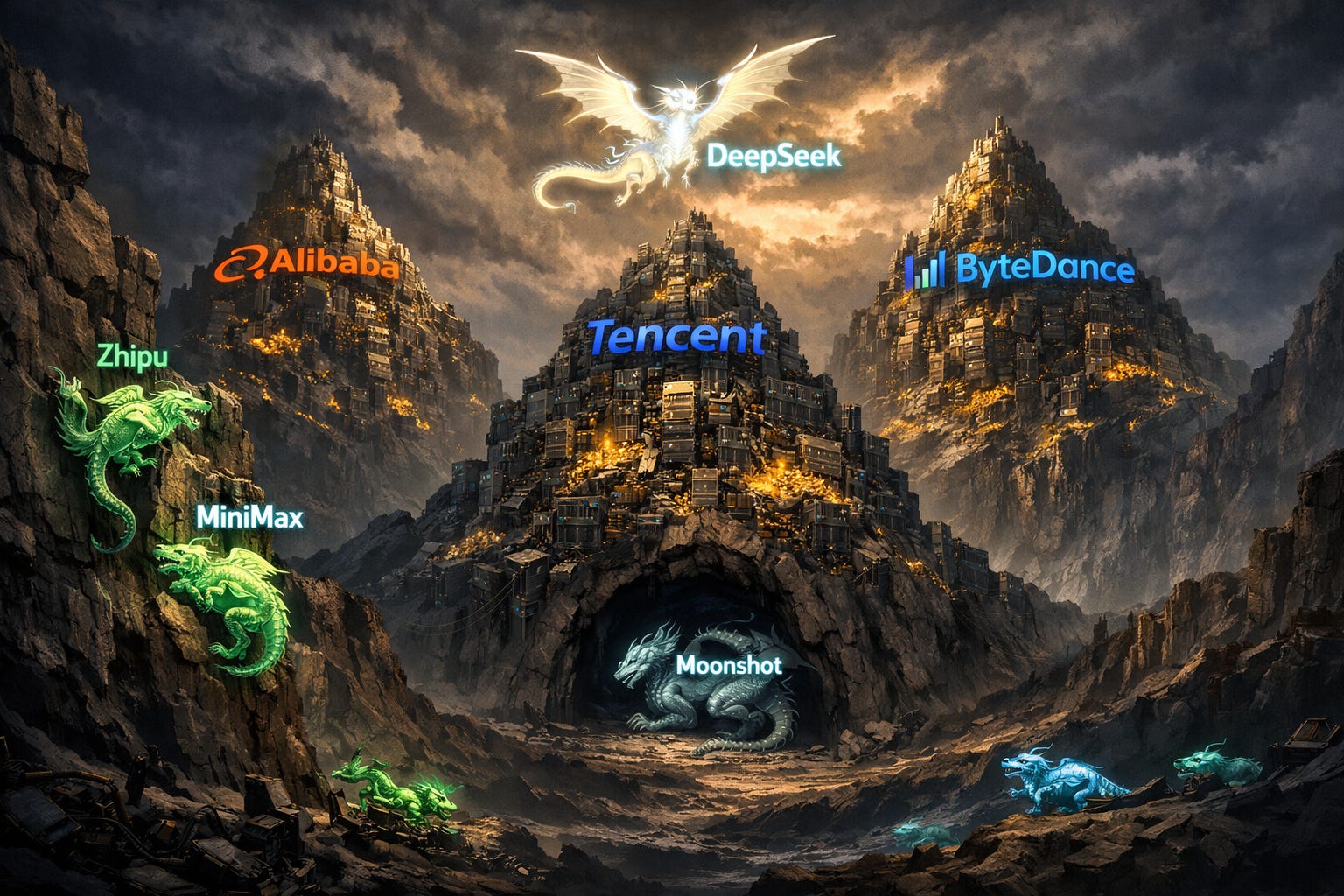
I. Introduction: The Dangers of a Vicious Low-Growth Cycle
The gap between the AI industries of China and the US continues to widen, even as China has made progress in other technologies, such as semiconductors. In the B2B sector, only 8% of Chinese businesses have adopted generative AI, which is far below the global average of 21%. In the B2C sector, monthly active users of Chinese AI applications grew by just 7% year-on-year in the third quarter of 2025, compared with a global growth rate of 19% over the same period. Reports also show that, by the end of June 2025, China was processing only 30 trillion tokens per day. Meanwhile, in the US, Google alone processes up to 980 trillion tokens per month. These disparities warrant close attention, and the forces driving them warrant close scrutiny.
This article is based on the view that competition between the AI industries of China and the US will move beyond input-driven technological catch-up [技术追赶] and evolve into systemic competition across the entire industrial ecosystem. Porter’s Diamond Model of National Competitiveness [Note: a model to explain what makes a country internationally competitive in a specific industry—see below] can be applied to examine this shift and compare the two countries’ AI industries. The analysis shows that, although China has multiple advantages in its supporting industries, the interaction of the factor side, the demand side and the competitive landscape has created a vicious cycle [恶性循环] that traps its AI industry on a lower growth trajectory [较低发展轨道上].
II. The Internet of Agents: AI’s new “commanding heights”
Competition in the AI industry is unfolding along three trajectories: large models [大模型], agentic AI [智能体] and the Internet of Agents (IoA) [智能体互联网]. Large models deliver intelligence at scale and compete to be the first to achieve artificial general intelligence (AGI) at the technological frontier. Agentic AI focuses on the targeted application of intelligence. It rapidly integrates products across a range of use cases. The Internet of Agents, meanwhile, enables the large-scale application of intelligence by establishing network effects and innovation ecosystems on a broader level.
It is important to highlight that these three trajectories are not merely sequential; they also influence each other in a top-down fashion. Agentic AI drives the improvement of large models, while the Internet of Agents promotes the widespread adoption of agentic AI. As a result, the Internet of Agents represents the high ground [制高点, literally “commanding heights”] in the competition between the Chinese and American AI industries.
In early 2025, DeepSeek burst onto the scene [横空出世] in the large-model space. It became the key player in China’s open-source efforts to compete against closed-source models in the US. To date, it shows no signs of losing momentum. However, China faces a less favourable competitive landscape for agentic AI. The recent surge in American agentic AI unicorn start-ups [智能体独角兽] points to a flourishing application ecosystem underpinned by strong infrastructure, whereas China has only a handful of such start-ups.
Moreover, the US has recently gained momentum along the Internet of Agents trajectory. OpenAI has made substantial investments in AI infrastructure through strategic partnerships with Nvidia, AMD, Oracle and other companies. At the same time, the launch of OpenAI’s product suite and public statements by Meta’s CEO regarding superintelligence signal a major shift in their AI business model. It is transitioning from tool-based agentic AI to the Internet of Agents. Early developments are laying the groundwork for this transition, and the move from “humans using AI” [人用AI] to “AI using AI” [AI用AI] is expected to drive exponential growth in token consumption. OpenAI has thus evolved from a leader in large-model technology into a leader of the Internet of Agents ecosystem, which pushes the American AI industry onto a higher growth path.
The Internet of Agents essentially represents a new form of economic organisation suited to AI as a new factor of production. Large models and agentic AI possess, respectively, the economic characteristics of zero marginal cost of cognition and zero marginal cost of generation. The Internet of Agents, meanwhile, is characterised by zero marginal cost of connectivity. Its widespread deployment would reduce transaction costs across the economy, as well as reinforce and scale up existing platform-based business models. In doing so, it could unlock additional potential for innovation and consumption, which would generate broad societal benefits. If China fails to act decisively along the Internet of Agents trajectory, it will struggle to fully exploit the potential of AI as a driver of economic growth [驱动经济增长的潜力].
III. Analytical Framework: Porter’s Diamond Model of National Competitiveness
In the 1980s, several key US industries lost ground to competitors in Japan and the Four Asian Tigers [Note: Hong Kong, Singapore, South Korea and Taiwan]. The American political and business establishment urgently needed new theoretical guidance. President Reagan invited Michael Porter to join the President’s Commission on Industrial Competitiveness, based on Porter’s expertise in competitive strategy. The Diamond Model emerged from his research on the commission. This model attributes industrial competitiveness to the broader national environment in which businesses operate, which is why it is called the National Competitiveness Model. It is particularly well suited to this study, as competition between the Chinese and American AI industries is driven primarily by innovation rather than by [lower] factor costs.
The Diamond Model consists of four determinants and two external variables. Together, they determine a country’s competitiveness and capacity for innovation in a specific industry. The first determinant is factor conditions [要素条件], which refer to the state of a country’s production inputs, such as the technical workforce or infrastructure required for competition in a particular industry. The second determinant is demand conditions [需求条件], which refer to the nature of domestic demand for that industry’s products or services. The third determinant is related and supporting industries [相关及支持产业], which considers whether internationally competitive supplier industries and other related sectors exist domestically. The fourth determinant is firm strategy, structure and rivalry [企业战略、结构与竞争]. It considers how companies are established, organised and managed, as well as the nature of domestic competition.
In addition, the government [政府] influences the interaction of these four determinants through its policies, investment and regulation. Chance [运气] represents unpredictable external events, such as technological breakthroughs or geopolitical shifts, which can alter the trajectory of an industry’s evolution. In the analysis that follows, I will apply this framework to examine the AI industries of China and the United States.
IV. The Respective Demand Conditions of The US and China Economies
AI development in China has lagged on both the business and consumption sides. Strictly speaking, this is not simply a gap between the AI industries of China and the US. It is an inevitable consequence of structural differences between the two countries’ economic systems.
At a macroeconomic level, the Chinese economy is dominated by manufacturing, while the US economy is primarily service-oriented. Current AI technologies, largely based on transformer architectures, are inherently better suited to service-sector applications than to production lines. Manufacturing requires high precision, stability and absolute certainty, whereas large models operate as probabilistic systems, which makes their integration into industrial environments challenging.
In the Chinese industrial sector, progress in mechanical engineering continues to drive embodied intelligence, with AI only playing a supporting role [锦上添花]. Notably, AI is absent from the section of China’s 15th Five-Year Plan [十五五规划建议] that addresses “building a modernised industrial system and reinforcing the foundations of the real economy” [“建设现代化产业体系,巩固壮大实体经济根基”]. By contrast, the US service sector is well positioned to benefit from the current wave of AI innovation. Concepts driven by venture capital, such as Service-as-Software, seek to replace traditional service models with AI-powered alternatives. This divergence helps explain why unicorn start-ups in this area are overwhelmingly concentrated in the US, while China has very few.
At a microeconomic level, Chinese businesses lag behind their American counterparts in both their willingness and their capacity to invest in AI. The difference in willingness can be partly attributed to a disparity in digital infrastructure [数字化基础]. American businesses benefit from strong digital foundations and higher levels of data readiness [数据准备], which bring them closer to realising returns from AI deployment and, in turn, increase their incentive to invest. By contrast, Chinese businesses face weaker digital foundations and lower data readiness. As a result, they require more time for preparatory work and remain further from value capture, which reduces their incentive to invest.
The gap in financial capacity reflects a pronounced divergence in profitability. Evidence from listed companies shows that American businesses significantly outperform Chinese ones in terms of margins. In addition, the average lifespan of small and medium-sized businesses in China is only three years, compared with eight years in the US. This implies that the typical Chinese business is nearly always struggling to survive, which leaves it little room to invest in digitalisation or AI.
China’s consumer purchasing power continues to be constrained by relatively low per-capita disposable income. This is a structural reality that is hard to dispute. However, a more encouraging trend is emerging: AI applications are delivering tangible productivity gains, which have significantly increased Chinese consumers’ willingness to pay for them. In practice, the distinction between consumer-oriented and business-oriented productivity tools is becoming increasingly blurred.
V. Related and Supporting Industries: A Broader AI-Industrial Ecosystem
The AI industry has three layers: hardware (GPU chips and computing centres), software (large models and agent protocols) and services (comprehensive agent offerings for consumers and businesses). China has achieved notable progress in hardware, particularly chips, and maintains significant advantages in upstream power infrastructure.
This analysis focuses on four key industries in the service layer from a comparative US–China perspective: the cloud (internet services), management (telecommunications), the edge (edge devices) and applications (software services). Currently, AI models are delivered via the internet and are complemented by user-side customisation. However, as AI integration deepens and expands, smart telecom networks and edge devices could provide critical channels for the delivery of AI services [Note: Hou does not elaborate here on software services, having discussed this aspect earlier in the piece]:
Internet Services: Companies such as Alibaba, Tencent, ByteDance and Baidu have made invaluable contributions in AI chips, large models and computing infrastructure. However, the internet industry [for our purposes] does not refer to internet firms that have expanded into core [infrastructure and technology] segments of the AI industry, but to the internet as a platform for AI service delivery—namely, over-the-top (OTT) media services. To a certain extent then, the “dual towers” [双塔] of the Chinese and American AI industries reflect continuity in the global configuration of the internet industry. However, this is not a simple case of history repeating itself. China’s internet, dominated by closed apps [封闭App], is facing significant internal inertia in the transition to the Internet of Agents. By contrast, the American internet, characterised by an open web [开放web], maintains a substantial share of independent platforms that respond to the “catfish effect” [鲇鱼效应] triggered by OpenAI and support the growth of the Internet of Agents. For example, OpenAI’s agentic commerce initiatives receive strong backing from platforms such as Shopify.
Telecommunications: Telecommunications form the backbone of network infrastructure and provide the ubiquitous, heterogeneous and secure connectivity essential for agentic services. On 28 October, Nvidia announced a US$1 billion investment in telecom giant Nokia to install AI-native wireless access networks (AI-RAN) in its base stations, which turns each station into an intelligent hub. China is pursuing similar initiatives. Recently, Huawei collaborated with the three major carriers [Note: China Telecom, China Mobile and China Unicom], UnionPay and the ANP open-source community to publish a white paper titled Intelligent Internet Architecture and Key Technologies [《智能体互联网架构与关键技术》], which sets standards for the Internet of Agents in the 6G era. Compared with the US, China’s telecom industry benefits from operators that are trusted forces in advancing national strategy. The three major carriers can construct foundational networks for the Internet of Agents, and use their reach and user base to provide core services such as personal data hosting and agent identity authentication, setting a reliable foundation for the ecosystem’s flourishing.
Edge Devices: Edge devices [Note: Devices where the AI computing is done in proximity to the data source, rather than on the cloud] have a pivotal role in the AI industry’s transition from agentic AI to a fully developed Internet of Agents. Its role extends beyond cost and performance optimisation in moving computing power from the cloud to local devices. More importantly, it also supports a key component of the Internet of Agents: demand-side agents (or personal agents) that act on behalf of internet users. Hardware manufacturers have clear advantages in promoting these agents, including portability, contextual data collection, the seamless integration of software and hardware, and strong local data security. Their profitability model further reassures users about data use. China’s hardware ecosystem, which encompasses smartphones and PCs, has substantial advantages over the US. Without a domestic equivalent to OpenAI, this sector could become the cornerstone of a distinctive path for China’s Internet of Agents.
VI. Firm Strategy, Structure and Rivalry
In the Diamond Model, firms serve as the primary drivers of innovation. Intense domestic competition encourages industrial upgrades and international competitiveness. An industry may have superior factor conditions and strong supporting sectors, yet it cannot achieve global prominence without healthy domestic competition. From this perspective, when examining the AI industries of China and the United States, it is not difficult to see that China’s AI industry faces constraints along the Internet of Agents trajectory because its monopolistic platform companies limit the country’s ability to compete with the US.
The competitive landscapes in China and the US differ markedly. The American AI sector thrives on dynamic interactions between established companies and new start-ups. OpenAI is a disruptive force that supports infrastructure investment and encourages innovation in B2C business models. It challenges well-established platform giants [老牌巨头] such as Google, Amazon and Meta. Among the mainstream large models, only Google’s Gemini was created by a platform giant. In contrast, China’s AI industry mirrors the country’s existing platform internet structure. Apart from DeepSeek, all the mainstream players in its AI industry, that is, ByteDance, Alibaba and Tencent, are platform giants [Note: Doubao, Qwen and Hunyuan/Yuanbao are their respective flagship AI models], while five of the six AI “young dragon” start-ups [Note: AI创业六小龙, i.e. DeepSeek, Zhipu AI, MiniMax, Moonshot AI, Zero One AI and Baichuan Technology] have lost their momentum [风头不再]. As for DeepSeek, its focus on AGI means that it has scant interest in business model innovation, and has not been able to play a disruptive role [Note: In terms of monthly active users, DeepSeek ranked fourth place in November 2025 among Chinese large language models].
These structural differences shape the nature and intensity of competition. The Internet of Agents brings “creative destruction” [创造性破坏] to the American AI industry. Conversely, China’s AI industry operates under platform dominance. This does not completely preclude innovation. For example, Meituan has launched an AI-enabled food delivery app, Xiaomei, and [ByteDance-owned] Doubao has tested AI-driven commerce. However, such efforts quietly take place within platform ecosystems, both lacking internal prioritisation and unable to trigger competitive pressure outside the company. Without disruptive external challengers, Chinese platforms compete mainly on traditional dimensions such as subsidies and user acquisition, which provide little incentive for industry-wide innovation.
The question of why China is yet to produce an equivalent to OpenAI cannot be answered without touching upon the distinction between open-source [开源] and closed-source models [闭源]. Without DeepSeek’s early advocacy for the development of open-source models, AI adoption in China would be even slower today. Yet DeepSeek’s substantial contributions mask that simple fact that it has cut off the possibility of countless other AI “young dragons” [小龙] from evolving into a Chinese equivalent of OpenAI, as investors will not assign high valuations to companies that perform below freely available models. In this sense, the impact of DeepSeek has been a double-edged sword for China’s competitive landscape, with [existing] platform companies becoming the main beneficiaries [of its open-source software].
VII. A Comprehensive Analysis of the Four Determinants
The analysis of the four determinants in the previous section leads to a pessimistic assessment. The factor conditions, demand conditions and competitive conditions of China’s AI industry have formed a mutually reinforcing negative cycle that is locking the industry into a relatively low growth trajectory. This explains the substantial gap between China and the US mentioned at the outset of this article. It also suggests that the gap is likely to continue widening.
On the agentic trajectory, China’s structural limitations on the demand side are unlikely to change in the short term. Just as the US has had to grudgingly accept that its industrial robot deployment lags behind China’s, China may need to accept without misgivings [心安理得] that its deployment of service robots (i.e. agents) lags behind the US. Through learning-by-doing [干中学], China is likely to surpass the US in robotics technology through large-scale deployment, while the US may use its early lead in agent deployment to further extend its advantage over China in model capabilities.
The Internet of Agents could have represented a major strategic opportunity for China. Just as China outpaced the US in mobile internet, our globally competitive telecoms and edge device industries were [projected] to provide a sturdy support [for its development]. However, stymied by scarce venture capital and a market dominated by massive platform companies, the rapid innovation cycle of the mobile internet era is unlikely to return. The largest companies, though flush with innovative resources, do not prioritise breakthrough innovation. Meanwhile, promising start-ups lack the necessary funds to scale.
The Internet of Agents could, in principle, harness network effects to offset the weak incentives that often limit the deployment of individual agents. As consumers adopt agents on the demand side, businesses on the supply side gain stronger incentives to participate. These dynamics generate additional momentum, which can be further reinforced by competitive pressures. In fact, the Internet of Agents does offer a low-cost pathway [轻量级路径] for businesses to adopt AI at scale. Under the current market structure, however, this outcome appears unlikely, as dominant platforms maintain a monopoly and restrict the independence of individual businesses.
VIII. External Variables: Government and Chance
It is difficult to argue that the situation described above bears no relation to government action.
The government’s relationship with platform companies is nuanced and has evolved into a form of mutual dependence. It is well known that Chinese platform companies operate cautiously and adhere closely to regulatory requirements. What receives less attention is the degree to which government departments rely on these companies as delivery partners or outsourced providers for regulation and public services. In practice, public authorities often depend on platform companies to carry out their administrative and regulatory functions.
As the Internet of Agents and the agent-based economy emerge, the government may not be fully prepared for this transition. It may continue to rely on existing platform companies out of a sense of inertia [惯性]. A market dominated by these companies may not only be tolerated but actively preferred. This preference manifests both subjectively and objectively: platform companies support the government in regulatory enforcement, while the government, in turn, favours them in the issuance of statutory licences. Regulatory requirements that platform companies can easily meet often represent major barriers to entry, or “mountains” [大山], for start-ups. These barriers act as gatekeepers for AI innovation. As such, entrepreneurs are left with a stark choice: bow down to platform dominance [成为平台顺民] or flee overseas [远遁海外] [for opportunities].
If circumstances were to prove more favourable, the issues outlined in this article would have no bearing. [It’s possible that] competition between China and the United States could be resolved relatively quickly. If Taiwan’s status were resolved, China could exert decisive leverage over the US through TSMC. This possibility may also help to explain the United States’ substantial investment in AI infrastructure. From a broader strategic perspective, the issues discussed here might be seen as minor “ailments” [癣疥之疾] and scarcely warrant attention.
Finally, three policy recommendations merit consideration. First, efforts should be made to encourage DeepSeek to take on a role similar to that of OpenAI (this could be challenging). Second, capital markets should be encouraged to adopt a greater risk appetite, and the regulatory burden on innovation should be reduced (in effect two separate measures). Third, support should be provided for the development of an Internet of Agents ecosystem focused on edge computing and network-level capabilities. This would be promoting an approach to the Internet of Agents with Chinese characteristics [中国特色的智能体互联网].
READ MORE
China’s AI Path and the Needham Question: From 1 to 10, Not 0 to 1

As both nations invest ever more significant resources into artificial intelligence, the divergent trajectories between China and the US have become a key issue—with many pointing to a philosophical—even quasi-religious—divide between the rapid adoption of practical AI applications in the former and the more abstract pursuit of AGI in the latter. Huang Ping, an up-and-coming associate professor at the Chinese University of Hong Kong, agrees with these analyses. He notes that despite state-funded investment drives in basic research, China’s innovation system remains relatively weak at original breakthroughs (moving from “0 to 1”) but excels at scaling and commercialising technologies (moving from “1 to 10”).
China's Strategy of Industrial Abundance: an Imperial Banquet, not Molecular Gastronomy

Echoing the previously covered analysis by public policy specialist Huang Ping (黄平) that China’s advantage in AI derives from its vast “systemic capacity” and pool of industrial demand, management theorist Sun Xi (孙喜) presents a lucid exposition here of how such an industrial system operates—theoretically and in practice.