



Orna Naftali is Abraham Miller Chair in Chinese Studies and Associate Professor in the Department of Asian Studies at the Hebrew University of Jerusalem. An anthropologist specializing in childhood, youth, education, and the family, as well as citizenship, legal consciousness, and national identity, she has authored three books: Children, Rights, and Modernity in China (2014), Children in China (2016), and Mobilising China's One-Child Generation: Education, Nationalism and Youth Militarisation in the PRC (2024). Her current research explores gender education, youth bullying, and juvenile delinquency in contemporary China. — Many thanks to her for contributing to this newsletter.
Debates over education and parenting often mirror deeper public anxieties about society’s current path and future direction. In the following essay on Chinese childhood, sociologist Zhou Juan delivers a sobering assessment, arguing that the crisis facing today’s children points to a fundamental fracture within Chinese society.
Zhou’s analysis reflects a wider academic and media discourse regarding youth issues—particularly isolation driven by digital addiction, soaring psychological distress and rising suicidal ideation. As she and other observers contend, this youth malaise is fuelled by ruthless academic competition and the strict regimentation of children’s time. Zhou argues that parents’ relentless drive for achievement strips children of emotional resilience, free play and a space of their own. She further notes that this pressurised landscape reveals distinct gender dynamics: girls frequently internalise strict discipline to succeed academically, whereas struggling boys are more likely to disengage or rebel. Meanwhile, China’s rural “left-behind children”, raised away from their migrant parents, face profound emotional detachment from caregivers who in Zhou’s words, “have no concept of what a childhood ought to look like.” Contrasting these contemporary conditions with her own 1980s-and-90s rural childhood, Zhou maintains that youth apathy today stems fundamentally from a growing disconnect with the natural environment and from “incomplete socialisation”. She warns that such deficient early experiences give rise to acute psychological distress that persists well into higher education and young adulthood.
Zhou’s insightful analysis helps explain the recent rise of the ‘lying flat’ (躺平) movement in China. Overwhelmed by 内卷 (“involutionary”) competition in school and the workplace, a growing number of Gen-Z and millennial youth are consciously lowering their expectations, choosing to forego home ownership, marriage and hyper-competitive career tracks. Beijing views this passive resistance as a direct threat to socio-economic stability and aggressively censors online debate around it. Indeed, state anxieties run deep: In April 2026, a Ministry of State Security official claimed that hostile foreign forces systematically orchestrate the “lying flat narrative” to “brainwash” young people in China. Yet while officials condemn the trend, the government has also launched various policy interventions to address the heavy academic burden Zhou describes.
Attempts to alleviate stress on primary and secondary school students in China date back at least to the early 2000s, most recently culminating in the 2021 “Double Reduction” (双减) policy, which curtailed homework loads and banned for-profit academic tutoring. Yet studies indicate that the policy has produced mixed results at best, failing to meaningfully ease the pressure on children. Ultimately, Zhou’s essay illuminates why such measures remain ineffective, while pointing to the root causes of the crisis in contemporary Chinese childhood.
— Orna Naftali
Key Points
Reports of youth crime, suicide and psychological distress have prompted schools to expand counselling and therapy, with “fragility” [脆弱] becoming a widely observed characteristic of contemporary youth.
Such fragility stems not from insufficient hardship, but from childhoods lacking the emotional and social resources needed to absorb setbacks and recover from them effectively.
A grade-centred education system divides “good kids” [好孩子] from “bad kids” [坏孩子], giving each group radically different experiences of adult attention and discipline throughout childhood.
“Bad kids” are often given up on as unmanageable, retreating into a silent state dominated by online games and phones as meaningful communication with parents and teachers breaks down.
By contrast, the “good kids” live under tightly controlled schedules, becoming exemplars of good behaviour only by internalising discipline and suppressing their exhaustion, resistance and desire for freedom.

Orna Naftali’s Mobilising China’s One-Child Generation: Education, Nationalism and Youth Militarisation in the PRC (2024) draws on qualitative fieldwork as well as state, media, and school materials to examine the intersection of education, militarisation, class and gender identities among Chinese youth.
Despite receiving opposite treatment, both groups develop similarly narrow inner lives, easily dominated by grades, adult approval, online distractions or other single sources of emotional meaning.
Withdrawal and over-compliance are the contrasting responses to this same narrowness. The resulting mutual incomprehension between the two groups may eventually harden into divisions between the social classes of the future.
Both groups face internal conflicts: “bad kids” seek recognition despite withdrawing, while “good kids” desire freedom despite practising self-restraint. Silence and total submission mark the destructive extremes.
This cohort’s apparent “selfishness” reflects not an “excess of self” [自我过剩], but an underdeveloped self, deprived of the play, freedom and social interaction needed to cultivate judgement and empathy.
These problems are likely to persist into adulthood, contributing to mental-health problems, hypersensitivity and intolerance among university students and in wider society.
The Author

Name: Zhou Juan (周娟)
Year of birth: Not publicly available (Age: early 40s)
Position: Associate Professor, Department of Sociology, Huazhong Agricultural University
Research focus: Rural sociology; agricultural governance; smallholder farming
Education: BA in Social Work, Jilin University (2006); MA in Sociology, Nankai University (2008); PhD in Sociology, Chungnam National University, South Korea (2012)

FRAGILE, SILENT, PITIABLE, DIVIDED AND ISOLATED: WHAT IS GOING ON WITH OUR CHILDREN?
By Zhou Juan (周娟)
Published by New Rurality on 15 June 2023
Human edited machine translation
(Illustration by ChatGPT)
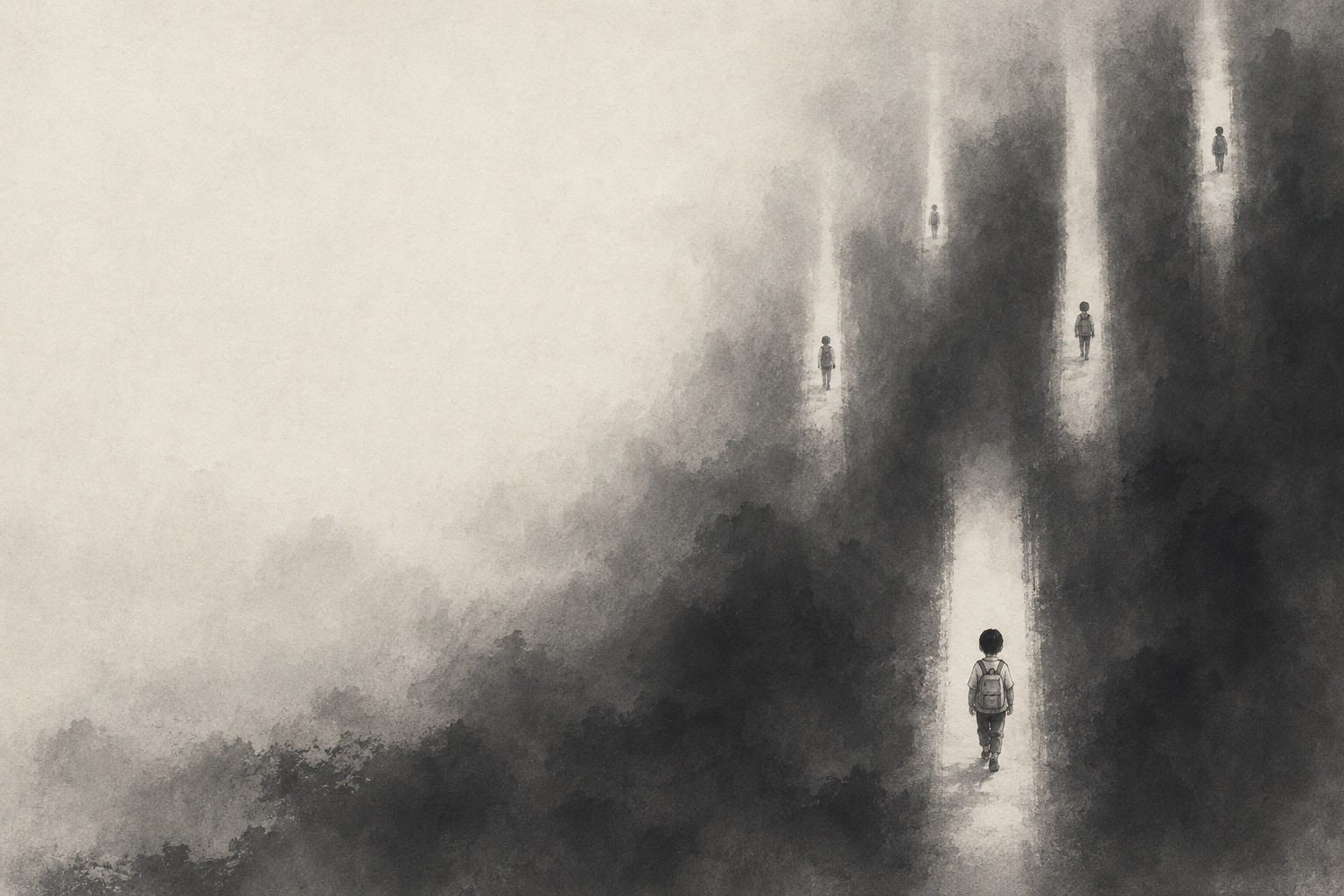
What is going on with our children? This question is one that many educators and parents are asking. Growing numbers of adolescents are committing serious crimes or taking their own lives with apparent “ease” [轻易], while mental-health problems have become increasingly prevalent among young people.
Is there something the matter with them? Increasingly, schools are establishing counselling and psychological treatment clinics in an attempt to “save” our children through therapy and intervention. But if we are to do this, we need to understand what has actually happened to them.
I. Snowflake Generation
Fragility [脆弱] is one of the main characteristics ascribed to adolescents in media discourse. In 2020, a fourteen-year-old boy in Wuhan jumped to his death after his mother slapped him in public. There are countless news stories of adolescents taking their own lives because they were not allowed to use their phones or were criticised by the teacher. When they see such reports or hear about such incidents, people born in the 1980s and members of older generations tend to wonder: “Why are children nowadays such snowflakes—unable to withstand the slightest blow or rebuke? When we were young, being beaten and scolded by our parents and teachers was perfectly normal, but we never heard about anyone killing themselves.”
Teachers, parents and psychological treatment organisations have come to regard inner fragility as a defining characteristic of today’s children. Consequently, teaching children to cope with setbacks and build resilience has become an important part of parenting, school education and psychological intervention.
But why exactly have our children become fragile? Is it because they have encountered too few setbacks? Every generation faces its own “setbacks”, just as every child encounters their own. Though the nature of those difficulties may change, life never ceases to present difficulties. For children growing up in the 1980s, not being able to eat the food they wanted, or being unable to hand over their school fees to their teacher on time, might have constituted a setback. For children today, a setback might mean their parents not buying them a toy they desire or refusing to let them use a mobile phone.
In reality, one finds that it is not that children [today] have experienced fewer setbacks, but that their ability to accept them has weakened. Why, then, have children become fragile?
II. The Silent Ones, and The Pitiful Ones
The word “silence” [沉默] is what encapsulates another significant characteristic of children that is leaving teachers both alarmed and helpless to intervene. The headteacher of a township secondary school, who had thirty years of teaching experience, once described the present situation to us as follows:
“What makes us teachers feel most powerless nowadays is not that they [the students] are naughty and difficult to discipline. Naughty children are actually easier to discipline. It is the silence [that is the hardest to deal with]. Schools used to be difficult to manage because there was so much fighting. Now the pupils do not fight at all, but rather keep their heads down, pursuing romantic relationships and playing games. Boys in particular have lost their openness and vitality, unable to summon up any energy or spirit. We have no idea what they are thinking, they do not fight or speak and whatever you say to them, they offer no response or reaction. Neither parents nor teachers can enter their inner worlds, as they are unwilling to communicate with others, experiencing neither the desire nor the need to do so. Yet they do not feel frustrated or under pressure either. Even if they score only a few marks in an exam, they do not even particularly care. They are content with things as they are and have no motivation to change.”
Students of this kind account for about a quarter of pupils at this headteacher’s school.
It is as though these students have been transported into another world, where everything is about mobile phones and games. Neither teachers nor parents can pull them back. A transparent wall stands between our world and theirs, preventing information from passing between the two. Voices from this side cannot reach the other, while voices from that side cannot reach us. However much we shout and call out to them, the children simply turn their backs, lower their heads and look at their phones. They neither hear us nor see us, and nor do they want to hear or see us. We feel desperate, while they remain cold and placid. We cannot get in, while they disdain to come out. What we see is their silence, but in that other world they may be happy and active. The adults have no means of finding out and know nothing about it. Their silence may mean that we are “losing” our children.
“Pitiable” [可怜] is the word that describes another group of children standing in contrast to the silent types. These are the pupils whom the headteacher described as receiving particular attention from their parents and who have an especially conscientious attitude towards their studies. Unlike the children whom nobody supervises or can control, every moment of these children’s time is carefully managed—indeed, managed rather too carefully. From Monday to Sunday and from seven in the morning until nine at night, every part of their day is planned and scheduled. Even the period between nine at night and seven the next morning falls within the scope of “sleep management”: they mustn’t stay awake, they mustn’t go to bed late, and nor can they go to bed early.
There is nothing inherently wrong with time management. The problem is that all this management revolves around the idea of “study”. I have seen far too many children whose entire lives outside school are filled with extra tutoring, and far too many parents who enrol their children in every kind of class available on the market. The general pattern is that younger pupils are trapped by extra tutoring, while older pupils are trapped by homework. It is usual for junior secondary pupils to be doing homework after midnight. This is not because they work slowly, but because they are given that much work. Of course, I have also heard many parents complain that their children have no time to play or sleep. Yet even as they complain, they do not seem to stop enrolling their children in classes or pressing them to finish their homework. Parents have ample reason to justify themselves: “What else can we do? Everyone is competing this intensely [大家都这么卷]. If we refuse to join the rat race, we’ll be harming our children.”
I have observed these children and spoken with them. They are generally not very physically robust, and many are positively frail. They can genuinely be described as “model children” [很乖]. The girls in particular are so obedient that it hurts to see [怪得让人心疼]. They quietly accept their parents’ arrangements. Perhaps at first they were reluctant or resisted, but gradually they grew accustomed to them and even internalised them. They came to regard attending numerous supplementary classes and completing large amounts of homework as simply what they’re supposed to do or their given responsibility: “Isn’t everyone else doing the same?” Some children even ask to, or insist upon, attending extra tuition classes because all the other children do so.
Inwardly, they may experience many moments of collapse or crying out [“崩溃”和“哀嚎”], but these feelings are quickly suppressed and they rapidly “return to the proper track” [回归正轨]. They may even continue completing their schoolwork while collapsing and screaming inwardly. After all, they do not have much spare time to waste. I once saw a parent make the following remark online: “Do you know why girls increasingly outperform boys at school? Because girls are better than boys at enduring the competitive rat race [更耐‘卷’] and withstanding intensive ‘hot-house’ [抗‘鸡’(娃)] parenting.” Is this girls’ good fortune or their tragedy?
III. A Cohort Divided
The main divide [撕裂] is between the “good kids” and the “bad kids”. Even within the same school and the same classroom, a clear boundary and profound gulf exist between the two. To the bad kids, the good kids are both “boring” and “not to be messed with”. They are boring because “all they know how to do is study, uncomprehending of anything we talk about, so we have nothing to say to each other—they’re like people from an entirely different world.” They are not to be messed with because “no matter whose fault it is, once the teacher gets involved, everything is always our fault [千错万错都是我们的错]. That’s what happens when you’re an underperforming student—the others are the ones the teachers will go out of their way to protect.”
To the good kids, the bad kids inspire both envy and disdain. They envy their “waywardness” [恣意] because it represents everything they want to do but cannot, yet they also disdain it because such behaviour is “despised” [唾弃] by parents, schools and even society. And so, beneath the same sky, in the same classroom and all within childhood, “good kids” and “bad kids” live as though they belong to two different worlds. They seldom communicate, struggle to understand one another and may even become antagonistic. Such a failure of communication, understanding and tolerance may well persist into adulthood and become a gulf between their respective social classes.
Children are also divided internally. Though one may be categorised as a “bad kid”, one still longs to be seen, recognised and praised, struggling between “going astray” and “becoming better”. Silence is one possible outcome of this struggle, and it is the worst one. Meanwhile, even “good kids” long to play and “let themselves go” [放纵]. They struggle between “indulgence” and “self-restraint”. Complete submission to discipline is one possible outcome of this struggle, and it too is the worst one. All these impulses are natural to children and, indeed, to human beings. But we—parents, teachers, schools and society—have not provided sufficient space in which these natural impulses can be expressed, reconciled and balanced. We leave children to face these internal divisions alone, allowing them all too easily to slide towards one extreme [让孩子独自在这些撕裂中轻易地滑向一种极端].
IV. Collectively Isolated
Isolation [孤立] is the cumulative impression created by the self-portrait of “the child” emerging from the different perspectives discussed above. Whether in families that are coldly indifferent or close-knit, jam-packed classrooms and crowded hallways, or amid the bustle and clamour of human society, they all feel isolated. This is because they lack sufficient time, space, opportunity and emotional energy to communicate and form connections with their parents, relatives, peers and society at large.
They appear to be surrounded by the family, school and society, and to be the objects of attention and care, yet they have never truly experienced an extensive or deep connection with anyone. All the attention paid by families, schools and society revolves around academic results. It is their marks, rather than the children themselves, that form the focus of concern. All of the child’s time, energy and emotional resources are likewise directed towards the single objective of academic results. It is as though each child, tightly surrounded by family, school and society, has an individual beam of “light” shining down upon them, while outside of that beam lie only darkness and emptiness [头顶都有一束单独照向他的“光”,“光束”之外皆是黑暗和虚无]. That lonely beam of “light” is the thing called “academic results”. Each beam lies apart, isolating the child from their surrounding world just as it beckons the child to rush desperately towards “that thing” as if their life depended on it. While the beams of light cannot merge, the darkness outside exists as a single whole [光束无法连成片,黑暗却融为了一体].
To feel what freedom is, children need enough unstructured time and unlimited space for their imaginations to roam. Only through knowing freedom can they actually experience their parents’ unconditional love and acceptance, and perceive the world’s beauty. Children need sustained and sufficiently frequent interaction with their peers before emotions such as love and hatred can be awakened in them. Only by playing, arguing and even fighting with their peers can they learn compromise, deference and respect, or understand rules and learn to abide by them. Only by learning and listening to stories from the adult world and about adults’ emotional lives can children gradually come to know and understand our world. More importantly, it is only through these sustained and profound interactions and connections with others that they can learn to put themselves in another person’s position [换位思考] and thereby develop empathy. This empathy is the starting point and foundation from which children may learn to tolerate others and assimilate into our world.
However, if children’s extra-curricular time is not only filled up with study but also fragmented [打碎] by an assortment of supplementary classes, or if their minds are burdened by studying and the pursuit of grades, how will they be able to sustain interactions or form deep connections with their relatives and peers? Time at school is essentially already set aside for study, and moreover schools now follow the principle that safety comes first, not even allowing children to leave the classroom during breaks, let alone romp about [嬉戏打闹] and play.
During lessons the rule is emphatically: “No talking.” At boarding schools, the desire to make pupils easier to manage means they are expected to remain in their classrooms at all times apart from meals. “Messing around” is anathema [最忌“打闹”], and the rule number one at bedtime is “No talking.” Even in nursery, the first rule that children are required to obey is “No talking”, followed by “Sit straight and don’t shuffle around.” Meanwhile, the communities of familiar faces in the neighbourhood that once provided the main setting in which children could organise their own play-dates, play or mess around have long since disappeared. Many families, moreover, have only one child. Whether looked at vertically or horizontally, our children are isolated—isolated from their families, school and society.
Many people believe that today’s young people suffer from an “excess of self” [自我过剩], that they are too egotistical, care only about themselves and give no thought to others—or, put it less politely, selfish and narrow-minded. I do not think this is an “excess of self”. Rather, it is the consequence of having failed to form a “self”.
Relevant theories in both psychology and sociology hold that the self is formed through interaction with others. Through various forms of social contact and interaction, children ought to come to know themselves by coming to know other people, while also learning norms through those interactions. But they are isolated in the three principal settings of socialisation—the family, the peer group and the school—and lack both interaction and deep communication. It is therefore difficult for them to carry through the process of socialisation to the end and form a mature and integrated sense of self. Selfishness and narrow-mindedness involve making calculations founded on a fully developed awareness of oneself. In this sense, what is described as young people’s “self-centredness” is, in my view, not selfishness or narrow-mindedness. It is rather a manifestation of incomplete socialisation and a “self” that is not fully formed—a form of “immaturity” or arrested development [一种社会化未完成、“自我”未完整的表现,即是一种“幼稚”或“幼态”].
V. A Barren Inner Life
Another consequence of isolation is that it leaves children unable to develop an inner life [心灵之域]. What is this inner life? Put simply, it is the child’s internal “secret garden”. It might contain a magical natural world, animals that understand their feelings, intimate companions, beloved toys, favourite games, people they like and “places” known to no one but themselves. It may contain a castle or small wooden cabin where they can be alone and where extraordinary, unexpected events might occur at any moment. It is the child’s own world. They enter this secret garden when they are happy, and when they have been hurt, allowing them to hide in the castle to relish their happiness alone or heal their wounds. By communicating with animals or enjoying the companionship of friends, they can either share their joy or the burden of their pain. This world acts as a buffer for negative emotions, an amplifier of positive ones and a space in which children can reconcile themselves both with who they are and with the external world.
When I was young, my parents argued frequently and sometimes even came to blows. My mother would hit me almost every day and, sometimes, not just once. Yet, neither back then nor today has this caused me much psychological trauma. This is because I was far too busy: in my head, I was responsible for “managing” all the fruit trees in our village, the fish in its streams and all our family’s animals. I knew how many fruit trees of each kind every household had planted, where on the mountain the wild hawthorns, wild jujubes and other fruits grew, and which field ridge had a towering mulberry tree. I knew which ditches were deep or shallow, which were full of eels and which were teeming with crabs and shrimps. I knew which mountain hollows contained legions of centipedes, which slopes abounded in medicinal herbs and where the venomous snakes lay in droves. I knew when each kind of fruit would ripen, when each kind of fish should be caught, and when to hunt for centipedes or gather medicinal herbs. I knew all these things intimately and regarded them all as my own.
I also knew which of my friends were the most suitable companions for catching centipedes and which were better for picking fruit. At home there was the little dog to which I was closest, a kitten I had rescued, the pigs, chickens and ducks that I had to feed three times a day, and the old ox that I cherished the most and was entirely responsible for taking out to graze.
The whole village was my “secret garden”. Throughout the four seasons, and even for different months of a single season, I always had my own things to keep me busy. I was free and happy in my secret garden. My parents’ arguments, my mother’s slaps and bullying from my schoolmates became merely parts of my life. Sometimes, even feelings of utter sadness and pain would vanish without a trace [消散无踪] at the moment when, perched on the ox’s back, I saw the fading glow of the setting sun.
When your life and inner life have so many dimensions, it is difficult to become so fixated on one thing or person that you cannot let it go. It is also hard to regard any one matter, especially a single difficulty, as overwhelmingly large or serious. In other words, a person’s inner life is relative. The magnitude of an “event” depends on the breadth of one’s inner mind, and the breadth and scope of children’s inner lives shape the emotional capacity, imagination and richness of their minds. When children have no time to encounter nature, make friends or develop their own interests, and when their sole objective is a single set of marks or measure of academic performance, it is a challenge for them to develop a rich and expansive inner life. It may instead become a barren, dry plain [荒芜如枯原], ready to be occupied immediately by games and mobile phones. Alternatively, it may contain only their parents and teachers, whose emotions might even substitute for the children’s own. This leaves their emotions without a buffer, apt to become narrow and inflexible [单一而偏执].
One can imagine, perhaps, that the inner wilderness of the fourteen-year-old boy who jumped to his death after his mother slapped him in public had, throughout his fourteen years on the planet, contained little else but his mother and her expectations. When the sensation of his mother’s disappointed words and her slap came crashing down on him [席卷而来], that stifled [逼仄] psychological space could no longer contain all the pent-up feeling that had accumulated within it. Once the place occupied in their minds by parents and teachers is taken over by a particular star, it is likewise possible to imagine the intensity of these children’s celebrity worship.
My nephew is a “seasoned” [资深] young internet addict. He is a typical case: he never raises his head, never speaks and [barely] eats, while his eyes remain permanently glued to his games and his mobile phone. On one occasion, when I spotted an opportunity, I quickly tried to start a conversation about something that interested him. I asked him why the game was so much fun, with the idea of him describing what exactly made it interesting and which elements appealed to him. He replied: “Fuck, it’s so intense!” I asked what exactly made it intense. He answered: “It’s just so intense—so, so intense!” I asked again and received the same answer. Then I understood. In his barren inner world, occupied by nothing but games, there existed no rich store of adjectives. “So intense” [太刺激] was the only phrase he possessed to describe his favourite game. Perhaps even the words “Fuck, it’s so intense!” had been learnt from the game itself.
This is true not only of my nephew. Some of the adolescents I have interviewed are unable to express their thoughts through language, let alone draw upon a rich vocabulary to describe things. Whether they are describing an event or a mood, beauty or ugliness, they can do little more than let the adverbs “extremely”, “very” and “so” do the full heavy lifting [使劲用“非常”“很”“太”这几个副词]. One possible reason for this inability to express and describe things is that prolonged exposure to mobile-phone videos and games has prevented them from acquiring a command of language. Another is that they have lost the capacity to feel, and simply have no thoughts left within them to express.
A stifled and barren inner life cannot nurture a rich and sensitive mind. While making it difficult for children to experience their own joy, anger, sorrow and happiness [喜怒哀乐], it also makes it hard for them to perceive the hardships and suffering of others, understand the world’s plurality and richness, or tolerate the differences within it. Are the various forms of antagonism found online not also manifestations of an inability to tolerate diversity and difference? Such a constricted and barren inner world arises from a constricted and barren childhood, but the anaemic desolation [苍白荒芜] of our children’s youth is not their fault. It is ours.
VI. No Child an Island
The importance of children to a society goes without saying. Here, I merely wish to use several observations to discuss the possible social consequences of a barren childhood.
First, during my rural fieldwork in recent years, I have found that many parents born in the 1990s have chosen to give up migrant work elsewhere [放弃在外务工] and return to their villages to accompany and supervise their children. Many explain their decision by saying, “I grew up as a left-behind child [留守儿童], and I don’t want my own child to become one as well.” It is indeed true that, in schools, many of the children who are difficult to discipline or remain silent are these left-behind children, whose academic performance also tends to be poorer. Yet these parents born in the 1990s, as former left-behind children, face a major difficulty: they do not know how they should raise their own children. Either they remain unable to manage them properly, or they enrol them in a large quantity of extra tuition classes. Put otherwise, they know only that they must not allow their children to become left-behind children, but have no concept of what a childhood ought to look like.
Second, while discussing adolescents’ mental-health problems with a secondary-school headteacher, I remarked in passing that such issues were also increasingly prevalent among university students, turning into a serious problem. The headteacher took up my remark quite naturally, saying, “That’s because they come to university from schools like ours!” I was taken aback for a moment before I understood. Of course! The headteacher meant that the problems affecting today’s primary and secondary pupils are not merely problems affecting schoolchildren. These pupils will grow up to become university students and young adults in society. As they mature, their problems will not disappear but rather evolve into a different kind of social problem.
Third, the American scholars Greg Lukianoff and Jonathan Haidt argue in The Coddling of the American Mind that one important reason American university students have become so inflexible, hypersensitive, quick to take offence, easily provoked and intolerant is the childhood they lost amid educational competition. Such characteristics of university students have directly contributed to some of the problems found on American campuses today, and even to certain problems within society more broadly.
Lukianoff and Haidt argue that one important reason American university students have become so inflexible and hypersensitive is the childhood they lost amid educational competition.
READ MORE
Xu Jilin on Sexuality, Boredom and Political Apathy Among China’s Youth (Part 1)

The following interview by Tencent Research Institute provides a fascinating account of Xu's perspective on the profound generational changes currently unfolding in China. It is based on his latest book published last month, “前浪后浪” (Waves of the Past and Future), which explores the intellectual journey of modern Chinese thinkers amid historical upheavals, drawing parallels with the existential struggles currently faced by China’s youth (those under 35).
What's striking is how closely this maps onto Ricœur's idea that identity isn't something you have, it's something formed through narrative interaction with others. Zhou's argument is essentially the same claim at the individual level — isolation doesn't just make children unhappy, it prevents the actual formative process that produces a coherent self, leaving what she calls an "unformed self" rather than a selfish one. It's a genuinely different diagnosis than the usual "kids these days" framing, and a more useful one: the problem isn't excess ego, it's a self that never had the raw material to fully form.
I was always in favour of a public system. And it wasn't until the West went insane, that I began to sympathize with people like Elon Musk who wants to abolish the department of Education. I really don't have the answers, and certainly its hard to say for the East.