
Sanctions and Economic Warfare in the US–China Contest: The "Renmin School" Playbook
A review of "Sanctions and Economic Warfare" by Di Dongsheng, Ji Xianbai and Wei Zilong
“Once sanctions end, the initiating country should proactively rebuild economic relations with the targeted state to mitigate any chilling effect. Such compensation and assistance not only help realise the aims of the sanctions, but also prevent the targeted country from developing sanctions immunity. This lays the groundwork for maintaining the credibility of future economic-coercion threats, sending a clear message: resistance incurs heavy costs, whereas compliance brings tangible benefits.” — “Sanctions and Economic Warfare”, by Di Dongsheng, Ji Xianbai and Wei Zilong
Recent exchanges of blows over Sino–US export controls have underscored that dominance in global trade is likely to remain the central battleground among the world’s leading powers. Against this backdrop, we review Sanctions and Economic Warfare (July 2025), a book by a group of scholars at Renmin University of China. Treating trade and economic instruments as the primary tools of statecraft in the current geopolitical moment, the authors draw on a wide range of historical cases to develop a realpolitik-inflected sanctions playbook for China’s strategic direction.
It is a bleak conception of trade, in which economic exchange is subordinated to power and geopolitics, illustrated through cases ranging from the use of border markets (互市) in imperial China’s management of Inner Asia to the Reagan administration’s deployment of economic pressure against the Soviet Union. Yet it is also a compelling account of economic statecraft, advanced by scholars who would endorse the recent US National Security Strategy’s assessment that economics constitutes the “ultimate stakes”.
— James Farquharson
Key Points
Effective sanctions use strengthens asymmetric economic interdependence rather than erodes it, deepening a rival’s reliance on the sanctions initiator over time.
The success of sanctions depends on whether short-term economic shock exceeds the adjustment capacity of the target, with shock-and-awe tactics more effective than gradual escalation.
Post-sanctions reassurance and trade normalisation reduce incentives for the sanctions target to diversify its trade links, preventing it from developing long-term “immunity” to future economic coercion.
Dynastic China’s management of steppe empires shows that exercising differential treatment towards rival economic blocs—penalising the strongest while rewarding the second-strongest—can fracture their internal cohesion.
Cognitive warfare can be employed to shape reactions to economic pressure, as the Reagan administration did during the Cold War by pairing economic pressure and encirclement with radio broadcasts in Eastern Europe.
Insights and analysis on China’s global ascension: China’s reach extends from boardrooms to trade blocs, steering investment, innovation, and strategic alliances across the globe. Authored by Pulitzer Prize-winning journalist Andy Browne, Semafor China will bring sharp analysis on how Beijing’s power is reshaping the new world economy. Be among the first—subscribe for free.
Interdependence between the US economy and Chinese supply chains, alongside Chinese diversification to other trading partners, makes economic encirclement unfeasible as a US strategy towards China today.
China’s strategy of economic warfare should be embedded in a wider strategy of alliance-building and trade consolidation, strengthening the cohesion of its trade system through demonstrations of economic power.
China’s long-term success in economic warfare will depend on constructing a “parallel system” of trade developed with “potential allies”, particularly across the Global South.
Ideology and narrative framing are instrumental to sanctions use: China should tailor moral frameworks to the cultural psychology of third-party countries to secure broad-based compliance with its sanctions regimes.
Humiliation of another state through economic warfare cultivates collective identity formation among one’s own allied bloc, while projecting a perception of one’s invincibility among geopolitical fence-sitters.
SANCTIONS AND ECONOMIC WARFARE
Di Dongsheng (翟东升), Ji Xianbai (嵇先白) & Wei Zilong (魏子龙)
Published by Renmin University Press in July 2025
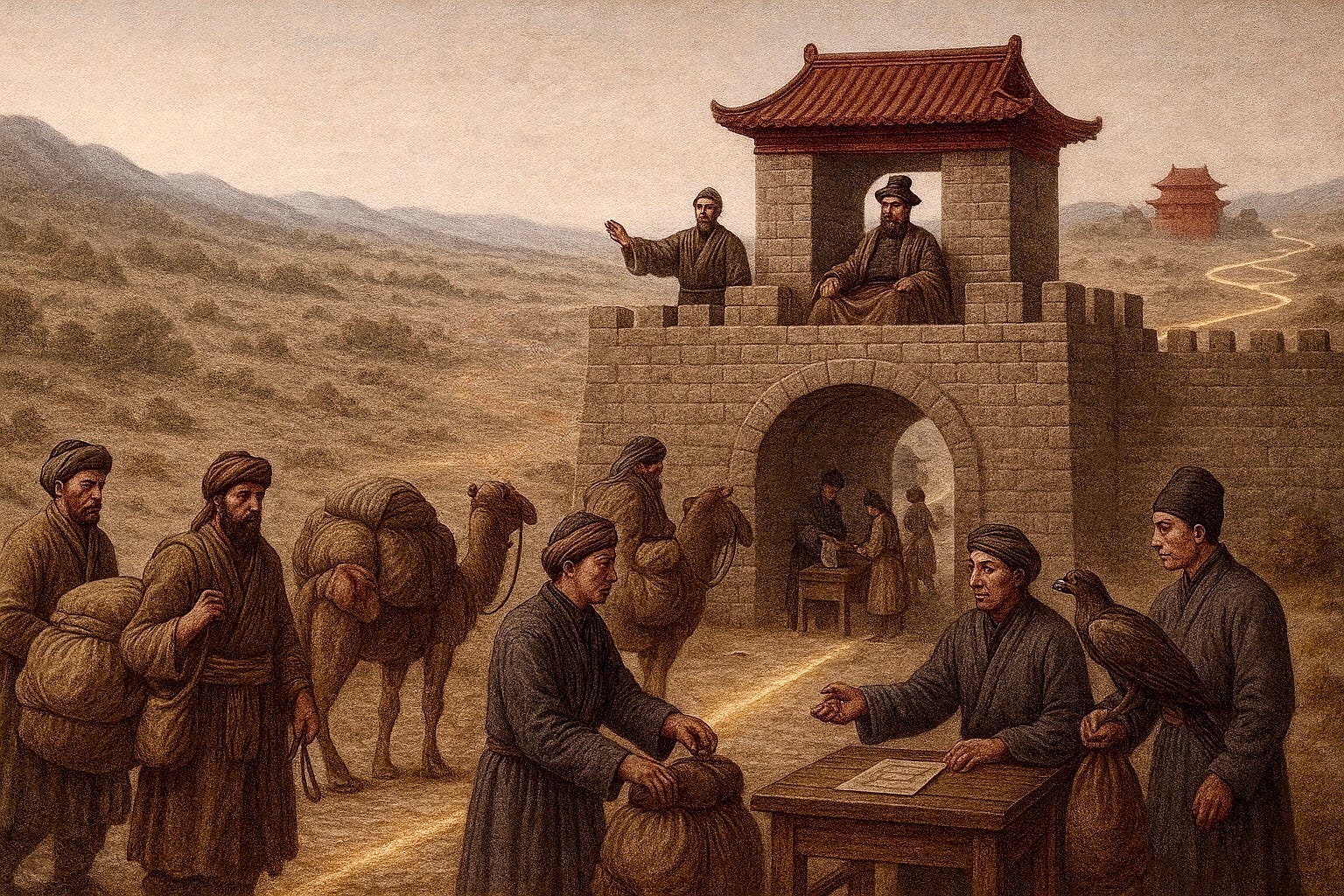
(Illustration by OpenAI’s DALL·E 3)
I. Interdependence as Power
The deployment of rare earth export controls by China this October boosted the decouplers’ narrative that the death knell of Chimerican interdependence has sounded. While Scott Bessent described the restrictions publicly as a “clear decoupling message”, the head of Tsinghua’s CISS think tank, Da Wei, offered a congenial solution to the Sino–US trade woes on similar lines: first, consign economic interdependence and the broken liberal order to the past, and then allow the US and China to enjoy a “normal”—or partially decoupled—relationship by prioritising domestic development over great power competition.
Decoupling the domestic from the international may be more complicated than that, as a recent book by a group of Renmin University international relations scholars makes clear. In Sanctions and Economic Warfare by Di Dongsheng, Ji Xianbai and Wei Zilong, the authors elaborate a strategic framework for sanctions use on the basis of establishing and maintaining “asymmetric economic interdependence [不对称的经济相互依赖]”.
The common-sense understanding of sanctions is that their efficacy inevitably decreases with usage, which erodes the very basis of economic interdependence that made them possible in the first place. In this view, China, by exposing its hand, will inevitably allow its near-monopoly on processing to be broken. After the most recent round of export controls, the Treasury Secretary claimed that this will occur within two years.
Di Dongsheng and his co-authors make the opposite argument: that deft applications of sanctions can strengthen rather than weaken asymmetric interdependence. By revealing a rival’s weakness, sanctions can be employed alongside psychological pressure to attract adherents to one’s geopolitical camp and strengthen in-group cohesion among allies—which, contrary to official discourse, they believe China should cultivate. Over time, this will reduce a rival’s ability to address its economic problems without reliance on one’s own economy.
II. Rationality and Irrationality in Sanctions Use
From a rationalist perspective, sanctions arise from a misalignment between a target state’s perceived and actual resilience. Were these perceptions aligned with reality, the state would either have already eliminated its vulnerabilities or complied with sanctions threats before their implementation. Hence, Di Dongsheng and his co-authors argue that the key to successful sanctions use lies in “whether the short-term shock generated by economic disruption can exceed the target country’s capacity to adjust”: in other words, maximising short-term shock-and-awe rather than allowing the target time to build resilience.
To illustrate this point, they recount a story from a legalist classic, the Guanzi—“Wearing fine silk to subdue the state of Lu” (“服帛以降鲁”). The story goes that Duke Huan of Qi wished to bring the neighbouring state of Lu under his control, and sought the advice of a political advisor, Guan Zhong. Guan Zhong noted that Lu specialised in coarse silk (绨) and instructed the Duke of Qi to relinquish his fine silk (帛) garments in favour of coarse silk, making it fashionable in his kingdom and shifting the focus of popular demand. As Lu’s ruler, eager for profit, pushed his people into full-time weaving of coarse silk, the state of Lu became entirely reliant on a Qi monopsony, handing the geopolitical cards to Duke Huan—who shortly afterwards reverted to wearing fine silk and cut off all economic exchange.1
Though this story does contain the strategic kernel of economic warfare, it is a somewhat crude portrayal of how such an instance of inter-state economic coercion would likely play out. Hence, aware of the pitfalls of a strategy that purely rests on building up leverage through rational calculation, the authors also draw on strategists such as Clausewitz—who included emotion within his trinity of the three elements of war—to describe the importance of “cognitive warfare” and narrative in shaping the response to sanctions among the elite and populace of the targeted countries.
Due to the risk of public humiliation of a sanctioned state producing a backlash, sanctions threats are at first best “made in private rather than through public opinion messaging” to “prevent the other side from losing face”. Furthermore, reassurance following the removal of sanctions is favoured for reducing the urgency felt by the targeted state to carry out supply-chain diversification:
“Once sanctions end, the initiating country should proactively rebuild economic and trade relations with the targeted state to mitigate a chilling effect [寒蝉效应]. Such compensation and assistance not only help realise the aims of the sanctions, but also prevent the targeted country from developing sanctions immunity [免疫力]. This lays the groundwork for maintaining the credibility of future economic-coercion threats, sending a clear message: resistance incurs heavy costs, whereas compliance brings tangible benefits.”
Such an analysis maps well onto real-world sanctions tactics. During the 2010 employment of quotas on rare earths exports to Japan after a naval incident nearby the Senkaku Islands, statements by Chinese government spokespeople and media outlets shaped a narrative that the measures were based on ensuring their domestic industry’s environmental sustainability—after all, the industry is highly polluting—and profitability, rather than exercising political pressure.
In this context, the 2014 WTO arbitration in favour of the plaintiffs—Japan, the EU and the US—is today presented by Chinese analysts as interference by a tribunal dominated by developed countries in the resource governance of a developing country. More recently, after the October controls, state media has leaned on similar arguments to 2010 in arguing for the policy’s moderation, while simultaneously emphasising that foreign firms (particularly European ones) using rare earths for non-military purposes are not the intended targets.
On the other hand, if one wanted to “establish a new global consensus”—say, by knocking a superpower of its perch—one would need more “dramatic” cognitive warfare tactics, rather than reassurance. Referring to both the US use of radio broadcasts in Eastern Europe during the Cold War and the concept of the “eight traitors [八奸]” in the legalist classic the Han Feizi (韩非子), the authors advocate an approach of embedding voices in the target state that initially appear as neutral and objective, before switching to a highly pessimistic narrative in the event of economic pressure. Amplified by ordinary “bystanders [路人]”, such messaging clouds elite judgement and magnifies the destabilising effect of economic warfare.
Such a combination of psychological and economic pressure aims to both “smash the collective cognition [集体认知] of the strong opposing camp” and entrench “negative expectations [负面预期]” of its ability to respond to future pressure. The effect could then be further amplified by “imprinting an image of the opponent as defeated, declining or decaying into the minds of global audiences through easily disseminated cultural products”. This could be achieved in the present day “if China’s GDP calculated at market exchange rates were to clearly surpass that of the United States, if China were to overtake the US in certain major technological contests, or [if it were to] defeat the US in a proxy war or a limited conflict”.
III. Building Hegemony: The Attraction of Sanctions
This sanctions logic is embedded in a broader vision of how China should construct a new system of global trade under conditions of long-term systemic rivalry. In an article analysing the “twilight of American hegemony”, the authors’ colleague Li Wei argues that, to counter a late-imperial United States bent on preserving its dominance, China should further intensify its global trading links—especially with the Global South—thereby deepening global dependence on Chinese supply chains and enhancing the “magnetic effect [磁力效应]” of its trading system. These trade networks are conceived as a central pillar of a “United Front” strategy in which, echoing Mao’s formulation, one must “accumulate many friends while leaving the enemy with very few [要把朋友搞得多多的,把敌人搞得少少的]”2
Di and his co-authors proclaim themselves to be forming a new “Renmin School” of international relations, explicitly invoking inheritance of their university’s former identity as a training college for Yan’an intellectuals during the Party’s pre-Liberation sojourn in the Northwest. What these “Renmin School” scholars advance is the economic warfare dimension of an insurgent strategy for a much larger arena—the international order.
In a world where, as they see it, competition between the two parallel market systems of China and the United States largely comes down to “an external comparison of the scale and quality of their allies and the stability of their [economic] systems”, strengthening alliance and trade networks is as important as direct competition between great powers. They advocate that China identify its “potential allies [潜在盟友]” and develop a “parallel system [平行体系]” to the US alliance and trading system.
It is not difficult to discern who these “potential allies” would be. Di has consistently advocated for the strategic importance of countries in the Global South—investing in them to develop new markets for Chinese goods and escape Western “exclusion and encirclement [封锁围堵]”, while in turn using influence among these fast-developing countries to “encircle the cities from the countryside [农村包围城市]” and constrain the West’s economic room for manoeuvre. Given demographic trends and the expanding share of Chinese exports accounted for by Global South countries, the authors are confident that they will eventually be able to play the role of a “parallel system” to the US trading bloc.
Based on a hierarchical logic, humbling an opposing bloc through economic pressure is the ideal means to establish one’s own “parallel system”. Used strategically, sanctions do not provide diminishing returns, but rather strengthen the magnetic effect of one’s own trading system:
“After achieving partial or incremental [局部和阶段性] victories, it is essential to promptly publicise and recapitulate the outcome of the sanctions. This helps allies develop a sense of accomplishment, power and identification, cultivating muscle memory [肌肉记忆] and habitual thinking that keeps them aligned. At the same time, it creates psychological deterrence for potential adversaries and for third parties who might try to play the “lone ranger” role [Note: 侠客, i.e. those who defy the sanctions consensus and continue trading with the sanctioned country], imprinting in neutral or wavering countries an impression that our side is invincible [不可战胜的思想钢印].”
IV. The Uses and Abuses of Moral Ideology
In contrast to the Confucian-inflected “moral realism [道义现实主义]” and ideal of the “kingly way [王道]” associated with scholars like Yan Xuetong, the intellectual hunting ground of the “Renmin School” generally stems from the Darwinist interstate competition of the Warring States—a period prior to the “Confucian-Legalist Synthesis” of the Western Han and during which Legalist thinking held sway. Di has previously overtly presented himself as more ideologically sympathetic to the legalist side of the synthesis that later emerged, arguing that “violence constitutes the underlying logic of human history” and approvingly quoting Mao that “throughout history, all effective and accomplished statesmen have been Legalists”.
For the authors then, ideology is viewed as a tool for gaining the cooperation and support of third-party countries for one’s sanctions—with the onus on “speaking softly with a subtle knife [口蜜腹剑]” and “sending troops under a righteous name [师出有名]”. Observing with a touch of irony that “before the formation of the ‘community of shared destiny for mankind’, universal values do not exist [在人类命运共同体真正形成之前,并不存在普世的道德规范]”, they argue that the ideology employed should be developed through an area studies-based understanding of the target state’s cultural psychology—using Confucian moral frameworks for East Asia, Quranic frameworks for Islamic societies, and Biblical frameworks for Christian societies.
Using economic ties and ideological legitimacy to maintain influence over a wide bloc of states is particularly crucial for preventing “spoiler [黑骑士]” or “lone ranger [侠客]” states from dampening the effect of sanctions—as has been the case with the dilution of Western sanctions on Russia’s energy exports. To illustrate how such defections can be avoided, the authors draw on dynastic precedents from China’s management of its northern frontier.
Contrasting the failed frontier policy of the Northern Song with that of the Ming, the authors argue that the Song was unable to meaningfully weaken the Western Xia through sanctions because the Khitan Liao maintained trading links with the Xia. By contrast, in managing the nomadic polities along its northern frontier, the Ming pursued a strategy of economic encirclement and isolation against the Left Banner Mongols—who, as the main family branch of the Golden Horde, enjoyed the greatest ideological legitimacy among the Mongol banners—while simultaneously exercising economic leverage over the Right Banner Mongols through the tributary (朝贡) and border markets (互市) system.
These differentiated measures discouraged the Right Banner Mongols from acting as a “lone ranger” outside the sanctions regime imposed on the Left Banner Mongols, while simultaneously enhancing the ideological legitimacy and pull of the tributary and border markets system. From this, the authors draw the following lesson:
“If the strongest member of an alliance is made the target of sanctions while the second-strongest member receives preferential benefits, this can enhance the latter’s strength and encourage it to challenge the dominant power in their system—allowing the sanctions initiator to reap the benefits of what they have sown [坐收渔利].”
This view echoes more pro-Russia interpretations of China’s positioning on the invasion of Ukraine, as well as speculation about a possible “reverse Nixon”. In that reading, aligning with the stronger, US-led camp against the weaker Russian one would repeat the Northern Song’s strategic error on its northern frontier: siding with a stronger power against a weaker one ultimately magnifies the stronger power’s threat to oneself. Whether the authors envisage applying similar divide-and-rule logic to the US alliance system, however, is not made explicit.
V. Learning from the Soviets: US Pressure and the Collapse of the Warsaw Pact
In developing sanctions as a tool for constructing a “parallel system” to that of the United States, the Cold War serves as the authors’ principal reference point. In their account, the collapse of the Soviet Union was shaped in large part by the Reagan administration’s weaponisation of the US alliance network to erode that of the Soviets during the 1980s—a strategic turn they associate most closely with National Security Decision Directive 32, issued in May 1982. At a moment when the US was widely perceived to be on the defensive, this directive marked a pivot towards “drawing upon the resources and cooperation of allies and others to protect our interests and those of our friends”, in practice involving pressuring allies to curtail trade and investment links with the Eastern Bloc.
The resulting strategy of economic warfare (alongside the arms race and funding opponents of the Soviet state in proxy wars) drained Soviet resources and helped to precipitate both Gorbachev’s reforms and its eventual abandonment by the constituent republics and Warsaw Pact allies. They argue that Gorbachev’s mistaken expectation of benefitting from US aid and economic engagement accelerated these reforms, an impression which Reagan’s “carrot and stick” strategy plausibly conditioned—though one which, contrary to their depiction, George H.W. Bush did not deliberately encourage.3
In particular, Reagan’s pairing of his economic strategy with psychological warfare—such as Radio Free Europe and Voice of America broadcasts in Eastern Europe—is seen as crucial in shaping Eastern Bloc perceptions during the Soviet endgame, a view shared by some US scholars.4 This “coalesced massive assault of truth”, as the VOA’s director at the time described it, linked economic hardship—exacerbated by Reagan’s economic statecraft—to the failures of the Soviet system, while simultaneously cultivating positive expectations about life beyond Soviet control.
This reading of history may explain a well-established concern with counteracting “spiritual colonisation [精神殖民]” (or “colonisation of the mind”):
“Western sanctions and economic warfare may have been even more lethal in shaping expectations and perceptions among Soviet leaders and the public than in their direct economic impact.”
Applied to the present, however, the authors argue that the US no longer possesses the capacity to impose comparable “exclusion and encirclement” across the Pacific. A “China out” Reagan-redux strategy of cutting China out from the supply chains of the US and its allies would impose far higher economic costs on the Western system than in the 1980s, and with a far more limited effect. This rests on what they perceive as the main achievement of reform and opening-up: creating a world where “the level of economic interdependence between China and America—alongside its vassals [附庸]—has reached unprecedented levels”.
VI. Conclusion: A “Renmin School” View of Post-Cold War US Economic Statecraft
Critical of the “path dependence” of post-Reagan US foreign policy, the “Renmin School” argue that Washington has internalised the lesson of its successful economic isolation of the Soviet Union too thoroughly, allowing post–Cold War strategy to ossify into a permanent “United States of Sanctions” regime. Rather than delivering short-term shock and awe, this approach has generated a “ratchet effect”, in which sanctions accumulate over time with diminishing marginal impact. The consequence, they contend, has been the consolidation of new and increasingly resilient trading blocs among sanctioned states—notably Russia, Iran and North Korea.
Given their view that reliance on the US’s existing alliance network to carry out “exclusion and encirclement” of China is unworkable, they would likely evaluate the emphasis of the recently issued National Security Strategy (NSS) on consolidating and retooling American finance, trade and alliance networks—primarily in the Indo-Pacific—as rational. Despite a common portrayal of the document as “isolationist retrenchment”, Chinese analysts do not generally view the NSS document as isolationist or soft on China—regarding its apparently softer language as more of a tactical retreat.
In common with Sanctions and Economic Warfare, the NSS even gestures towards competition with China for influence in the “so-called ‘Global South’”, where China is acknowledged as having “recycled perhaps $1.3 trillion of its trade surpluses into loans to its trading partners” and successful overseas infrastructure projects. The document suggests that US capital, as well as their allies’ “net foreign assets of $7 trillion”, could be leveraged in response. Announced on the heels of the NSS as a strategy to “block China’s Belt and Road Initiative”, the overseas resource development pact “Pax Silica” (though only one letter away from a hegemony-ending Freudian slip) may yet signal a strategic shift towards the more explicit instrumentalisation of US and US-allied capital to counter a China-dominated “parallel system” of trade linkages.
In the same vein, among the series of potentially harmful measures that the “Renmin School” scholars suggest the US could take against China, most of the perceived threats involve strikes at China’s nascent alliance system. In a worst-case scenario, they speculate that sabotage of China’s overseas railway links (such as the China–Europe link) and seabed cables could, “paired with public opinion warfare [舆论战], cause the overseas reputation accumulated over the years by the Chinese enterprises and the government to evaporate overnight [归零]”. Alternatively, they conjecture that the US could exercise its dominance of international communications to spread negative narratives about Chinese goods, such as aeroplanes and electric cars, in foreign countries (as was indeed done regarding Sinovac in the Philippines).
Nonetheless, the scholars view the resilience of one’s alliance and trading network as the central pillar of any great power’s economic strategy. Apart from US pressure, they believe that the Soviet Union’s failure to construct a more robust and self-sustaining trading bloc meant that the Warsaw Pact became a liability rather than a strategic asset. This reading lends significance to another influential Chinese commentator’s characterisation of recent US policy towards its allies as a potential “Gorbachev moment”: an attempt to rework an ostensibly dysfunctional system of economic and political linkages too hastily, thereby risking its unravelling altogether.
The Authors
Name: Di Dongsheng (翟东升)
Year of birth: 1976 (age: 48/49)
Position: Deputy Dean and Professor, School of International Studies, Renmin University of China (RUC) (since 2017); Dean of the Institute of Regional and Country Studies, RUC; Deputy Director and Secretary-General, Centre for Foreign Strategy Research, RUC (since 2011)
Other: Frequent exchanges with officials at China’s National Development and Reform Commission (NDRC), Ministry of Foreign Affairs, Ministry of Industry and Information Technology, International Liaison Department etc.
Research focus: Global political economy of money and finance; US political economy; Chinese foreign policy
Education: BA, MA and PhD Renmin University of China (1994-2004)
Experience abroad (as a visiting scholar or lecturer): Sciences Po Paris, Durham University, Vrije Universiteit Brussel, Georgetown University
Name: Ji Xianbai (嵇先白)
Year of birth: Not publicly disclosed
Position: Associate Professor, School of International Studies, Renmin University of China (RUC); Director, Institute of South and Southeast Asian Studies, Institute of Regional and Country Studies, RUC
Research focus: International political economy; South and Southeast Asia
Education: BA (2009) Xiamen University, China; MSc (2013) and PhD (2019) S. Rajaratnam School of International Studies (RSIS), Nanyang Technological University, Singapore
Experience abroad (as a researcher or visiting scholar): Multilateralism Studies Centre, RSIS, Singapore; EU Centre Singapore; School of Politics and International Relations, Australian National University; Centre for China Studies, Chinese University of Hong Kong
Name: Wei Zilong
Year of Birth: Not publicly disclosed
Position: PhD Candidate, School of International Studies, Renmin University of China
桓公曰:“鲁粱之于齐也,千榖也,蜂螫也,齿之有唇也。今吾欲下鲁梁,何行而可?”管子对曰:“鲁粱之民俗为绨。公服绨,令左右服之,民从而眼之。公因令齐勿敢为,必仰于鲁梁,则是鲁梁释其农事而作绨矣。”桓公曰:“诺。”即为服于泰山之阳,十日而服之。管子告鲁梁之贾人曰:“子为我致绨千匹,赐子金三百斤;什至而金三千斤。”则是鲁梁不赋于民,财用足也。鲁梁之君闻之,则教其民为绨。十三月,而管子令人之鲁梁,鲁梁郭中之民道路扬尘,十步不相见,绁繑而踵相随,车毂齺,骑连伍而行。管子曰:“鲁梁可下矣。”公曰,“奈何?”管子对曰:“公宜服帛,率民去绨。闭关,毋与鲁粱通使。”公曰:“诺。”后十月,管子令人之鲁梁,鲁梁之民饿馁相及,应声之正无以给上。鲁梁之君即令其民去绨修农。谷不可以三月而得,鲁梁之人籴十百,齐粜十钱。二十四月,鲁梁之民归齐者十分之六;三年,鲁梁之君请服。
Although such analysis of American hegemony has previously been rare in an official discourse normally wedded to the concept of “peaceful development”, a recent article by China’s top security official has articulated the essence of this view.
Zubok, Vladislav: “Collapse: The Fall of the Soviet Union”, Yale University Press, 2021, 144-145.
Brands, Hal: “Making the Unipolar Moment: U.S. Foreign Policy and the Rise of the Post-Cold War Order”, Cornell University, 2016, 81-84.


