



With Iran’s future in question, we found this 2013 article by Zhang Wenmu, an old-school strategist from Beihang University, worth revisiting. One conclusion from our briefing on Chinese reactions to the recent US-Israeli strikes is that many analysts appear relatively unworried about the Iranian regime’s immediate prospects. Zhang offers a contrasting perspective—albeit one from over a decade ago—casting Iran as a strategic barrier to NATO’s eastward expansion and the westernmost link in the Zagros–Hindu Kush–Himalaya chain that has historically shielded China from outside powers’ eastward advance. That barrier has not yet collapsed, but it appears more vulnerable now than it has in years. Read in that light, this piece lands rather differently today.
— Jacob Mardell
Key Points
The Zagros–Hindu Kush–Himalaya chain links the Iranian Plateau to China’s western frontier, making Iran the outermost shield of China’s western security.
Iranian Plateau states, not India, historically absorbed and blunted west-to-east pressure from outside powers before it could reach China’s western approaches.
Afghan resistance and the Himalayan barrier are proof that even British India could not effectively project land power into China’s western frontier.
India, lying outside this highland barrier and dominated by lower terrain, is more vulnerable to invasion and less strategically consequential for China’s security.
Today, the Iranian Plateau states are resisting and wearing down “NATO’s eastward expansion” (北约东扩), giving them greater strategic value for China than India.
The Author

Name: Zhang Wenmu (张文木)
Year of birth: 1957 (age: 68-69)
Position: Researcher at Beihang University’s Strategic Issues Institute; and an executive director of the World Socialism Research Centre of the Chinese Academy of Social Sciences (CASS)
Other: Sent down to the countryside in 1975 after graduating from middle school, resumed education in 1979 at Northwest University in Xi’an after resumption of the Gaokao
Research Focus: National security strategy; naval power; comparative development (with a focus on India-China comparisons)
Education: Northwest University, Tianjin Normal University, Shandong University (PhD in law, 1997)
Foreign Experience: Visiting scholar in 2000-2001 at India’s Jawaharlal Nehru University’s international relations faculty

THE IRANIAN PLATEAU: A “BRIDGEHEAD” FOR THE SECURITY OF CHINA’S WESTERN FRONTIER
Zhang Wenmu (张文木)
Published by Xinhua, 21 April 2013
Lightly edited machine translation
(AI-generated illustration; not a precise map)
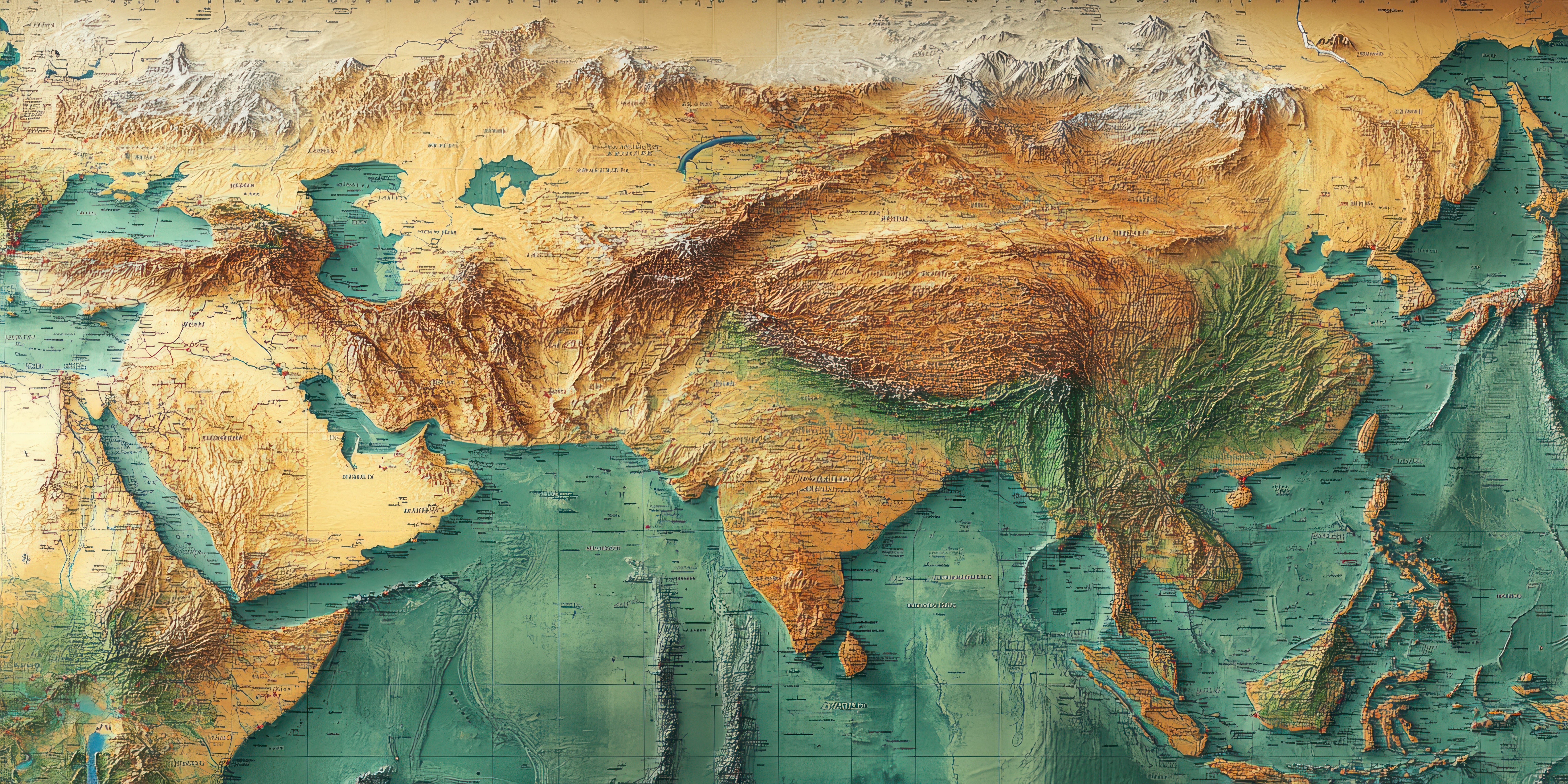
Iran is the front-line state of the Iranian Plateau. It is located in south-west Asia, bordered to the north by the Caspian Sea and to the south by the Persian Gulf and the Arabian Sea. To the east, Iran adjoins Pakistan and Afghanistan; to the north-east, it borders Turkmenistan; to the north-west, it neighbours Azerbaijan and Armenia; and to the west, it borders Turkey and Iraq. The great majority of Iran’s territory lies on a plateau, at elevations generally ranging from 900 to 1,500 metres. Its west and south-west are dominated by the broad Zagros mountain system, which accounts for roughly half of the country’s land area. The centre consists of arid basins forming a number of deserts, including the Kavir Desert and the Lut Desert. Only along the south-western coast of the Persian Gulf and the northern coast of the Caspian Sea are there small areas of alluvial plain.
I. The Natural Strategic Barrier Safeguarding Asia
The most historically significant phenomenon in South-west Asian geopolitics is that the Zagros Mountains run east into the Hindu Kush and then into the Himalayas north of India, and together with the Iranian Plateau and the Qinghai-Tibet Plateau form the world’s most imposing natural strategic barrier—the “Zagros–Hindu Kush–Himalaya” barrier—which, from west to east, safeguards the “pivot area” [枢纽地带] of the Asian continent. It is precisely because of this strategic barrier that, apart from the period of Arab rule in the Middle Ages, and although Iran in ancient and modern times was fragmented into a number of Iranian Plateau states (including all of Iran and parts of Afghanistan and Pakistan), these states nevertheless succeeded in resisting the incursions of the Western powers and thereby avoided the fate of India, which was completely colonised. India, by contrast, lay outside this strategic barrier and in modern times was subjected to prolonged British colonial rule, ultimately becoming a kind of “London orphan” abandoned in South Asia by its imperial metropole, Britain.
Iran’s geopolitical position and strategic posture give it immense significance as a “bridgehead” [桥头堡] for the security of China’s western frontier. Historically, the security of China’s western frontier has long faced pressure from successive eastward expansions out of Europe: from Alexander’s eastern campaign in the age of ancient Greece, to the Roman Empire’s eastward expansion, to the Crusades of medieval Europe, and then to the forceful incursions launched by modern and contemporary European powers, Tsarist Russia, the Soviet Union, and even, in the 21st century, the United States, against the states of the Iranian Plateau. Without exception, these invasions by outside great powers were either blocked outside the Iranian Plateau or heavily worn down within it.
II. Iran as China’s First Western Firewall
More than that, the states of the Iranian Plateau and China’s western frontier are closely bound together by the “Zagros–Hindu Kush–Himalaya” strategic barrier. In this sense, Iran, the state at the barrier’s westernmost end, has in effect become the first “firewall” for the security of China’s western frontier. Their fate in resisting the Western powers is as closely bound up with the security of China’s western frontier as lips and teeth [唇齿相依]: if Iran were crushed, then powerful Western forces advancing eastwards by sea or by land would, via the ancient Silk Road crossing the Iranian Plateau (on this, the geographical foundation of today’s “Eurasian Land Bridge” has taken shape), bear down on China and pose a major threat to China’s western frontier.
During China’s Han dynasty, the force of the Roman Empire’s eastward expansion was checked at the western frontier of the Parthian Empire, greatly easing the strategic pressure on China’s western borderlands. Perhaps driven by the same strategic imperative, Zhang Qian, the envoy to the Western Regions dispatched by Emperor Wu of Han, specifically sent his deputy in 119 BCE to visit the Parthian Empire (Parthia, that is, the region of present-day Iran). The Parthian king, in evident excitement, dispatched 20,000 cavalry to welcome the Chinese envoy from afar. This suggests that Parthia and China already had mutually dependent strategic needs at the time.
Likewise, it was because the Afghan people in modern times, making use of the forbidding terrain of the Hindu Kush, mounted extraordinarily tenacious resistance to the British colonisers that Britain was unable to push northwards, still less penetrate the vulnerable zone of China’s western frontier—namely the western borderlands of Xinjiang—and collude with the Yaqub Beg puppet regime to wreak havoc in China. Meanwhile, the barrier posed by the Himalayas, the world’s highest mountain range, meant that during Britain’s more than one hundred years of rule in India, it was likewise unable to intervene effectively in Tibetan politics from India’s northern frontier: on 3 August 1904, Britain did capture Lhasa, but by winter the British were forced to withdraw to India because they could not endure the extreme cold at high altitude. From this the British drew the lesson that “Tibet’s inaccessibility makes it impracticable [to] do anything [to] stiffen military resistance to China.” [Note: Britain did enter Lhasa in August 1904. However, the quotation about Tibet’s inaccessibility appears to derive from a British communication of June 1950.]
Nor was this lesson entirely lost on the United States, Britain’s successor as global hegemon: in 1950, the Americans wanted to provide Tibetan rebels with enough combat equipment for six months [of fighting], but [the logistical obstacles were formidable since] “pack animals were the only practical means of transport, and the quantity of ammunition in question would have required some 7,000 mules. Since so many mules were not available, some or all of the three-inch mortars and ammunition might not be moved out of India”, the United States later came to realise that supporting the Dalai clique [达赖集团] would “require a very considerable expenditure of funds over a long period”. [Note: The point that sustained U.S. support for Tibetan exile and resistance activity required substantial long-term funding is supported by a 1964 CIA memorandum. The passage appears to compress that later assessment together with earlier 1950 U.S. discussions of the logistical difficulty of aiding Tibet.]
The deep defensive belt formed for China’s western frontier by the “Zagros–Hindu Kush–Himalaya” mountain chain on China’s western frontier meant that, even after occupying India, the modern Western powers were still unable to pin China down effectively from the south-west by land, and were therefore forced to detour by sea into the East China Sea in pursuit of their objective of imposing forceful control over China. In other words, this protective barrier not only greatly delayed the timing of the West’s full-scale invasion of China since the Roman Empire, but also, compared with India, weakened the degree of its influence over China. By the same logic, it was precisely because the Xiongnu, advancing westwards from the commanding heights of Xinjiang, faced no such plateau barrier along the way that they were able to move into Europe ahead of Rome’s eastward advance, forcing the Germanic peoples, who might otherwise have moved east, southwards and ultimately bringing down the Roman Empire. [Note: The identification of the Xiongnu with the later Huns remains disputed among historians, as does the claim that their westward movement ultimately brought down the Western Roman Empire.]
III. The Iranian Plateau Against “NATO Eastward Expansion”
By comparison, India, which lies outside the sheltering screen of the “Zagros–Hindu Kush–Himalaya” barrier and has relatively low-lying terrain, has been more vulnerable to external invasion. The Indian plains account for a little over two-fifths of the country’s total area, while mountains make up only one quarter and plateaus one third, but most of these mountainous and plateau areas lie at elevations of no more than 1,000 metres. Low, gently sloping terrain predominates across the country: it is not only easy to traverse, but also fertile. This low-elevation, level terrain greatly weakened India’s ability to resist foreign invasion, and as a result it endured prolonged occupation by foreign peoples.
What scholars of China’s frontier history should note is that neither Alexander the Great, who once penetrated into India, nor the Mongols and British, who occupied India in the medieval and then modern periods, nor even the Indians themselves in 1962, long after independence, were able, at the foot of the towering Himalayas, to shake China’s south-western frontier.
This historical experience supports the conclusion that what matters most for the security of China’s western frontier is the plateau states with Iran at the front line, not India: yesterday it was the Iranian Plateau states, not India, that successfully resisted the eastward expansion of the Roman Empire; today it is they, not India, that are resisting and wearing down “NATO’s eastward expansion”.
It follows that the anti-hegemonic struggle of the Iranian Plateau states, and not merely that of India, carries major and far-reaching significance for China’s national security. If one further takes into account China’s heavy dependence on crude oil imports from the Iranian Plateau states, then—provided, of course, that Central Asia does not come to exhibit historical conditions comparable to those of the medieval Arab Empire—the security of the Iranian Plateau states has greater strategic value for China than India’s, in a true lips-and-teeth sense [唇亡齿寒].
READ MORE
China's Middle East Policy by Peking University Prof. Wu Bingbing

• China pursues ‘balanced diplomacy’ [平衡外交] in the Middle East, which entails not picking sides and not making any enemies.
• To help strengthen its ties with the region, Beijing’s strategy has been one of 'positive balancing' [积极的平衡]. That is, closer cooperation with one actor (e.g. Iran) will pressure others to follow suit (e.g. Arab Gulf countries).
• China’s two main priorities in the region are: (i) resolving the Israeli-Palestinian conflict; and (ii) establishing a Gulf security dialogue platform.
• If Chinese initiatives such as the BRI, GDI and GSI are highly compatible with the region’s need for development and security, ‘Chinese-style modernisation’ is the ideational glue that can help bring countries in the Middle East and China closer together.
This simplified map may help visualize the Alpine Himalayan Belt refered to in the article
https://www.researchgate.net/figure/Alpine-Himalayan-Belt-Papanikolau-2021_fig1_373011174