


In terms of deliverables, the Trump-Xi Summit disappointed already-low expectations. The most important announcement was a two-month extension, to January, of the Busan Framework established last October — far shorter than the one- or two-year extension Chinese negotiators had been seeking.
Chinese commentary struggles to specifically locate the “constructive” in all of this, and dwells on the meeting’s “bridging” function — maintaining a baseline throughout the US midterms, which are considered an unpredictable moment in the domestic political cycle and a near-term risk factor for the relationship.
In official commentary, symbolism and language are the focus, even if difficult questions lurk beneath. CCTV’s Yuyuan Tantian blog approvingly quoted Trump’s invocation of “gung-ho” as a symbol of Sino-US cooperation.1 The term originated in a wartime mistranslation of China’s Industrial Cooperatives (工合, for short) as “work together”, and a similar linguistic elasticity appears in Yuyuan Tantian’s treatment of “respect, fairness and reciprocity” (the US addition to the new formula of a “constructive relationship of strategic stability”, which China has now also adopted).
In Trump-administration terms, “fairness and reciprocity” usually refers to redressing unequal market access and global trade imbalances. The blog acknowledges this, but instead recasts the phrase in terms of sovereign equality, national status and China’s preferred principles of global governance.
“Respect” is the prerequisite. It means respecting each other’s social systems, development paths and core interests, in keeping with the spirit of the three Sino-US joint communiqués. “Fairness” is a guiding value embedded in the new type of international relations advocated by China […] “Reciprocity” emphasises mutual benefit and a balance of rights and obligations, equality of standing in international affairs and consideration for each other’s interests.
The use of “a shared formula, interpreted differently by each side” has long been a deliberate strategy for managing Taiwan relations. It seems novel in the US-China relationship itself.
Yet the summit has brought some aspects of the relationship into sharper focus. In the following, we discuss how Chinese analysis and commentary present:
The implications for US-China trade
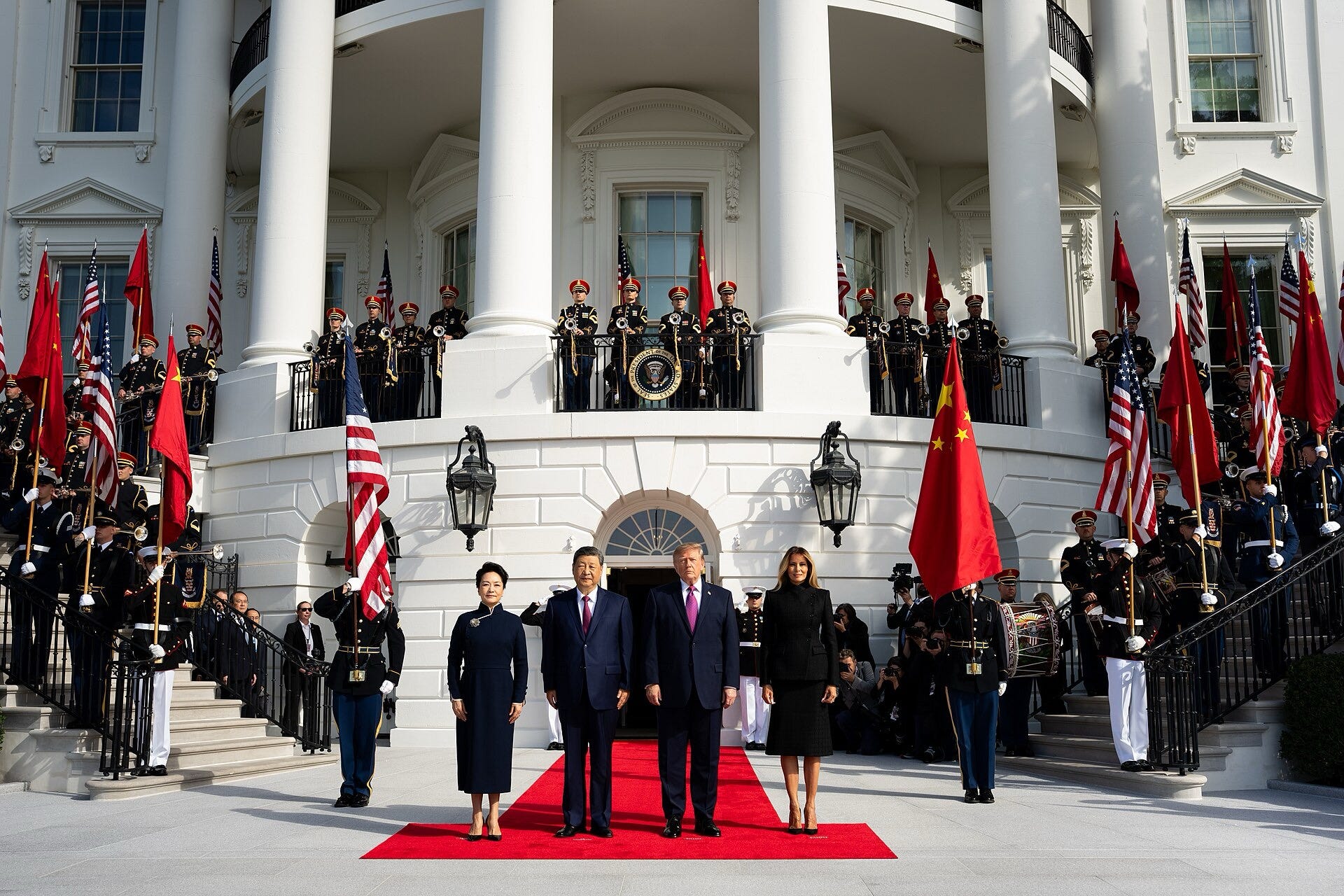
“Pomp and circumstance” at the summit
Prospects for future cooperation on AI safety
The road ahead for “strategic stability”

Paid subscribers enjoy early access to select content and full access to Sinification’s archive. As a non-profit, Sinification depends on your support.
I. Trade: “Higher than Expected” Future Risks
The well-connected political blogger Ren Yi (Chairman Rabbit) summarised the shorter-than-hoped-for extension of the Busan truce as a sign that Trump plans to use rolling extensions, alongside the continued possibility of signing off on the $13 billion arms sale to Taiwan as a “chip”, to “keep China in suspense”. He sees the fact that Trump only has two years left in his mandate as extra reason to avoid “indulging in fantasies” of hoping for any giveaways.
According to the macroeconomic analyst Luo Zhiheng, the currently planned 30 billion USD in tariff reductions only touches on a very small proportion of US-China trade — equivalent to a drop of 1.9 percentage points in the overall US tariff on imports from China, leading to an estimated overall tariff of 19.5%.
Luo views the ongoing Section 301 investigation into “structural excess capacity and production issues” as likely to be used by the administration to maintain the overall tariff level on China at around 20%, even with marginal declines in the tariff rate via expanding Board of Trade exemptions for non-sensitive goods. Section 232 investigations, he warns, could cause tariffs on semiconductors and other sensitive goods to rise further. He is pessimistic about further progress in the short term, predicting a “higher than expected” risk level for disruption in US-China trade over the coming months, and advocating continued trade diversification and improvements in China’s own sanctions toolkit.
A post-summit article, co-authored by Huang Chaofeng, Vice President at the National Institute of Strategic Studies at Shanghai Jiao Tong University, similarly argues that the US sanctions toolkit is continuing to expand against the backdrop of strategic stabilisation, and advises Chinese companies to improve “sanctions circumvention” and advance de-dollarisation. The US ambassador’s recent post on X about China’s grip on rare earths, although a contrast with the summit’s bonhomie, is unlikely to have come as a shock.
II. Optics: The Pot that isn’t Boiling
Much of the commentary, and especially social media and state media reports, focused on the significance of the optics. As Ren Yi put it, there is a certain value in avoiding the elephant(s) in the room during ceremonial visits. If, as he argues, “the form is the substance”, then some degree of progress can be claimed over May:
As the Chinese saying goes, “Don’t point to the pot that isn’t boiling.” If two people know they cannot talk through a particular issue without hurting their relationship, put it off. First discuss the things they can talk about, leaving the difficult questions until later. Once the “heat is right”, “the water will naturally find its channel”.
For propaganda purposes, the “exceedingly rare” diplomatic gesture of Trump meeting Xi on the tarmac was useful for signalling prestige stemming from China’s status (see translation from Sinocism of a Xinhua report on the visit). Given China’s carefully pruned online space, searches related to some of the more comic or uncomfortable moments at the summit (such as “granite” or “Les Misérables”) yielded no relevant results, and the comments sections under state-media Weibo posts about Xi’s invitation to 100,000 young Americans to study in China were obscured.2
Posts that interpreted the cordial reception as a sign of China’s national strength, meanwhile, were widespread. In a comment representative of that overall tenor, one netizen opined, “Blondie understands etiquette perfectly well, but only exercises it towards entities that possess value and heft.” Who qualifies, in that case? “There are likely only two people in the world who meet his standards,” another quipped.
While in terms of tangible agreements, the visit may not have been especially constructive, some netizens wholeheartedly agreed with Trump’s views on construction — particularly the renovation of historic buildings. Images of guests sitting cosily around tables at the state dinner in the East Room elicited amused sympathy for Trump’s ongoing replacement of the East Wing of the White House with a new banquet hall.3 When one commenter on the post suggested Trump may be missing the comparatively roomy Great Hall of the People, another opined, “How can that, with everyone crammed in like at some village fete, be compared to a proper grand establishment like ours?”
By contrast, a minority seemed unaware of Trump’s construction projects in DC, pointedly remarking that “American taxpayers would never allow their money to be spent on their leader’s banqueting hall” — a reminder that, within the bilateral relationship, Americans are not unique in treating the other side as a foil to their own domestic frustrations.
III. AI Safety (mostly TBD)
Apart from the outline of an “AI dialogue” mechanism between He Lifeng and Scott Bessent, with another meeting promised for late November, little was announced on joint AI risk management. In terms of what could come next, Liu Chong, Director of CICIR's Center for Sci-Tech and Strategic Studies, argues for starting with shared risk assessments and vocabulary, building scientific trust and eventually reaching a “strategic consensus on applying the brakes when necessary”.
One interesting recent development is a softening in the ideological positioning of “open source” as a morally superior alternative to “closed source”. Zheng Yongnian, a heavyweight scholar at CUHK-Shenzhen, has previously presented open-source AI as the purest expression of China’s cooperative development model. Addressing future US-China cooperation on AI safety, he is now more equivocal about China’s attachment to open models:
In my view, we are still not discussing AI nearly enough. We cannot simply say that closed models are good and open models bad, or vice versa. Openness and closedness are themselves relative concepts. When we discuss open source, we often mean releasing model weights, rather than making everything available without restrictions. If we ignore these boundaries and insist on unrestricted openness, managing the risks becomes a major problem. Governments can use artificial intelligence, and so can NGOs. Constructive forces can use it, and destructive forces can use it too. A balance needs to be found here.
This may reflect the more balanced language on open source in China’s latest AI Safety Governance Framework, suggesting that concern about “loss of control” is shifting the dial in other aspects of China’s AI discussion. It at least shows a degree of growing alignment among US and Chinese policy analysts in the assessment and definition of AI risks, but there is some way to go towards a joint risk-management mechanism.
IV. Future prospects: Making it through the Midterms
Throughout 2026, Chinese analysts have been heavily indexing on the role of the midterms in the US-China relationship. One expectation, advanced by Fudan international relations scholar Wu Xinbo among others, was that the pre-election period could offer a window for securing concessions by offering purchases that Trump could sell to his base.
In the absence of significant agricultural purchase announcements subsequent to the May meeting, the mental model has shifted towards interpreting the midterms as a source of pressure on Trump to be tough on China. On the eve of the summit, Sun Chenghao argued that the more realistic objective was therefore not a comprehensive breakthrough, but preserving a baseline of stability as US electoral politics intensifies around the elections and the arrival of new figures in Congress.
Looking ahead to what most Chinese analysts expect to be Democratic gains in the midterms, Chinese scholars project a discounting of the Trump dividend for the bilateral relationship, weakening the personalised approach that many Chinese analysts have seen as an opening. Fudan scholar Meng Weizhan, based on his assessment that the Democrats will flip the House but not the Senate, regards Trump’s free hand in foreign policy as likely to be weakened through greater Democratic power to launch investigations and influence congressional hearings:
[A narrow majority in the House] would mean that the overall trajectory of US competition with China would remain unchanged, but Trump would have less room to ease economic and trade frictions through his personalised and transactional approach.
While analysts do not regard a full derailment of US-China relations as likely, the midterms are expected to cap the scope for improvement, especially by increasing political pressure around Taiwan. Financial analyst Zhao Jian captures the prevailing view that, over the near to medium term, the most realistic goal for the relationship will be risk reduction and preserving room for manoeuvre — “not ceasing to fear the other side, but still picking up the phone despite that fear”.
READ MORE
What China Wants from the Washington Summit

Xi Jinping is scheduled to make a state visit to the US, meeting Trump on September 24. Ahead of the trip, He Lifeng is also expected to meet Scott Bessent this weekend in New York. An extension of the Busan agreement, the establishment of a Board of Trade to reduce tariffs on non-sensitive goods and discussions over AI risks are on the agenda.
Trump-Xi Summit: Chinese Analysts on the New Strategic Stalemate

Chinese experts are broadly upbeat about Trump’s 13–15 May state visit to Beijing. The trip is portrayed not just as a successful summit, but as evidence that US-China relations have entered a new phase.
Trump said: “It was the United States Marines’ encounter with Chinese people that inspired the Marines to adopt a Chinese phrase they still use today, gung ho. The Marines use it as an expression of great enthusiasm, but in Chinese, it literally means working together.”
To British ears, this is an oddly bleak choice for conveying the spirit of managed competition. Per the Cambridge Dictionary, “gung ho” is defined as “extremely enthusiastic about doing something, especially going to war”. In fairness, Yuyuan Tantian could have referenced worse historical markers from the visit. Reportedly, the Chinese delegation were shown around a collection of documents in the Library of Congress that included the Treaty of Tianjin and Treaty of Wanghia, both of which belong to the canon of “unequal treaties” from the era of “gunboat diplomacy” and the “century of humiliation”.
Subsidies for foreign students coming to China are not always calculated to bring out Chinese netizens’ internationalist side. See the comments section on this post for a pre-summit example.
One advantage of the limited venue space was that it provided a face-saving explanation for the absence of Chinese business leaders. Somewhat implausibly (though one cannot know for sure), Fudan’s Wu Xinbo suggests that the small Chinese delegation was simply down to seating constraints: “The reason the Chinese guests were so few was that, as Trump has said, there wasn’t enough seating, and all the American industry leaders wanted to be there.”