




This interview with Yao Yang, one of China’s most prominent economists, is the first in Conversations, a pilot series of in-depth interviews with Chinese scholars, policy analysts and public intellectuals exploring the ideas and debates shaping contemporary China. Where possible, interviews will also be released in audio form.
Yao has featured extensively in the pages of Sinification, in part because he combines considerable establishment standing with a rare willingness to speak candidly about the challenges China faces.
Across a career spanning development economics, institutional change and political philosophy, he has sought to explain China’s rise and the political order that made it possible. Readers of Sinification will perhaps know him best for his argument that China entered a 20-year era of “correction” around 2018: a necessary response to the excesses of reform and opening, but one in which the screws have now been tightened too far. Now dean of the Dishui Lake Advanced Finance Institute at Shanghai University of Finance and Economics, Yao previously led Peking University’s National School of Development for more than a decade.
The interview opens with Yao’s reflections on his childhood in rural Jiangxi and his current research into the damaging pressure China’s zhongkao system places on children, families and society more broadly. We then turn to the substance of his “period of correction” diagnosis: the post-2018 “new era”, weak domestic demand, the property downturn, local government debt and the external consequences of China’s growing trade surplus.
Throughout, Yao combines confidence in China’s underlying economic capacity with frank pessimism about the current state of the economy and the risks of failing to change course.
I’d encourage listeners and readers to stay until the end of our conversation, where Yao explains why he is no longer so certain that China will avoid Japan-style stagnation, why he remains comparatively optimistic about the U.S.–China relationship and how Beijing might restore incentives for risk-averse local officials.
The transcript has been lightly edited for clarity and brevity, while maintaining Yao’s voice, which you can hear in the full podcast.
— Jacob Mardell
Key Points
Yao’s commitment to rural development grew out of his childhood in a Jiangxi village. On returning from the United States, he defined his mission as speaking “loudly for peasants in the countryside”.
The zhongkao, China’s senior high-school entrance examination, sorts children too early, producing tragic human costs while training conformity and “killing young people’s entrepreneurship or spirit of innovation”.
The “new era” represents a 20-year correction to the “anything goes” period, taking China “back to Mao’s period of time” in spirit before a post-2037 synthesis of Chinese tradition and selected Western ideas.
Beijing should balance technological progress with stronger consumption, rescue highly indebted local governments and halt the property downturn. The central government has “turned the screws too tightly” on local-government debt.
China still lacks a social contract binding state and society, reflecting a centuries-long “great political divergence” from Europe. The next 20-year cycle may reveal what a distinctly Chinese social contract looks like.
Officials recognise the external pressure generated by China’s trade surplus, but weak domestic demand and vast productive capacity leave them with few alternatives. Europe’s “ultimate solution” is to open its doors to Chinese investment.
China cannot sustain a “mercantilist approach” indefinitely. Europe should tone down its national-security rhetoric, while China should accept equity-sharing and technology-transfer requirements as part of investing abroad.
State Council Order 837 exposes deep tensions and poor inter-agency coordination within Chinese policymaking. If fully implemented, it will make outbound investment “very, very difficult”.
U.S. restrictions on China have been driven by emotion, but “people will come back to rational calculation”. With the Democrats having “no chance” in 2028, an inward-looking America and China’s capacity to retaliate should produce a more stable equilibrium and, eventually, new rules.
The risk of Japan-style stagnation can no longer be dismissed. Officials “don’t want to take responsibility”, while tighter discipline suppresses initiative. Publishing local-government assets and debts could create a measure of bottom-up accountability.
The Author

Name: Yao Yang (姚洋)
Age: 61 (Nov. 1964)
Position: Dean and Professor, Dishui Lake Advanced Finance Institute, Shanghai University of Finance and Economics
Previously: Dean of the National School of Development, Peking University
Research focus: China’s political economy, political philosophy and economic development
Education: BA-MA Peking University (1982-1989); PhD University of Wisconsin-Madison (1996)

SINIFICATION INTERVIEW WITH PROFESSOR YAO YANG
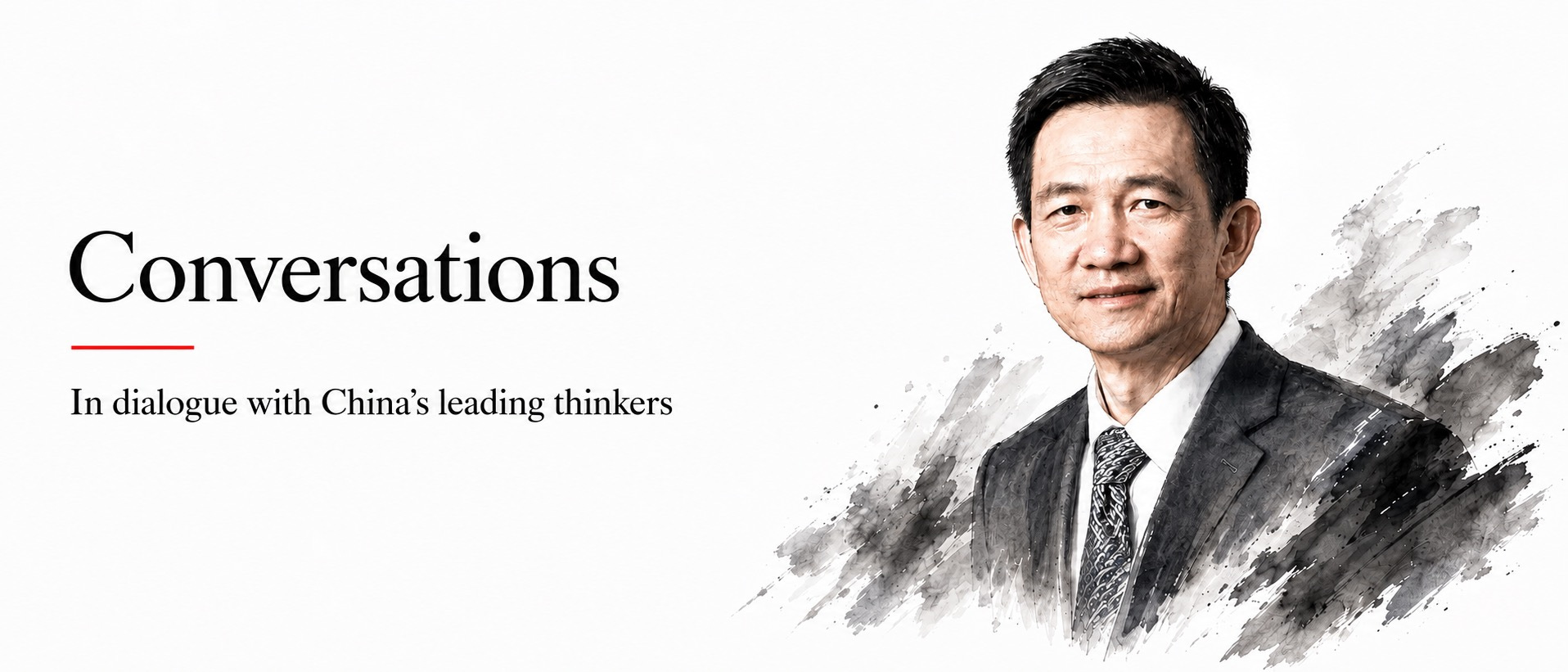
Yao Yang (姚洋)
Transcript has been lightly edited for clarity and brevity.
(Illustration by ChatGPT)
I. From Rural Jiangxi to Development Economics
Jacob: Good morning, Professor Yao Yang. It’s fantastic to see you again, and thank you so much for joining us today.
We’ll be covering a lot of ground in this conversation, from your thinking on education reform to the broader domestic economy, China’s trade surplus and U.S.-China relations. But I’d like to begin with a question about your personal background, if I may.
You were born just before the Cultural Revolution and came of age during a period of enormous change in China. What kind of childhood did you have, and how did those early experiences shape the way you came to think about China’s development and China’s place in the world?
Yao Yang: Well, I was born in 1964, so when I was, I think, 10 months old, my parents sent me back to the countryside.
I was born in Xi’an, and my parents’ hometown is in Jiangxi. I lived with my uncle and auntie for eight years, and afterwards I went back for another year. So that experience has had a lot of influence on me.
I know what’s going on in the countryside, right? I’ve been back to the village many, many times and I still support the students from my old primary school.
Yesterday I met them because I launched a small programme with two or three of my EMBA students. Each year they bring about 20 students to Beijing—they go to historical sites like the Forbidden City and the Great Wall. Of course, they also go to Beida Campus. That provides a lot of inspiration for those little kids, most of whom are around 10 to 12 years old.
So I still have a lot of connections with my home village.
It also had an impact on my choice of PhD programme when I went to the United States. I graduated from the Department of Agricultural and Applied Economics at the University of Wisconsin–Madison. I studied development economics at the university and so when I decided to return to China in 1997, I said my mission is to speak loudly for peasants in the countryside.
II. The Zhongkao and the Costs of Educational Sorting
Jacob: I know you’ve been doing a lot of work on the topic of education in China, and that your new book grows out of this research. I was hoping you could give us a preview and maybe explain to us the book’s central arguments.
Yao Yang: Our book is about the zhongkao [中考].
In China, we only have nine years of compulsory education, which is low compared to other countries with comparable income levels, like Brazil—most countries have 12 years of compulsory education.
So because of that, kids aged 15 or 16 have to take a high school entrance exam, and that exam is going to decide whether they can go to an academic high school or a vocational high school.
The difference is huge. If you go to an academic high school, there’s an 80% or 90% chance you are going to end up in a university, whereas if you go to a vocational high school, you are going to take a job immediately after your graduation, or go to a technical college—and most likely you are going to become a worker or a skilled worker.
At the age of 15 or 16, the system is going to determine your fate for your whole lifetime, right? So that’s why parents are so anxious about their children’s education in middle school. They have to do a good job in the exam, so they can go to academic high school.
That causes a lot of problems in China. First, children are under huge pressure. Depression is just really common among kids aged between 12 and 15 years old. Most kids in other countries at this age are just playing, but in China they have to study really hard.
The second problem is that parents are also depressed. Some of them, particularly the mothers, drop out of their jobs and stay home to coach the kids.
There’s a really sad story: one mother quit her job and then tried to coach her boy, so the boy could go to a good high school. They had a particular high school in Shanghai in mind, but the result was bad. The boy didn’t get into that high school, so the boy jumped off the building, and the mother did that too. That’s so tragic, right? It’s a huge social problem.
Families spend tons of money on extracurricular training. Kids don’t have holidays, don’t have weekends, but have to go to all these extracurricular training programmes. It’s just crazy, and it’s wasteful. If everyone increases their efforts on studying, then each one’s effort cancels out the other’s, right? This is about the relative scores, not about your absolute scores. The number of academic high schools is fixed.
So that’s why I started this project. Actually, the project was supported by an entrepreneur in Shanghai. He read my speeches online and wrote to me out of nowhere. I didn’t know him. And he said, “Professor Yao, I want to support you. If you need money, I’m going to give you money.” So in the end, he donated 1 million RMB for us to conduct this project.
It took a long time because it was during the pandemic. We visited many vocational high schools and also vocational technical colleges in two cities, and in the end we did a big survey in one city. We surveyed students who graduated from middle school in 2007 and 2009 and then traced their education and job experience up to today.
The results are quite telling. If you compare academic high school graduates with vocational high school graduates, the first group of students earned much more in their first job. But if you look at their current salaries, there is actually no significant difference. They are, on average, about the same. But if you look at their occupations, there are huge differences. Vocational high school graduates usually work in more labour-intensive jobs and academic high school graduates usually work in office jobs. So it’s not about income; it’s more about social status.
That’s one thing. Another is that if you look at the salaries of those academic high school graduates, you’re going to see that their current salaries can be almost perfectly predicted by their zhongkao scores.
This means that all their education has been training them for just one thing: to follow the rules. “You’ll be a good citizen; you’ll be a good worker.” That’s it.
But if you look at the salaries of those vocational high school graduates, there’s a huge variation. Some of them have really high incomes; some have really low incomes. That’s why their average is about the same as that of academic high school graduates.
This made me think really hard about the meaning of education. Probably, in China, education is just about putting all the students into one mould: train them to be the same.
By contrast, if you look at those people who don’t have that much education, they have preserved some of their inborn characteristics or talents. For example, if you are good at taking exams, that means you are probably going to lose your propensity to take risks.
But if people don’t have that much education, some of them can still take risks. So education in China is a huge problem. I think education in China is killing young people’s entrepreneurship or spirit of innovation.
III. China’s Twenty-Year “Correction”
Jacob: I wanted now to move on to a broader question about China’s economy. You’ve argued that China entered a period of correction in 2018 after four decades of reform and opening, and that this period may last until 2037. What would have to happen for you to conclude that the correction is ending earlier, or conversely, that it’s becoming a more permanent model?
Yao Yang: Well, history is not linear, right? History is full of cycles. Look at the United States. Now, the United States is also undergoing a correction.
There is a very interesting book written by two American scholars. It’s called The Fourth Turning. It says that in American history there are long cycles of 80 to 100 years and in each long cycle there are four smaller cycles, each lasting for 20 to 25 years.
I think that after the Second World War, the whole world has fallen into this pattern. In China, I can also observe this 80-to-100-year cycle.
Since 1949 we have experienced several cycles. The first one is Mao Zedong’s period of time, right? About 30 years. Then Deng Xiaoping, about 40 years of reform and opening.
And we have entered a new period, the so-called “new era”, which is also going to last for 20 years. So then we can conclude the full cycle of 80 to 100 years.
So you ask the question: What about after 2037?
I think by that time we are going to enter a new large cycle.
Even today we can say something about the new cycle. We can learn from history. During Mao’s period of time, he built up the new China, right? He began this huge drive of industrialisation.
Of course, he made a lot of mistakes, but he finished one thing: he laid a strong and firm foundation for China’s industrialisation. But, of course, he closed the door to the outside world, though I don’t think he fully controlled the world situation at that time. The West had an embargo on China, and China had kind of a really haphazard relationship with the Soviet Union.
But then came Deng Xiaoping’s period, 20 years, from 1977 to 1997, when he died. So this was the first 20 years of reform and opening. And what was the main feature? The main feature was to open the door and learn from the West. So Western ideas just flooded into China.
Then we come to the second 20 years of reform and opening: the Hu Jintao–Wen Jiabao period, plus a little bit of the Jiang Zemin period. So in that period of time—I actually said this 20 years ago—China became a normal developing country. A normal developing country means chaos, right? Almost anything goes, no direction. Politics is becoming corrupt. Corruption is widespread. But of course, people have a lot more freedom.
Then came 2012, when Xi Jinping came to power. And he began this change. There were several years of transition, and by 2018 China had really entered a new era. So in the new era, the task is mainly to correct the problems of the second 20 years of reform and opening.
So in a lot of senses, China is moving back to Mao’s period of time, at least in spirit. So with that, we can think about a new cycle for China after 2037. First, China is becoming more confident and developing a stronger sense of itself. China is a great country again. China is one of the strongest countries in the world.
And then idea-wise, people will move towards Chinese tradition to find resources. I think by that time China will be ready to re-evaluate Western ideas that we received during the 40 years of reform and opening, and to absorb some of them and reject some of them. We are going to see a kind of new Chinese culture that blends, or that sits firmly in Chinese tradition, but that also absorbs some Western ideas.
Jacob: And we’re in 2026 now. So do you think China’s on track to enter, over the next decade, this new cycle of a more confident opening?
Yao Yang: I think so, yeah.
IV. Where the “Correction” Has Overshot
Jacob: And you’ve argued that the post-2018 period of correction was necessary, of course, but also that China’s screws have been tightened too much. Where would you say concretely Beijing should loosen those screws first? In, for example, private enterprise or education, as we’ve touched on, or ideology, foreign policy, or anything else?
Yao Yang: Firstly, I think on the economic front, the Chinese government should balance between consumption and technical progress.
Technical progress is critical for China, of course, no doubt about it. But the problem is that there is a tendency to put those two things—consumption and technical progress—kind of in conflict with each other.
I don’t think that’s the right approach. If we look at the United States, consumption is growing so fast, but technical progress is also so quick. China’s recent history also tells us we can do both. Between 2012 and 2018, China’s consumption increased quite dramatically. Consumption as a share of GDP increased from 48 percent to 55 percent in a matter of six or seven years.
That’s really fast. But in the meantime, China’s innovation also went up. The number of unicorns in 2018 in China was higher than in the United States. So I think the Chinese government should think twice, carefully, about this balance between consumption and technical progress.
So this is one thing. Another thing is that the central government has turned the screw too tightly on local governments, right?
The central government is forcing local governments to repay their debts. That’s almost impossible. It is too enormous. So local governments are now having a really, really difficult time on their financial side. They cannot pay their employees; they cannot pay their contractors. That has a huge impact on the whole of the economy through the supply chain, and also on consumption. So the central government has to think about, not just loosening the screws, but also rescuing local governments.
In the real estate sector, the correction has been too deep; it has been overshooting. I think in China, everyone agrees with this. So the government should take major measures to stop the decline of the housing sector.
You know, at the highest point, China sold 1.8 billion square metres a year. Today that number has been halved. I heard from government officials that sales are probably going to decline to 500 million square metres. Only by that time will the housing sector be stabilised. Then that’s just too much, right? Too much overshooting over there.
So it’s not about the institutions or the control. Many Chinese people, Chinese economists, always say, “Oh, we need the reform, we need reform,” but I don’t think it’s a matter of reform—it’s a matter of policy.
If the central government can adopt some policy changes, then we can change the situation in China.
V. The “Great Political Divergence” and China’s Missing Social Contract
So that’s on the economic side. On the social and political side, I think we have to find a new social contract between the state and the citizens.
I’ve been conducting a project on Chinese history, or the political history of China. We are proposing the concept of a great political divergence. You know the great divergence between China and the West, right? Pomeranz’s thesis.
[Note: Kenneth Pomeranz’s influential 2000 book, The Great Divergence, argues that the most economically advanced regions of China and Europe remained broadly comparable until around 1800, when access to coal and resources from the Americas helped north-western Europe pull ahead.]
Between China and the West, there was another divergence, a political divergence. Before 1000 AD, China’s political history looked very much like European political history. The main theme was state-building, or the consolidation of power to the ruler—to the emperor in China, to the king in the West.
But by around the Northern Song period in China, the emperor had consolidated his power, but the central government didn’t have enough state capacity to tax people.
So in the end, the central government just gave up grassroots society. Chinese society became bifurcated. At the top, we had the emperor, plus his bureaucrats, and at the bottom, we have all the ordinary people.
But in the West, particularly in the 17th century, as exemplified by Britain, there was this almost century-long fight, right, between the king and Parliament, which was composed of the newly emerged commercial class. In the end, they reached the compromise of the Glorious Revolution, and the whole society became one.
I talk about this because in China we still feel that. We have a strong government on top, and we have numerous ordinary people who don’t care that much about politics. They have what I call political apathy. We have not developed this social contract between the state and ordinary people.
So I think this is a framework to understand China and the difference between China and the West. It’s not just a dictatorship or authoritarian regime versus a democracy. It actually has deep roots in history, so it’s going to take a long time for China to build a new social contract between the state and the society. I think we have to wait until the new cycle begins.
Jacob: And what does this new contract look like, do you think?
Yao Yang: I don’t know. Probably it’s not like liberal democracy in the West. Of course, people now treat liberal democracy as an abstract ideal. That’s not true. If you read history, that’s not true. It’s a historical process. People say, “Hey, this is so good,” and they have to create theories to defend it, right, starting with John Locke and all the others further down the road.
But really, when the Glorious Revolution was settled, it was a compromise, right? So China has its own history. Probably China will develop a new kind of governance model. I don’t think the current governance model is permanent. It’s still evolving. It’s going to take decades, even centuries, for China to build a new governance model.
VI. China’s Trade Surplus and the Case for Investment in Europe
Jacob: This is fascinating, but in the interests of time, I’d like to move on to the external effects of China’s economic and political model, starting perhaps with the trade surplus.
So China’s large and persistent goods trade surplus, as you know, is being interpreted in Europe more and more as a systemic threat rather than just an economic imbalance. To what extent do you think officials in Beijing are concerned about the external consequences of the trade surplus, and how do you think Beijing should respond to the concerns of partners like the EU?
Yao Yang: I think government officials are fully aware of the external pressures.
China wants to have a good relationship with the EU, but the problem is that China’s domestic demand is so weak. Look at the first half of this year. Retail has barely grown. The CPI is almost zero, right?
[Note: Official data show that retail sales of consumer goods rose only 1.3% year on year in the first half of 2026. The consumer price index (CPI), which measures changes in the prices paid by households, rose 1.0% year on year. By saying CPI was “almost zero”, Yao is referring to this low rate of consumer-price inflation.]
But on the other hand, China has a huge productive capacity, so I think the central government is forced to promote exports. When there is weakness in the domestic economy, then the central government says, “let’s export.” So you can see over the last several years, exports have been growing so quickly—to everyone’s surprise, I say.
But for the China-EU relationship, I think that the ultimate solution is just for the EU to open the door to Chinese investments. But the EU is still influenced by the United States, right? The recent case in the UK is a perfect example. In Scotland, a Chinese company was about to set up a huge factory to produce wind turbines—that’s a £1.5 billion investment, huge. But then Starmer declared, “No, it’s about national security; we have to stop that project”—under American pressure.
[Note: The company was Ming Yang Smart Energy, which proposed investing up to £1.5 billion in a wind-turbine factory at Ardersier near Inverness. In March 2026, the UK government ruled out supporting Ming Yang turbines in British offshore wind projects on national security grounds, prompting the company to pause the plan.]
So that’s really bad. National security is a really ambiguous concept—if you use this concept without any boundaries, I don’t think the EU-China relationship will improve.
Some European friends wish China would impose some voluntary restrictions on exports. I don’t think that’s going to happen. If Europe opens its door to Chinese investment, it’s going to be good for Europe, right?
For one thing, they can just use China’s capacity to produce cheap and high-quality products. Why not? But of course, Europe also has the problem of high costs. The cost of operation in Europe is just so high, particularly in Germany, because of the energy crisis. Even German companies are moving out of Germany. So, yeah, it’s a complicated situation. It’s about politics, but it’s also about economics.
Jacob: And in terms of Chinese investment being offered as a solution to trade surplus concerns, to what extent do you think this investment will genuinely substitute for exports, or will the two grow in tandem, as I think we might be seeing currently with Chinese investments in Europe, where we have exports continuing alongside it?
And another question, related perhaps—how much of the supply chain will move out with Chinese investment? Given how important China’s domestic industrial ecosystem is to Chinese firms’ success, will much of this migrate, or will it mostly be more front-end assembly?
Yao Yang: Well, I think in the initial stages of Chinese investment, exports from China to Europe are going to increase because many of the intermediate goods are still going to be imported from China, right? This is what is happening in India. Chinese investment is moving to India, but India has a larger trade deficit with China.
But you have to have a long-term perspective. That is, if Chinese companies become localised, then they are going to develop a supply chain network in Europe. Then they are going to cut imports from China.
Of course, there are also debates around technology transfer and equity-sharing requirements. My personal view is that China should accept that Europe has requirements for equity sharing and also technology transfer, because China did that, right? Back in the 1990s, China did exactly that.
I think this is a win-win situation. Many people said, “Hey, if we transfer technology to other countries, then we are going to lose.” I think that’s really short-sighted. The whole world is integrated. China cannot stay here on its own. China relies on the international market.
In the next several decades, China is going to invest all over the world. It’s just not imaginable that China can take this mercantilist approach forever. That is, we are going to invest in your country, but we are not going to transfer technology to you guys. It’s just impossible.
And because competition in China is so fierce, we really don’t need to worry about losing technology. For example, in the auto industry, it used to be the case that every five years a company rolled out a new model, right? But in China, almost every year they’re going to roll out a new model. So why worry about it? You talk with those automakers; they don’t worry about this. Why should the government?
So this is two-way traffic. Europe should make some adjustments, particularly by lowering its voice on national security, and China should have a more open mind on technology transfer and equity-sharing requirements.
VII. Outbound Investment Controls and Policy Conflict
Jacob: And do you think Beijing is moving in this more open-minded direction? I ask because I’m thinking about the new State Council regulation on overseas investment, or Order 837, which took effect this month.
This rather prosaic-sounding regulation seems very significant—it elevates two decades of departmental rules into law and adds teeth, giving Beijing a range of powers under Articles 24 and 25 to act against foreign entities that discriminate against Chinese investors.
It also has lots of provisions to stop technological leakage, so my question is: what do you make of this regulation and how does it fit into your recommendations about Chinese companies recreating China’s industrial ecosystem overseas?
Yao Yang: My reading is that it was, in the first place, a reaction to national security rhetoric all over the world, because every country is talking about national security. China is also paranoid about national security, right?
So that’s definitely the factor of the first order. Secondarily, there is also a lack of coordination among different government agencies.
In addition to concerns about technological leakage, there are also concerns about tax evasion and capital flight. So, you know, different government agencies put their concerns into law, okay?
For example, the monetary authorities are really concerned about capital flight, so that’s why the new law tightened up outbound investment. According to the new law, everyone has to apply to the government if they want to invest, but there are some murky boundaries. If someone has a foreign bank account and they buy financial products, then, indirectly, they invest outside China. Does that qualify as an outbound investment? If it does, then that person has to apply to the government. But that’s almost impossible, right?
So I think there is a lack of consideration there. A lack of coordination. And for tax, China now wants to follow the United States, right? To tax Chinese people’s income outside of China—and then they also write it into law. They want to track who is investing outside of China, so they can tax them.
My personal reading is that if this law is put into effect, then it’s going to greatly impact China’s outbound investment. It’s going to make outbound investment very, very difficult. But this is against the government’s general policy orientation—that is, to encourage Chinese capital to invest outside China. Okay, the so-called going abroad policy. So you can see that even within the government there are a lot of policy conflicts.
[Note: Order 837 brings resident individuals within the scope of China’s outbound-investment framework, but leaves the detailed rules governing their investments to be issued separately.]
VIII. Optimism about U.S.–China Relations
Jacob: I wanted now to ask a question about U.S.-China relations. The Beijing summit concluded in May with both sides claiming success, and there’s a sense that the American strategic threat has been at least put on hold for now.
I wondered, firstly, whether you shared that assessment and, secondly, how much of that relief is structural versus perhaps the accident of a transactional president who I believe you’ve called the only pro-China figure in the administration. So what happens to the relationship after Trump? Perhaps even after the midterms?
Yao Yang: Yeah, I’m always optimistic—or more optimistic than most people—about U.S.-China relations.
The reason is that I can see why the United States started the trade war and also export controls on China. It was out of emotion. It was not the result of rational calculation, right?
For example, I asked one of my American friends who used to work in the government, “Have you realised that if you make China feel pain, the United States is also going to suffer?” She said, “Yes, we know that.” Then I said, “Why do you still want to do this?” And she said, “We want to punish you guys.”
This is emotion. So I asked her one last question: “What’s the endgame of this export control, this trade war on China?” And she said, “We don’t know.” So there’s no plan, right? It’s all about the emotion.
You know, for most Americans, they will say, “Oh, China has cheated us, so we are angry. We are going to punish you.” But exactly because this is emotion, I don’t think it’s going to last forever. People will come back to rational calculation.
I’ve been to the U.S. four times this year already. So I talked with people. I saw a lot of changes in people’s views about U.S.-China relations. People are becoming more rational about China. So with that, I can say Trump’s visit to Beijing was a good start towards stabilising U.S.-China relations.
But as you said, Trump—and you know I said, “Trump is the only person in the American administration who’s for China.” What about after Trump?
My guess is that the Democrats have no chance to get into the White House in 2028. Probably not for the next eight years—at least eight years. After 2028, there will still be a Republican president, and that president is going to have MAGA as his political base.
So then, in that sense, we can make a prediction, right? That is, the United States will still, like today, look inwards. The United States has to solve its domestic problems.
So China and Taiwan are not going to be a huge concern for the United States. And with that, then I can say that U.S.-China relations will be stabilised further.
I also hope that the United States and China will work out some rules to govern the two countries’ competition. We are in competition, no doubt about that. But the problem is that the United States now destroys all the rules it has created in the last 80 years.
So we have to rebuild the rules, right? And this is an opportunity for China. China can talk with the United States to start new rules. I think that after a while, the two countries will sit down and talk about the new rules. Those new rules will be quite different from the current WTO rules. But we need rules to govern the competition. For example, the new rules might put restrictions on export controls.
China now has the ability to retaliate, so I think the two countries will reach an equilibrium. We are not going to beat up the other side, so why don’t we just settle down—think about some rules, or what kind of technologies are not allowed to be transferred to the other side, and that’s it.
Jacob: And do you think those discussions have already started within the framework of the new relationship of strategic stability?
Yao Yang: I don’t think they have started, but there are good signs, right? At this summit, the two sides agreed to set up two committees. One is the trade committee, the other one is the investment committee. So that’s a good start—particularly the investment committee.
I place high hopes on it because now Chinese companies cannot invest in the United States and American companies don’t invest in China. Not because of China—it’s just because of the United States. The American government doesn’t allow them to invest in China. So if, through this committee, the two sides can negotiate some rules to govern bilateral investment, that’s going to be a gigantic step toward the normalisation of the two countries’ relations.
Jacob: And are there discussions in China about post-Trump and who might be better for the China-U.S. relationship?
Yao Yang: Yeah, people are beginning to say, “What about after Trump?” People, I think, are a little worried because who knows?
Even if Vance became the president, what would he do? Who knows? Right? Probably he’s just disguising himself today. He pretends to be a pupil of Trump, but after he really becomes the president, who knows what he would do?
But, as I said, I’m more optimistic about U.S.-China relations. Even if Vance becomes the president, I don’t think he’s going to deviate from Trump’s China policy that much.
IX. Japan-Style Stagnation and Economists’ Pessimism about the Economy
Jacob: For my final questions, I wanted to get back to the Chinese domestic economy, but specifically to the shape of the economic debate in China. When foreign China analysts read Chinese economists like yourself, what do you think they often miss? And would you say that Chinese economic debates are more open, more constrained, more divided or more policy-relevant than they appear from the outside?
Yao Yang: Yes, people can be easily influenced by the media, right? So today in the West, China is depicted as an economically and technologically strong country.
Whenever I talk with foreign friends, they say, “Oh, China is the only bright spot in the world.” Okay, that’s the impression. But inside China, there is a rich debate about the direction of the country, and most economists are worried about the lack of demand in China. I mean, in the past, when foreign experts warned China about China’s Japanisation, I always opposed it, right?
[Note: “Japanisation” refers to a prolonged combination of weak growth, very low inflation or deflation and low interest rates, associated with Japan’s economy from the 1990s.]
You know, I said China is not going to become Japan in the 1990s. But today, when someone says that China is going to become another Japan, I’m not that confident anymore about opposing that view.
Many economists in China just think the same as I do. So yeah, it’s not that we economists and also government officials don’t care about domestic consumption. It’s just that we still have this policy inertia over here, right? With that inertia, it’s really difficult to boost domestic demand.
Jacob: Why are you less confident nowadays about China not becoming another Japan?
Yao Yang: Well, you look at the data, right? Retail has declined month on month for more than 20 months now. By May, year-on-year growth had turned negative. So that’s a really important sign. Consumption is really lagging behind.
So that’s one, and also CPI is always around zero. PPI has been negative for a long time. It only turned positive in the last several months, only because of the oil price. I don’t think that’s going to last long. Once the situation in the Strait of Hormuz settles down, the oil price will just drop back.
[Note: The producer price index (PPI) measures changes in the prices industrial firms receive when their products are first sold. A negative year-on-year reading means that these “factory-gate” prices are lower than a year earlier. China’s PPI turned positive in March 2026 and rose 1.5% year on year over the first half. Oil prices affect the index directly through petroleum extraction and refining, and indirectly through fuel, petrochemical and other industrial input costs.]
And then you look at investment: private fixed-asset investment growth has been negative. And overall fixed-asset investment growth has also been negative. That’s quite severe, because much of the fixed investment has been done by local governments.
[Note: In the first half of 2026, fixed-asset investment excluding rural households fell 5.7% year on year, while private investment fell 8.5%. State-holding investment fell 2.3% and infrastructure investment fell 2.4%.]
This means the local governments are not investing. Many people wonder where the money goes, because local governments take on a lot of debt, and they’re supposed to invest, but they haven’t. Many people suspect that the local governments are diverting those debts to repay the older debts.
So all the signs are adding up. I’m deeply worried.
X. Risk-Averse Officials and China’s Growth Potential
Jacob: And for my last question, just back to the shape of the economic debate in China, is it possible to map the economic debate into ideological or policy camps?
Yao Yang: Well, yeah, our voices have been heard by government officials, right? So when you talk with government officials, particularly privately, they actually think the same as we do. There’s not much difference.
I think it’s just determination. The lack of determination. This is the problem in China now. Government officials don’t want to take responsibility. They see the problem. They know how to solve the problem, but there is just a lack of determination inside of the government.
Jacob: And where do you think that lack of determination stems from? If you were to just think of the—
Yao Yang: Anti-corruption—the anti-corruption campaign has a big impact on ordinary government officials’ decision-making.
And the emphasis on discipline also has an effect.
I can understand why the Central Committee of the Party is tightening control over government officials, right? To increase discipline among them. It’s just because, as I said, in the second 20 years of reform and opening—anything goes. There was no discipline on government officials.
So the new era, one of its tasks, is to correct that, to rebuild the Party, to purify the Party again, okay? So that’s the political consideration. I think that consideration in the long run is correct and also necessary for the Party.
But in the short run, it has a negative impact on government officials’ incentives, right? No one wants to take initiative because if you take the initiative, there’s a risk.
So that’s one of the deeper problems the Party has to solve. The Central Committee already sees the problem. If you read the government documents, it says, “Oh, we should allow for government officials to make mistakes,” the so-called rongcuo [容错]—to tolerate mistakes.
But on the ground, it’s so difficult to implement. You know what I mean, right? On the one hand, if you make a mistake, you will argue, “This was done with good intentions. I just made a mistake.” But then the party discipline committee doesn’t think that way. You made a mistake. That was a mistake. You should be punished.
So you see this conflict or this tension inside the Party organ. I hope that one day the Party will solve this problem and ease the tension.
Jacob: Concretely, are there any policy steps the central government could take to loosen the screws on risk-averse local officials while preserving the balance between encouraging initiative and avoiding a return to corruption and state capture?
Yao Yang: I think the government, or the Party, is trying to take a top-down approach, but now it’s also trying to take a kind of bottom-up approach. For example, in the reform plan of the Fourth Plenum of the 20th Central Committee, there is one reform that many people have ignored.
That is, every level of government is going to have a balance sheet of their assets. That is, they are going to make their assets and debts open to the general public. And who’s implementing this reform? The People’s Congress.
So the People’s Congress is overseeing local governments to create this balance sheet. The plan was to finish this reform by 2030. Five years’ time. I have some doubts about whether this reform can be concluded in five years. It’s going to be really hard. Local governments just resist, right?
But if this reform is finished, then we are going to have bottom-up monitoring of local governments—that is, the local people’s congress is going to monitor them. If you take too much debt, then the Congress delegates, the people’s delegates, will say, “No—why do you want to have this white elephant project? We don’t need it.”
[Note: The Fourth Plenum’s recommendations for the 15th Five-Year Plan call for compiling a macro balance sheet covering the major sectors of the economy. Under a parallel framework, governments at county level and above report annually to people’s congress standing committees on state-owned assets and government debt, with the reports made public.]
Jacob: For my very last question, I’d like to ask a forecasting question, and I wondered what your instincts were as to what China, the United States and the global economy look like 10 years into the new cycle. So let’s say 2037, around that time.
Yao Yang: It’s really hard to predict. You know, economists are really bad at prediction. But I think the United States will have a correction in its stock market. I think this is a consensus. Many big investors and economists have this consensus because the valuations in the American stock market are just too high. So there will be a correction, but the correction is not going to kill the American economy. It’s just like the 2008 financial crisis didn’t kill the American economy. So that’s the U.S.
China—it pretty much depends on government policy. If the government doesn’t change its policy, doesn’t boost domestic consumption enough, I’m actually quite worried about the Chinese economy. But if the government changes its policy, China—the Chinese economy—will come back. I still believe China’s economy has 5.5 to 6% growth potential. It’s our supply capacity, right? It’s just our demand hasn’t caught up with the supply.
Jacob: I actually forgot which year we were in! I meant to ask about the 2040s, but that’s probably even harder. So we’ll leave it there. And it’s been—I know you have another engagement to get to, but it’s been really fascinating talking to you. And thank you so much for your time.
Yao Yang: Thank you.
READ MORE
Yao Yang on China's Era of "Correction" (Part 1)

Today’s edition opens with an introduction by Gerard DiPippo, Senior Researcher at RAND and Associate Director of the RAND China Research Center. He was previously a Senior Geo-Economics Analyst at Bloomberg Economics, a Senior Fellow at CSIS, and served for 11 years in the U.S. Intelligence Community. His research focuses on China’s economy, industrial policy, financial system, and its ties with the United States. Gerard’s latest article on
Yao Yang on China's New Era: A Return to a Planned Economy? (Part 1)

Today’s edition begins with an introduction by David Ownby. David is currently a research associate at the Max Planck Institute for Social Anthropology and was until recently a professor of history at the Université de Montréal. He is also the founder of a blog which continues to serve as a major source of inspiration for this newsletter and which I highly recommend subscribing to:


