



Today's introduction is from Dr Gatra Priyandita, a senior analyst at the Australian Strategic Policy Institute specialising in Southeast Asian security and the geopolitics of cyberspace. He has published widely in academic journals, policy reports and newspapers, including recently an insightful analysis of Indonesia’s naval exercise with China and its implications for Indonesian foreign policy. We're very grateful to him for contributing to this newsletter. — James
Dr Xue Song argues that Sino-Indonesian relations under President Prabowo Subianto are becoming “more strategic and institutionalised”. Her evidence includes the inaugural Comprehensive Strategic Dialogue, the second foreign and defence ministers’ (2+2) meeting, a planned 2027-31 action plan and expanding defence cooperation, including through the Peace Garuda exercises. She contends that economic frictions such as nickel policy can be contained within this framework, and that Indonesia’s engagement may widen political space for other ASEAN states to pursue defence ties with China. The institutional intensity is real and is broadening the relationship beyond economics. However, it also reflects a practical need to manage divergence, and both dynamics are at work.
Xue’s account fits China’s broader effort to complement economic ties with institutionalised political-security channels in Southeast Asia. As trade and investment mature, they generate frictions that economic instruments alone cannot manage, so ministerial dialogue becomes a means of handling sensitive issues, notably the South China Sea, with a pivotal ASEAN member. The Cambodia 2+2 suggests China is differentiating its instruments according to partners’ alignments. Xue’s emphasis on “strategic autonomy” reflects a Chinese preference for a regional order that accommodates hedging rather than alignment, since hedging states dilute US-centred arrangements without requiring Beijing to offer security guarantees.
Indonesian officials would likely read these developments through bebas-aktif, which the Prabowo government frames as “a thousand friends and zero enemies”: preserving flexibility without foreclosing options. As Xue notes, Indonesia’s defence cooperation with China sits within a portfolio that includes many countries, including the United States and Australia. Although defence cooperation with China remains thinner than many other states, a comprehensive relationship with China does complicate Indonesian foreign policy, because competing priorities can produce controversial decisions. The 2024 joint statement, which acknowledged China’s claims in the Natuna Sea, and the naval exercise east of Taiwan both attracted domestic scrutiny, since each could be read as accommodating Chinese positions. Such episodes show economic, diplomatic and security priorities pulling in different directions, alongside persistent Natuna-related concerns and a nickel policy framed as down-streaming and resource sovereignty rather than accommodation of Chinese firms.
Sino-Indonesian relations are therefore improving and increasingly institutionalised, but the two trends should not be conflated. Institutionalisation is as much a means of managing strategic distrust as a sign of its disappearance. Dialogue mechanisms give Jakarta channels to test Chinese intentions and signal red lines while keeping its options open. The durability of the relationship will depend less on the density of these mechanisms than on whether they produce restraint where interests diverge.
— Dr Gatra Priyandita
Key Points
China’s optimal strategy towards ASEAN countries is to help expand their room for manoeuvre, enabling them to preserve strategic autonomy and cooperate selectively with both China and the US.
As economic cooperation alone becomes insufficient to sustain the China-Indonesia relationship, security cooperation is evolving from a relatively minor area into a main pillar for the Sino-Indonesian relationship.
The main fields of defence cooperation include expanded exercises, maritime law enforcement coordination and proposals for defence industry cooperation, technology transfer and personnel exchanges.
Expanded dialogue frameworks, including the “2+2” foreign minister and defence minister dialogue and the Comprehensive Strategic Dialogue, institutionalise China–Indonesia relations and provide channels for managing differences.

Thomas des Garets Geddes will be in Washington from 19–21 October and New York from 21–24 October. If you’re interested in what we’re building and might like to support it, or know someone or an organisation that might be, please do get in touch. We have several new strands of research that we’re keen to discuss.
The institutionalisation of the relationship through this type of cooperation may help contain economic disputes, including over nickel pricing and quotas, although some political assurances still need to translate into action.
Indonesia’s dialogue frameworks and a passing exercise with China in waters near Taiwan demonstrate that maintaining close defence ties with West-aligned states does not exclude security cooperation with Beijing.
This cooperation does not aim to displace Indonesia’s defence ties to the US, Japan and Australia, which are unlikely to change soon given they are underpinned by longstanding reliance on Western equipment, training and logistical support.
However, Indonesia’s defence engagement with China could make similar cooperation less politically sensitive elsewhere in ASEAN, although member states differ considerably in their security priorities and perceptions of Beijing.
The Scholar

Name: Xue Song (薛松)
Year of Birth: Not publicly disclosed
Position: Associate Professor, Center for China’s Relations with Neighbouring Countries, Institute of International Studies, Fudan University
Research Focus: Indonesian domestic politics and foreign policy, China–Southeast Asia relations, ASEAN studies
Education: BA in Indonesian, Peking University (2010); MA in International Relations, Chinese Academy of Social Sciences (2012); PhD in Political Science, specialising in International Relations, Tsinghua University (2018).
Experience Abroad: Visiting researcher at Cornell University, US, and Paramadina University, Indonesia; visiting scholar at the ISEAS–Yusof Ishak Institute, Singapore, and Universitas Muhammadiyah Yogyakarta, Indonesia; secondment to the Political Section of the Chinese Embassy in Indonesia (2021–2023).

FROM NICKEL TO JOINT EXERCISES: CHINA–INDONESIA TIES REMAIN ON TRACK DESPITE FRICTION
Interview with Xue Song (薛松)
Published by Guancha.cn on 27 August 2026
Lightly edited machine translation
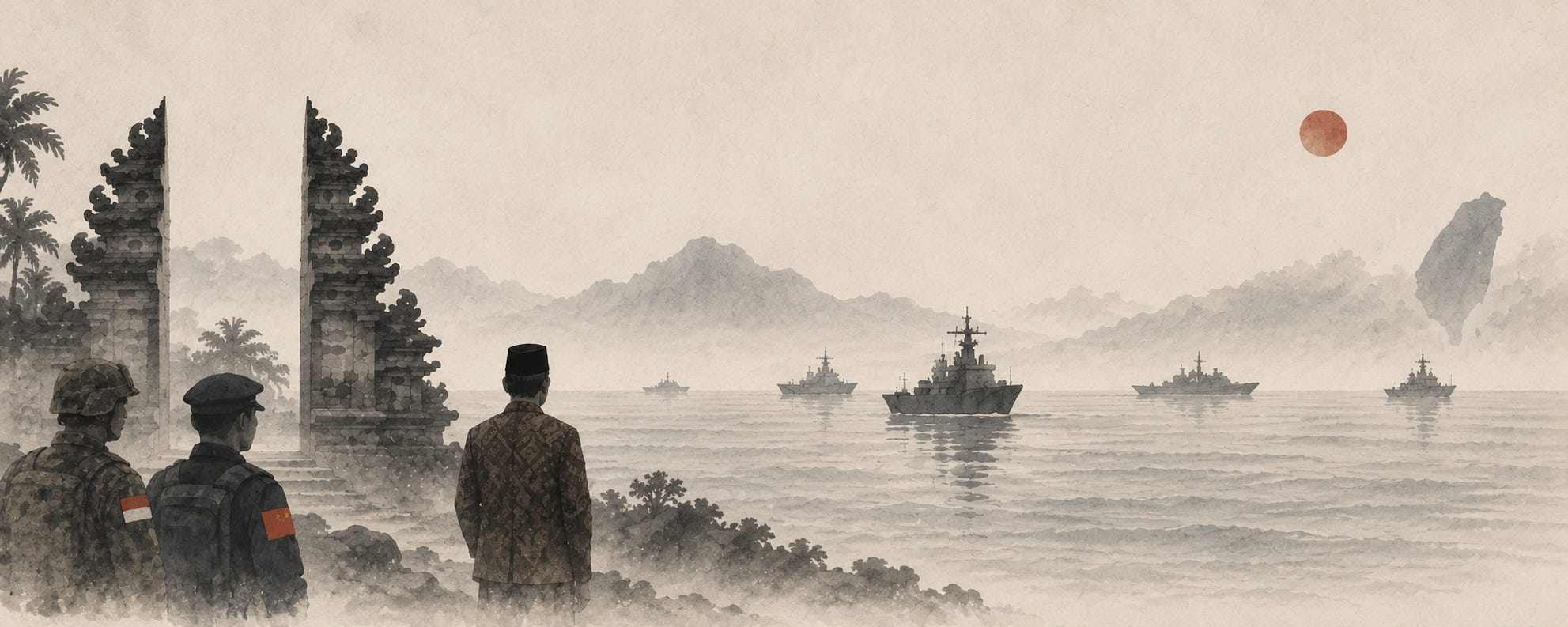
Illustration by ChatGPT
Question 1: What is the significance of the first Comprehensive Strategic Dialogue and the second “2+2” meeting of foreign and defence ministers held between China and Indonesia on August 21?
Xue Song: This visit marks a key point in the rebuilding and gradual consolidation of mechanisms for bilateral cooperation since Prabowo took office.
Under Joko Widodo [president from 2014-2024], China and Indonesia had already established a high-level dialogue and cooperation mechanism. Since Prabowo took office, the two sides have strengthened their institutional arrangements for political and security cooperation. Last year, they held their first “2+2” meeting of foreign and defence ministers and decided to establish a Comprehensive Strategic Dialogue mechanism. This year, they held their second “2+2” meeting and formally launched the Comprehensive Strategic Dialogue with its inaugural meeting.
China–Indonesia relations are therefore entering a new phase that is more strategically-oriented and institutionalised. By more “strategically-oriented”, I mean that discussions have broadened to encompass critical and emerging issues such as defence and security, energy and minerals, and artificial intelligence. By “more institutionalized”, I mean a clear division of responsibilities. The Comprehensive Strategic Dialogue coordinates cooperation across the board, while the “2+2” focuses on political affairs, security and defence. The two sides have also begun drawing up a new five-year action plan for 2027–2031, making cooperation more systematic and predictable. This, too, reflects the relationship’s increasingly strategically-oriented and institutionalised character.
Question 2: How does one understand Indonesia’s imposition of tighter nickel mining quotas and new pricing structures, measures which could be seen to impact Chinese companies?
Xue Song: Investment is an important pillar of China–Indonesia relations, but it is not the whole relationship. After Chinese companies collectively raised concerns about these nickel mining quotas, taxes, fees and regulation around the middle of this year, high-level exchanges and dialogue at various levels remained largely unaffected. [Note: The Chinese embassy in Jakarta also raised concerns, criticising the “frequency of recent regulatory changes” in Indonesia.] When Wang Yi met Indonesian Foreign Minister Sugiono in late May, Indonesia explicitly pledged to provide a favourable business environment for Chinese companies. In June, Indonesian Finance Minister Purbaya made a special visit to China to advance Indonesia’s first issuance of panda bonds in the Chinese market, worth around US$1 billion. The initiative received strong Chinese support, while the visit also advanced local-currency settlement and financial cooperation. In July, the two sides held their tenth foreign policy planning dialogue in Beijing and continued to advance cooperation in investment, green energy and advanced technology.
This shows that China–Indonesia relations have deep foundations and considerable resilience, allowing specific trade and economic disputes to be contained within the broader bilateral relationship.
The Comprehensive Strategic Dialogue sent further positive signals about both sides’ willingness to resolve differences through communication. Indonesia stated that the success of Chinese companies was also Indonesia’s success. Meeting Wang Yi, Prabowo said China had provided Indonesia with valuable confidence and support. He welcomed further investment by Chinese companies and pledged to continue improving their business environment.
Indonesia’s recent nickel policies reflect a complex mix of domestic and international factors. These include domestic considerations such as fiscal revenue, resource governance and the development of downstream industries, alongside global nickel prices, capacity expansion and international industrial competition. They therefore cannot be simplistically understood as targeting Chinese companies alone. China supports Indonesia’s efforts to turn its resource advantages into industrial strengths by developing downstream industries. This fundamental direction of cooperation has not changed.
Overall, these frictions remain manageable differences of interest within the existing framework of bilateral cooperation. What we need to watch next is whether this high-level political consensus translates into more concrete Indonesian government measures on mining quotas, taxes and fees, enforcement standards, policy communication and policy continuity.
Question 3: What is the significance of the two sides proposing deepening defence cooperation and expanding joint exercises and training at the China–Indonesia “2+2”?
Xue Song: There are two reasons why Indonesia was the first country with which China established a ministerial “2+2” mechanism.
First, the mechanism clearly bears the imprint of an Indonesian initiative. The ‘2+2’ format is not a traditional feature of China’s bilateral diplomacy, whereas Indonesia had already established similar mechanisms with countries including Japan and Australia. As early as 2023, while attending the Shangri-La Dialogue in Singapore as defence minister, Prabowo publicly stressed the importance of establishing a China–Indonesia “2+2” mechanism to strengthen defence and security cooperation. The two sides subsequently progressed from senior officials’ meetings to ministerial meetings.
Second, China also has a practical need to elevate political and security cooperation with Indonesia. Previously, the relationship’s most prominent achievements were concentrated in trade, investment and infrastructure. As the comprehensive strategic partnership has deepened, however, economic cooperation alone has become insufficient to sustain its development. Indonesia is both ASEAN’s largest country and an important member of the Global South, with considerable influence on the South China Sea, regional security and relations between major powers. China therefore also needs a higher-level platform for regular, direct communication with Indonesia on political affairs, security, defence and international and regional developments.
Subsequent developments suggest that this mechanism has set something of a precedent. In April this year, China and Cambodia also held their first “2+2” strategic dialogue involving their foreign and defence ministers. This shows that China has begun using the “2+2” as an institutional tool to strengthen dialogue on strategic and security issues with certain important partners.
Security and defence cooperation are becoming more important in China–Indonesia relations. The two sides had already established a reasonably strong foundation for cooperation while Prabowo was defence minister. The trend has become more pronounced since he became president. They have resumed and expanded the “Peace Garuda” joint training exercises, while coordination between their maritime law enforcement agencies has also strengthened. Indonesia has publicly assessed the possibility of purchasing Chinese J-10 fighter jets and other equipment. This meeting further proposed strengthening defence industry cooperation, technology transfer and personnel exchanges. Security and defence are therefore gradually developing from a relatively weak link in the relationship into a more important pillar of cooperation.
Question 4: Could Sino-Indonesian joint exercises, such as the recent passing exercise in waters east of Taiwan, ease concerns among other ASEAN members about defence cooperation with Beijing?
Xue Song: It could indeed have something of a demonstration effect. Indonesia is ASEAN’s largest country and has long maintained a diplomatic tradition of not choosing sides, meaning that its choices on sensitive geopolitical and security issues often serve as something of a regional bellwether. Objectively, this passing exercise east of Taiwan demonstrates that a major ASEAN country committed to strategic autonomy [战略自主] can conduct military training with China while maintaining close defence cooperation with the United States, Japan and Australia, and that doing so does not necessarily mean strategically aligning with either side. This may ease some of the political concerns other ASEAN countries have about expanding defence cooperation with China.
Indonesia’s demonstration effect is also apparent on other sensitive issues. For example, after Indonesia and China reached an intergovernmental consensus on joint maritime development in 2024, China and Malaysia further deepened their bilateral dialogue on maritime issues. China has also continued to advance joint maritime development with Brunei.
At the same time, this demonstration effect should not be overstated, because ASEAN countries differ considerably in their security strategies and their perceptions of China in security terms. Ideally, the hope is that Indonesia’s actions will make security cooperation with China less politically sensitive for some ASEAN countries, broadening their options for security and defence cooperation and strengthening their strategic autonomy.
Question 5: How should we understand Indonesia’s diplomatic choice of “strategic autonomy” in deepening trade and defence cooperation with China while maintaining close security relationships with the United States, Japan and Australia?
Xue Song: On the one hand, this choice reflects Indonesia’s longstanding tradition of an “independent and active” foreign policy. Its core principle is to safeguard strategic autonomy through diversified partnerships, rather than simply seeking an equidistant balance between major powers.
On the other hand, Indonesia’s close security relationships with the United States, Japan and Australia are strongly shaped by established patterns of cooperation. The Indonesian armed forces, particularly its air force and navy, have longstanding Western connections in main battle equipment, personnel training and military education. Even if Indonesia expands equipment purchases from non-Western countries, it cannot quickly change its existing equipment systems, training practices and logistical support networks. Its security cooperation with Western countries therefore has strong structural foundations and considerable continuity.
Moreover, broadly expanding security and defence cooperation with countries in both East and West is itself a fairly explicit policy direction of the Prabowo government. While continuing to deepen defence ties with Western countries, Prabowo is actively expanding relations with emerging powers such as China, India and Türkiye. Indonesia and India, for example, continue to strengthen cooperation in maritime security, joint exercises and training, and the defence industry. Relations with Türkiye have expanded into defence industries such as drones and fighter aircraft, and the two countries have also established a “2+2” mechanism involving their foreign and defence ministers.
Within ASEAN, Indonesia’s choices do reflect a tendency among a considerable number of members to pursue strategic autonomy. But ASEAN’s internal differences are substantial, and the Indonesian model cannot simply be generalised to all member states.
Question 6: What do the different approaches to China taken by Indonesia and the Philippines mean for China’s management of its ties with ASEAN countries and the maintenance of regional strategic balance?
Xue Song: I would hesitate to describe Indonesia and the Philippines as two diametrically opposed “models for dealing with China”. The Philippines has certainly strengthened security cooperation with the United States considerably in recent years. But this shift is also substantially shaped by the policy preferences of the Marcos Jr administration and is, to some extent, specific to the present period. Its security policy could change as domestic politics and the external environment evolve. ASEAN countries’ policies towards China are therefore better understood as a dynamic spectrum than as two opposing models.
Indonesia occupies a position on this spectrum particularly characteristic of “strategic autonomy”, seeking to maximise its strategic room for manoeuvre. This is also the position that a considerable number of other ASEAN countries hope to maintain amid competition between major powers. From this perspective, deeper China–Indonesia relations are broadly conducive to regional stability and strategic balance, showing that countries in the region can use dialogue mechanisms with China to manage differences and expand shared interests.
In recent years, the United States has strengthened its regional security posture while increasingly deploying economic tools such as tariffs, trade measures and industrial policy, creating new forms of external pressure on Southeast Asian countries. In these circumstances, deeper China–Indonesia relations show that Southeast Asian countries still have strategic room for manoeuvre between major powers and that maintaining strategic autonomy remains a practical possibility. For China, its closer ties with Indonesia also demonstrate that managing relations with ASEAN countries depends on expanding their room to avoid choosing sides, increasing the shared gains from cooperation and carefully managing sensitive issues through dialogue. This is how a stable regional environment that benefits all parties can be established.
READ MORE
China's Periphery Diplomacy: The Importance of Southeast Asia

Today’s post is an edited transcript of a talk given last month by the prolific and ubiquitous Zheng Yongnian (郑永年)—a political scientist who spent most of his career abroad and has now fully espoused his new role as one of China’s most prominent public intellectuals.
Putting a Stop to Manila's Provocations in the South China Sea

Until recently, Chinese scholars would emphasise the importance of maintaining stability and preventing escalating tensions in and around the contested territories of the South China Sea. Controversial voices, such as Zhao Hongwei’s (赵宏伟), calling on Beijing to put an immediate end to the Philippines’ “provocations” through more radical means were the exception.